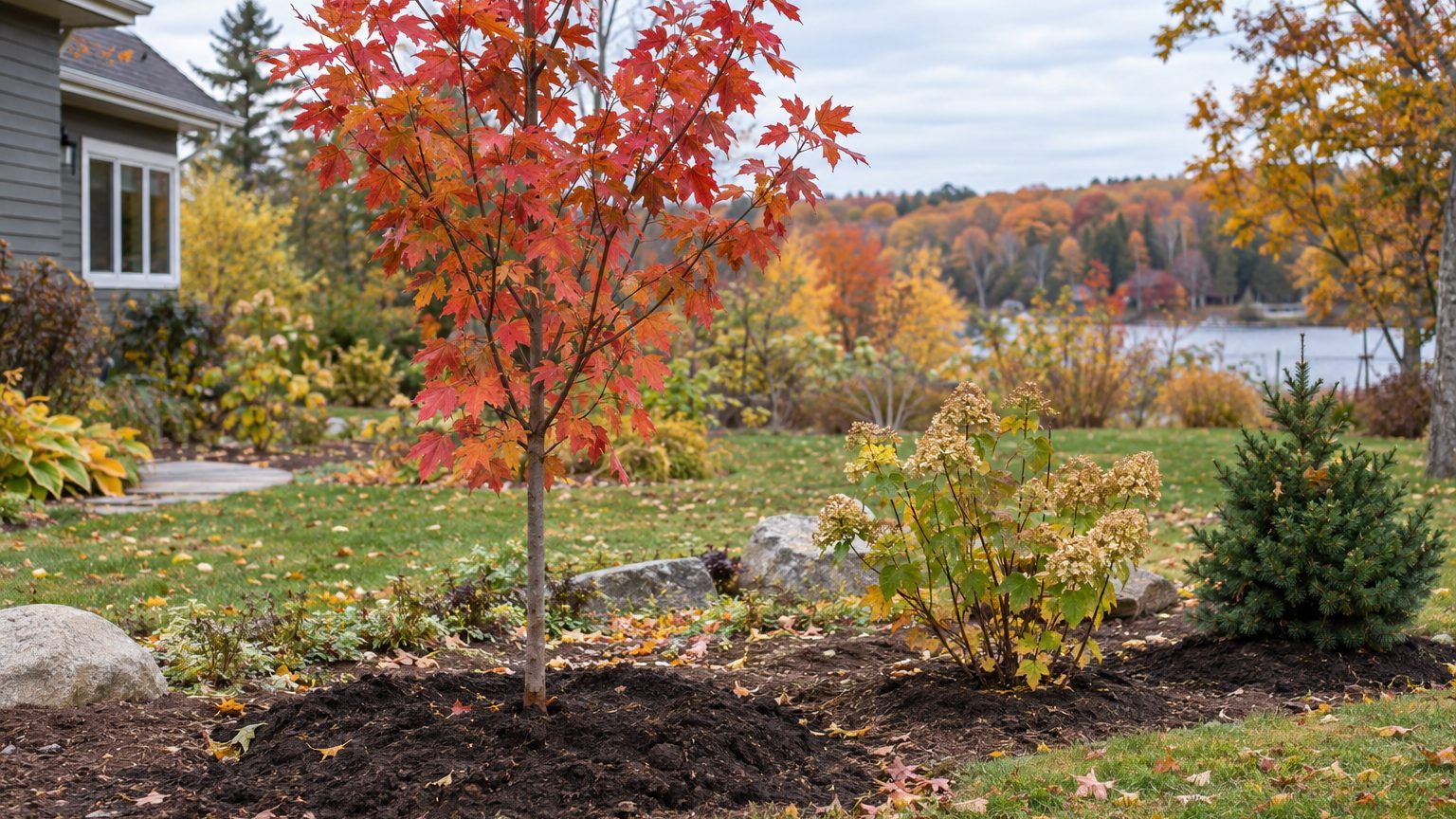

In Delaware, the safe target for fall planting is six weeks before the first fall frost. At the Wilmington airport weather station, that works out to September 14 to September 26. It is a conservative line, not a hard cutoff. Roots keep growing in soil that is workable and above freezing, so a hardy container-grown tree planted in October often still gets established. The odds slip with every week after that, and some plants are better held until spring.
The deadline in Delaware
Air and soil run on different clocks. A frosty morning tells you the air dropped to 32°F, but soil is a slow-moving heat bank. It cools gradually and keeps roots active for weeks after the first freeze in the air. That gap is the whole reason fall planting works, and it explains why the real deadline is set by the ground and not by a leaf color or a first frost warning.
The rule most extension programs lean on comes from Cornell Cooperative Extension in Orleans County, New York: “Fall is an excellent time for transplanting, provided you get them to their new home at least 6 weeks before the ground freezes, allowing them time to establish roots before winter dormancy.” (Cornell Cooperative Extension, Fall Gardening). Note what it counts from: frozen ground, not a frost in the air.
Delaware’s numbers come from the NOAA NCEI 1991-2020 Climate Normals for the Wilmington airport station. Using the 30 to 70 percent probability band for a 32°F freeze (NOAA NCEI station data), the first fall frost lands between October 26 and November 7. Count six weeks back and you get September 14 to September 26. Write that range on the calendar as your safe target.
| Milestone | Reference-city timing | What it means |
|---|---|---|
| Safe planting target | September 14 to September 26 | Six weeks before the first fall frost |
| First fall frost | October 26 to November 7 | NOAA NCEI 1991-2020 normals, Wilmington airport station |
| Ground freezes | Later than the first frost | The true limit, and it varies by site |
Why the true limit runs later, and where your yard falls
The September range is deliberately cautious. Because the ground freezes after the air does, the actual limit falls later than those dates. Delaware is not a place where the rule can be ignored, either. The mean daily minimum of the coldest month at Wilmington is 25.6°F (NOAA NCEI Climate Normals 1991-2020), well under freezing, so the soil does freeze and the six-week logic applies.
One caution matters here. Those figures belong to an airport station, a reference city, and not a statewide guarantee. Suburban and rural gardens typically see the first fall frost one to two weeks earlier than the airport does, and more at elevation or on open, exposed ground. If your yard sits in a cold pocket, or on higher and more open ground than the reference station, shift the whole window earlier. Check your own county (New Castle, Kent or Sussex) against the First and Last Frost Dates in Delaware before you settle on a date.
Hardiness zones tell a separate story. The USDA Plant Hardiness Zone Map 2023 (built on 1991-2020 normals) puts Delaware in 7a-8a. That is a range across the state, based on a single variable, the average annual extreme minimum temperature, so it says whether a plant survives the winter at all, not when to plant it. The Delaware guides cover how the state’s regions differ.
The same math applies elsewhere; only the frost dates change. How Late Can You Plant Trees and Shrubs in Fall in Indiana? runs it with that state’s numbers.
What to plant late, and what to wait on
Container-grown and balled-and-burlapped plants that are fully hardy for your area are the ones that do well when they go in late. They arrive with roots already formed, or with a good chunk of the root system intact, and they can keep building on that while the soil stays workable. Borderline plants and evergreens that lose water all winter are the risky group.
| Type of plant | Late-fall verdict |
|---|---|
| Fully hardy container-grown trees and shrubs | Good choice, best inside the safe window, workable after it |
| Fully hardy balled-and-burlapped trees | Good choice, but favor the early part of the window |
| Plants rated only marginally for your area | Wait for spring |
| Broadleaf and needled evergreens | Plant early in the window or wait for spring |
Hardiness is where fall planting gets people in trouble. The coldest-month minimum at Wilmington averages 25.6°F, and that is a mean of nightly lows, not the worst night of the winter. Individual nights dip lower, and a plant sitting at the edge of its rating with a half-grown root system has no margin. Some camellias and other southern-leaning shrubs fall in this camp. Give them a full growing season of roots first by planting in spring, and check the tag against the USDA zone for your county.
Evergreens are the second trouble spot, and for a different reason. Rhododendrons, hollies, boxwoods and arborvitae keep their foliage all winter, so they keep losing moisture to sun and wind even when the soil is cold. A plant with roots that are new or barely grown cannot keep up. Planted early in the window, an evergreen has time to make roots. Planted late, it may spend the winter running a water deficit and come out brown in spring.
Some deciduous species also have a reputation for sulking when moved in fall, so it is worth asking the nursery where you buy. If you are weighing a specific plant, plant hardy container and balled stock inside the September window, and hold marginal plants and evergreens until spring. The Planting and Caring for Trees, Shrubs and Perennials section covers the planting steps themselves.
Watering and mulch until the ground freezes
A newly planted tree spends its first winter working underground. Above the soil, the buds are shut and nothing much is happening. Below, roots are pushing into the surrounding soil for as long as it stays workable and above freezing. Whatever you do in fall should serve that hidden work: keep the root zone evenly moist, insulate it, and leave the top of the plant alone.
Water deeply, then keep going
A light sprinkle wets the surface and stops there. Water slowly so it soaks down through the whole root ball and the soil around it, then let the top layer dry a bit before the next round. Delaware falls can run dry, and a dry fall is a real threat to a young tree, since it cannot reach for moisture beyond the small zone it has colonized. Push a trowel or screwdriver into the soil beside the root ball. If it comes out dry, water. Keep watering deeply until the ground freezes, including a final soak before the first hard freeze locks the soil up.
Fertilizer waits. Feeding in fall can push tender new growth that winter kills, and it does nothing for a root system that is already busy. Skip pruning too, except for broken or dead wood.
Mulch in a ring, not a volcano
Mulch evens out soil temperature and slows water loss, which is exactly what fall-planted roots need. NC State Extension gives the depth plainly in its Extension Gardener Handbook (chapter 11, Woody Ornamentals): “A 2-inch to 3-inch layer of mulch suppresses most annual weed seeds and makes it easy to hand-pull any that do germinate.” On trees, it says: “Provide a 3-inch layer of mulch to reduce water loss and maintain uniform soil moisture and temperature around roots.”
Both sentences point to the same depth, and more is not better. Spread the mulch in a wide, flat ring that starts a few inches back from the trunk, so the flare where the trunk meets the roots stays exposed. A pile heaped against the bark holds moisture against it, invites rot and gives rodents a sheltered place to chew. More detail is in Mulching Without Killing the Plant.
What goes wrong
Most failures trace back to one of four causes, and all four are avoidable.
The first is simply planting too late for the climate. A tree that goes in after the ground has started to freeze has little or no time to root, and the soil may be too hard to dig well anyway. Because the true limit is the ground freezing and not a date on the calendar, a mild week in December does not mean the window is open. If the ground is already frozen, wait for spring rather than forcing a shovel into it, and keep the plant in its pot, sheltered, until then.
Winter burn is the second. Evergreens lose water through their foliage on sunny, windy days while frozen or cold soil cannot resupply them. The leaves or needles turn brown and crispy, often visible only in late winter. Early planting, good watering going into freeze-up and a protected site all help.
Heaving is third. Delaware winters tend to swing between freeze and thaw, and each cycle can push a shallow root ball upward. Newly planted stock, with its loose backfill and small roots, is the most vulnerable. After a thaw, look at the base. If the root ball has lifted, press it gently back into place and top up the mulch ring.
The fourth is drying out in a dry fall, which is easy to miss because cool weather makes people think the plant needs less. It does not, as long as it is alive and the soil is not frozen.
Common questions
Is it too late to plant trees in Delaware in November?
November is past the safe window, since the first fall frost at the Wilmington reference station arrives between October 26 and November 7. It is not automatically too late. Fully hardy container-grown trees can still go in while the soil is workable and not frozen, but they get less time to root. Expect to water deeply and mulch right away, and keep marginal plants and evergreens out of this late group.
Do the September 14 to September 26 dates apply in my county?
They are the reference-city figure for the Wilmington airport station, not a statewide guarantee. Suburban and rural gardens typically see the first fall frost one to two weeks earlier, and more at elevation, so colder or more exposed spots should plant earlier. Look up your own county, whether New Castle, Kent or Sussex, and count six weeks back from its first frost.
Which is better for shrubs and trees in Delaware, fall or spring?
For plants that are fully hardy, fall is an excellent time, provided they go in with enough weeks before the cold. Spring is the better call for plants rated only marginally for your area and for evergreens you cannot get planted early in the window. Spring planting gives them a whole growing season of roots before their first winter.
Does the six-week rule apply in Delaware, where winters are mild?
Yes. The coldest-month mean daily minimum at Wilmington is 25.6°F (NOAA NCEI Climate Normals 1991-2020), below freezing, so the ground does freeze and the timing matters. That number is an average of nightly lows, so single nights run colder, which is one more reason to keep borderline plants for spring.