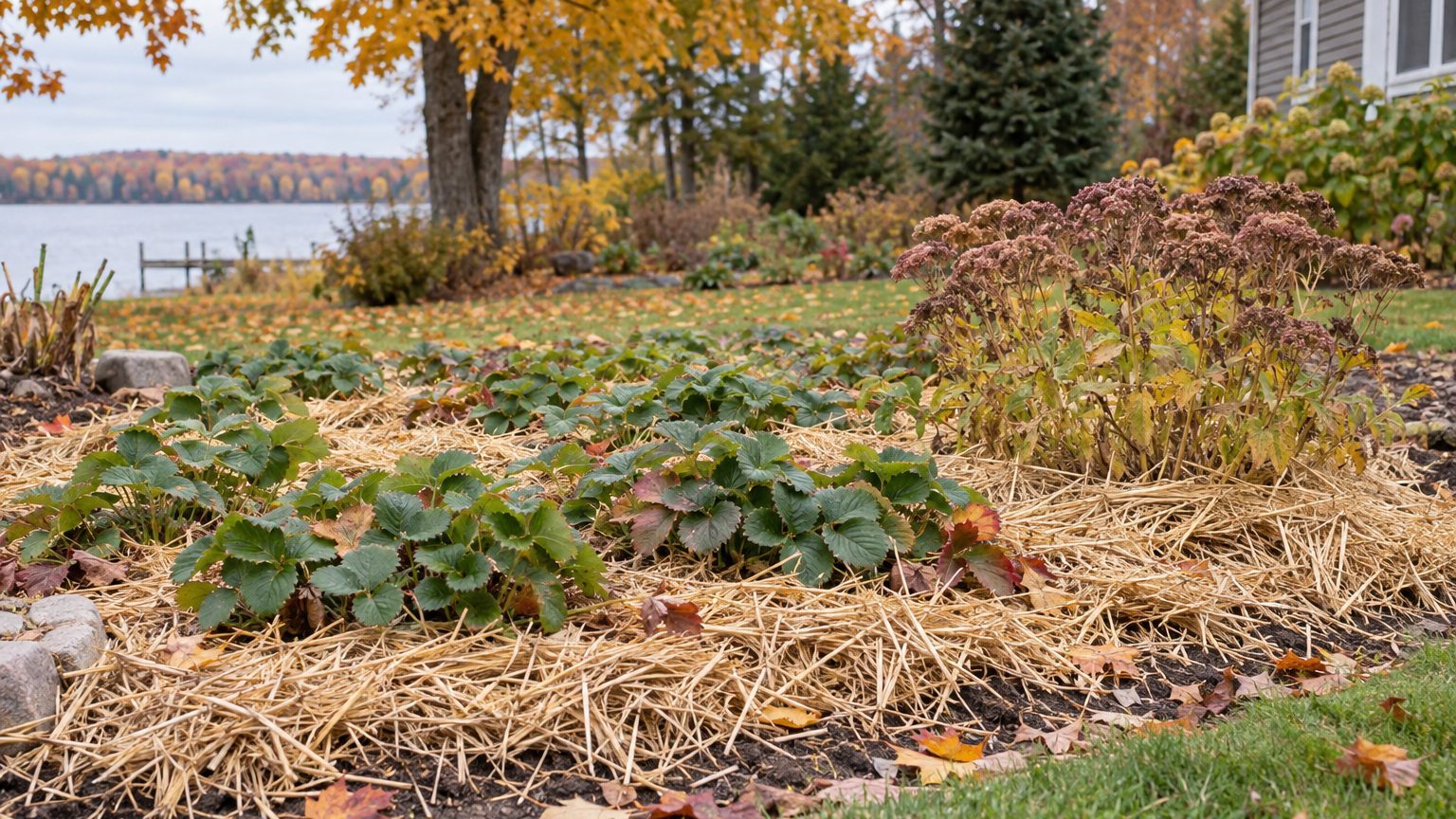

Minneapolis gardeners wait until the ground itself starts to freeze before laying winter mulch, not at the first frost warning. That’s several weeks after the first fall frost hits, once nights have driven cold deep enough to lock the soil solid. Push a trowel into a bare patch of soil, and once it meets real resistance, spread the straw or leaf mulch that same week.
When to put winter mulch down in Minnesota
Minnesota’s ground freezes hard every winter, so the question here isn’t whether to mulch, it’s when. NOAA’s NCEI 1991-2020 Climate Normals put the Minneapolis area’s first fall frost between October 11 and October 23, and that date is only the starting gun. The soil itself needs several more weeks of cold before it locks up, and that later moment, not the frost itself, is when winter mulch actually does its job.
The ground-freeze rule
New gardeners assume mulch is there to keep roots warm, and that assumption is what gets the timing wrong. Winter mulch is there to keep the ground frozen and stable once it has already frozen, buffering the swings of a January thaw followed by a hard refreeze that heaves shallow roots right out of the soil. Lay mulch down while the ground is still warm and unfrozen and you get the opposite effect: heat gets trapped under the layer, crowns stay active longer than they should, and the space becomes a cozy nesting spot for rodents before the ground has hardened enough to keep them out.
In practice, that means holding off well past the point where the Minneapolis frost window closes, once a stretch of nights near NOAA’s cold-month minimums has had time to work into the top few inches of soil. Push a trowel into a bare patch of garden bed. If it meets resistance, if the top inch or two crunches instead of gives, the ground has started to freeze and it’s time to spread the mulch.
Farther north
Northern Minnesota runs on a tighter clock. NOAA’s climate normals show frost timing shifting two to three weeks earlier the farther north you go in the state, which means a gardener near Bemidji or International Falls should expect the soil to firm up two to three weeks ahead of someone gardening in Minneapolis. The rule stays the same, wait for the ground to freeze, but the calendar that triggers it moves earlier to match. For the state’s full planting and frost calendar beyond mulch timing, the Minnesota guides section breaks down how these windows shift region by region.
Nobody gardening in this state gets to skip the step. USDA’s Plant Hardiness Zone Map puts Minnesota across zones 3a to 5a, and Minneapolis’s own coldest month averages a nightly low of 8.8°F under NOAA’s 1991-2020 normals. That’s cold enough, for long enough, that unprotected crowns and shallow-rooted perennials take real damage most winters. Compare that with a warmer climate like Florida, where When to Mulch Strawberries and Perennials for Winter in Florida covers an entirely different calendar built around occasional cold snaps rather than a hard freeze that lasts all season. For county-level detail on exactly how far the frost window shifts across Minnesota, see First and Last Frost Dates in Minnesota.
Strawberries
Strawberry crowns sit right at the soil surface, which is exactly the problem. A hard freeze-thaw cycle without cover heaves the whole plant half out of the ground, snapping roots that were never built to hold on to open air, and a crown left exposed through a Minnesota winter rarely survives to spring intact. Clean straw, sold loose rather than baled hay full of seed heads, is the traditional cover for strawberry beds because it stays light and airy through winter instead of packing down into a wet mat the way leaves or grass clippings do.
Timing and material
The same signal used everywhere else in the yard applies to the strawberry bed. Straw goes down once the soil surface has started to freeze, following the after-frost timing described above rather than a fixed calendar date, since the exact week shifts depending on where in Minnesota the bed sits. Covering too soon leaves crowns soft and active going into the coldest part of the season, which is worse than no cover at all.
On depth, NC State Extension’s Extension Gardener Handbook describes a general mulch layer of “a 2-inch to 3-inch layer” as enough to suppress weeds and keep soil conditions even, and that same order of depth is what most home strawberry beds get going into winter, enough straw to hide the crowns from view without burying them under a solid block. Pile straw two to three inches deep over the whole bed, not just around each crown, so wind can’t scour bare patches down to soil and leave part of the row exposed.
Uncovering in spring
Pulling the straw back matters as much as laying it down. Leave it too long after the ground thaws and new leaves push up pale and thin, then burn in the first strong sun or rot at the crown from trapped moisture. Pull the mulch back to the row middles as soon as new growth tries to push through it, and keep it nearby to rake back over the crowns if a late frost threatens after that. For more on choosing varieties and running a strawberry bed through the rest of the year, see Growing Strawberries.
Perennials and borderline plants
USDA’s Plant Hardiness Zone Map puts Minnesota across zones 3a to 5a, with the coldest pockets in the north and the milder edge nearer the Twin Cities. A perennial rated hardy only to zone 5 is working at the edge of what the state allows even in a mild year, and a plant that hasn’t had a full season to root in is more vulnerable than an established clump of the same species. Garden mums bought and tucked in late in the season, roses grafted onto hardier rootstock, and anything recently divided or transplanted are the plants worth mulching every single year, not just when a hard winter is forecast.
Which perennials need it
Perennial herbs sit in this same borderline category in a Minnesota garden, since several common kitchen herbs are less cold-hardy than the vegetable beds around them. The national guide to Getting Perennial Herbs Through the Winter covers which ones need a protective layer and which tolerate the state’s winters without help. The same after-freeze timing that applies to strawberries applies here too: wait for the soil to firm up before covering.
Ring, not mound
The depth guidance stays consistent across the yard. NC State Extension’s Extension Gardener Handbook calls for “a 3-inch layer of mulch to reduce water loss and maintain uniform soil moisture and temperature around roots” around woody plants, and a similar three-inch depth works over perennial crowns too, enough to buffer temperature swings without smothering the plant underneath.
Build it as a ring, not a mound. Mulch piled straight against a crown or stem holds moisture right where rot starts, and gives a mouse or vole a heated tunnel straight to the base of the plant. Leave a few inches of bare soil right at the crown and bank the mulch in a ring around it instead, the same way a mulch volcano piled against a tree trunk causes more harm than the bare ground it was meant to protect. The national guide to Mulching Without Killing the Plant covers that ring-versus-mound distinction in more detail.
What goes wrong
Most winter mulch failures in Minnesota trace back to one of four mistakes, and each one is easy to avoid once you know what to look for.
- Mulching too early: covering before the ground has frozen keeps crowns soft and active into the coldest part of winter.
- Matted mulch: wet leaves pack down into a solid layer that sheds water and smothers whatever sits underneath.
- Vole tunnels: mulch piled against the stem or crown gives rodents cover to chew bark and roots all winter long.
- Late uncovering: mulch left in place too long into spring produces pale, weak growth prone to rot.
Fixing it before spring
Mulching before the ground has frozen is the single most common mistake, and it usually comes from good intentions: a gardener sees the first frost warning and covers the beds that same week. Warm, damp soil under a blanket of straw or leaves keeps crowns active longer instead of pushing them into dormancy, and that soft growth is exactly what a hard freeze weeks later kills outright.
Matting is the second failure, and it shows up as a slick, packed layer that sheds water instead of insulating. Straw resists this better than leaves because it stays loose, but even straw mats down if it’s piled too thick or gets soaked repeatedly before it has a chance to freeze solid.
Voles treat a mulched bed as a heated tunnel system, chewing bark and crown tissue all winter under cover most gardeners never lift until spring. A ring of bare soil around the base of shrubs and perennials, rather than mulch piled tight against the stem, closes off the easiest entry point without giving up the insulation the rest of the bed still needs.
Leaving mulch in place too long after the spring thaw is the last mistake, and it happens in the season you’d least expect trouble. Strawberry crowns and perennial shoots pushing up through a heavy layer come up pale, weak, and prone to rot right where they meet the wet mulch. Pull mulch back as soon as new growth appears, then hold it nearby in case a late frost calls for covering the bed again.
Common questions
Can I use leaves instead of straw on strawberries?
Leaves work in a pinch, but whole leaves mat down into a wet layer over a Minnesota winter in a way loose straw doesn’t. Shredded leaves drain better than whole ones and are a reasonable second choice if straw isn’t available.
What if I already put mulch down before a hard freeze?
Pull it back off if the ground hasn’t frozen yet and there’s still time before the next cold snap. It’s better to expose the bed briefly than to leave crowns sitting under a warm, damp layer while they’re still trying to go dormant.
Do containers need the same treatment?
Container roots are more exposed to cold than roots in open ground, since soil in a pot freezes from all sides instead of just the top. Moving pots against a foundation wall or into an unheated garage does more for a container plant than surface mulch alone.
Does mulch replace a cold frame or row cover for strawberries?
No, mulch and row covers solve different problems. Mulch buffers the soil temperature around dormant crowns, while a row cover or cold frame is built for extending an active growing season, and the two aren’t interchangeable for winter protection.