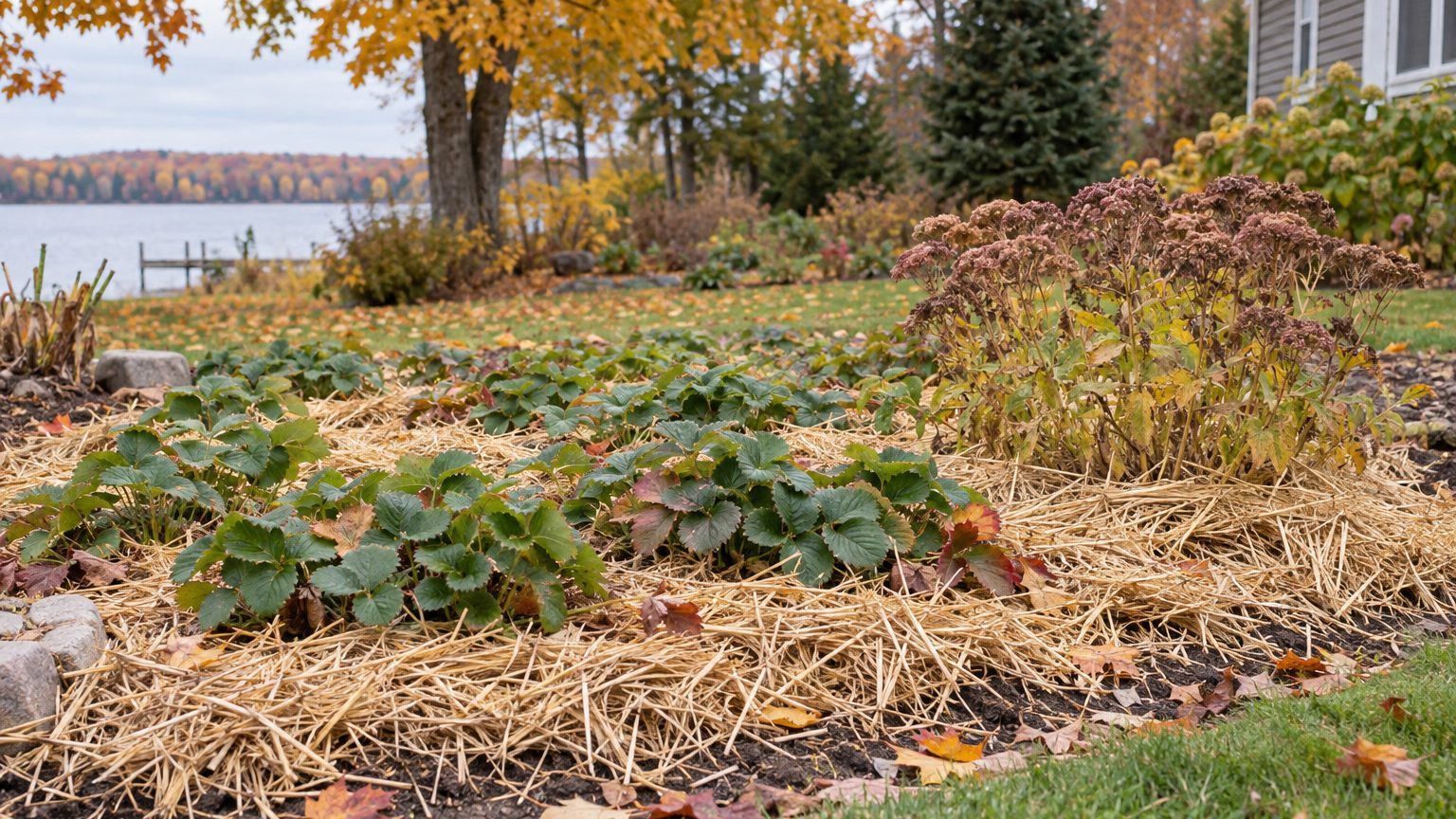

In Missouri, winter mulch goes on after the ground starts to freeze, not when the first frost arrives. At the Kansas City reference station, the first fall frost lands between October 18 and October 29 (NOAA NCEI 1991-2020 Climate Normals). Mulch waits until after that stretch, once the soil has stiffened. Strawberries get clean straw, borderline perennials get a loose ring, and all of it comes back off in spring.
When to put winter mulch down in Missouri
Winter mulch is not a blanket. A blanket keeps a warm body warm, but mulch is there to keep frozen soil frozen. The real danger to shallow-rooted plants is the freeze-thaw seesaw, where soil swells, sinks and swells again until a crown is pushed up out of the ground with its roots dangling in cold air. A layer of straw or shredded leaves evens out those swings.
Put the layer down too early and it works against you. Warm soil under a thick cover stays damp and soft, crowns start to rot, and mice and voles find a cozy new apartment. That is why the calendar alone misleads people. A cool October night in Kansas City does not mean the ground is ready.
The Kansas City reference station shows why the wait pays off. Its coldest-month mean daily minimum is 19.5°F (NOAA NCEI Climate Normals 1991-2020). That is an average of the nights, so many are colder, and the ground does freeze here. Missouri as a whole covers USDA hardiness zones 5b to 7b (USDA Plant Hardiness Zone Map, 2023), so what follows is anchored to Kansas City and shifts as you move around the state.
Wait for the first frost window of October 18 to October 29 to pass, then mulch once the top of the soil stays stiff on cold mornings. The first frost is a signal that the season is turning, not permission to mulch.
Reading the ground instead of the calendar
Your own yard gives better cues than any date. Look for a crust on the soil at dawn that doesn’t fully soften by afternoon. A garden hose gone rigid overnight is another sign. So is a strawberry patch whose leaves have been blackened or flattened by a hard frost, since that means the plants have stopped growing and are dormant.
The frost dates in your part of the state set the frame around all this. The First and Last Frost Dates in Missouri page breaks them down by area, and it is worth a look before you pick a weekend.
Colder north, milder south
The Kansas City figures come from a station at Kansas City International, well north of the city itself. Downtown tends to run about five days earlier in spring, so even inside the metro area the dates wobble.
Farther north in Missouri, the first fall frost comes sooner and the ground freezes sooner, so the mulching window opens earlier on the calendar. Southern Missouri is milder still, and the same logic holds there with a later start. In every case you wait for the ground, and a warm spell after mulching is no reason to tear anything back off. Leave the cover in place until spring.
Strawberries
Why crowns suffer
A strawberry plant keeps its growing point right at soil level, in a compact crown, and its roots are shallow. Those two facts explain the trouble. A crown sitting at the surface has nothing between it and a cold snap, and shallow roots are the first to be lifted when the soil heaves. Bare cold dries and burns exposed tissue, and repeated thawing loosens the plant’s grip on the ground. The plants come through most winters looking fine in the fall and dead-eyed in April.
Strawberries also need a little cold to settle into dormancy. Covering them while they are still green and growing is one of the more common ways to lose them, because a plant smothered before it slows down tends to rot. Give them their first frosts, then a stretch of cold nights in which the soil begins to freeze.
Straw, depth, and spring removal
Clean straw is the standard material for the job. It is light, it drains, and it fluffs up around the crowns instead of packing down. Hay is a poor substitute because it is full of seed and turns your patch into a weed nursery. If you are new to the crop, the guide to Growing Strawberries covers the rest of the season, from planting to renovation.
As for depth, the only figure I will cite comes from NC State Extension. The Extension Gardener Handbook says that “A 2-inch to 3-inch layer of mulch suppresses most annual weed seeds and makes it easy to hand-pull any that do germinate.” That statement is about general mulching, not strawberries specifically, but it gives a sensible ceiling. Straw settles after rain and snow, so spread it loosely to that depth and don’t pile it higher. More is not better, and a thick, wet cap on the crowns is the opposite of what you want.
Cover the plants with clean straw only after the ground begins to freeze, and pull it back off in early spring as soon as new growth turns pale and leggy under the cover. A yellowish tint on fresh leaves means the plants are reaching for light.
Don’t haul the straw away entirely. Rake it into the aisles between rows, where it keeps weeds down and keeps berries clean later. When a frost is forecast after growth has resumed, especially once blossoms open, lay it back over the plants for the night and take it off again the next day. Blossoms are far more tender than crowns.
Perennials and borderline plants
Most hardy, established perennials in Missouri do not need winter mulch. They evolved to handle the swings, and a heavy blanket can hold moisture around the crown and cause more damage than it prevents. The plants that gain the most from a layer fall into a few groups.
| Plant group | Why mulch helps | Where the mulch goes |
|---|---|---|
| Perennials planted this fall | Roots haven’t anchored, so heaving can lift them | Loose ring over the root zone, kept off the crown |
| Plants rated only to the zone above yours | Cold nights near the edge of what they tolerate | Ring around the base, added after the ground freezes |
| Garden mums and other shallow-rooted plants | Shallow roots are vulnerable to freeze-thaw cycles | Ring around the plant with stems left clear |
| Woody perennial herbs | Winter wet and cold together do the damage | Light, airy cover around the base only |
Because Missouri runs from USDA zone 5b to 7b (2023 map), a plant that is reliable in the southern part of the state can be borderline in the north. Check the rating on the tag against your own spot. Kansas City’s coldest-month mean daily minimum of 19.5°F (NOAA NCEI 1991-2020 Climate Normals) tells you how cold the typical worst month gets, but the plants that fail are usually the ones caught by an unusually deep night, so a margin is worth having.
Herbs deserve a mention here. Lavender, sage, thyme and rosemary all resent wet feet in winter more than cold itself, so they want a light cover, not a heavy mat. The write-up on Getting Perennial Herbs Through the Winter goes into which ones to protect and which to leave alone.
For depth, NC State’s handbook gives the tree-oriented version of the same rule: “Provide a 3-inch layer of mulch to reduce water loss and maintain uniform soil moisture and temperature around roots.” Read that as a cap for perennials as well. Two sentences from the same source, two purposes, and they land on the same order of depth.
Mulch new and borderline perennials after the ground freezes, and shape it as a ring around the crown rather than a pile on top of it. Leave a gap of bare soil right at the stem so air can move and the crown stays dry. A ring that climbs the stem turns into a volcano, and volcanoes hold water against the plant and give rodents a hiding place.
What goes wrong
Nearly every winter mulch failure is a timing or a thickness problem, and most of them show up in spring, when it is too late to do much. Here is what each one looks like and how to head it off.
Mulching too early. The plants look fine going into winter, then crowns turn soft and dark in spring and the leaves collapse. Warm, damp soil under a cover breeds rot. The prevention is the rule from the first section: wait past the October 18 to October 29 first-frost range, then for the soil to stiffen, and only then spread the cover.
Mulch that mats. Whole leaves, especially large ones like oak, lock together into a wet sheet that cuts off air. You will find it slimy and stuck to itself under a snowmelt. Shred leaves first, or use straw, and keep to the 2-inch to 3-inch range NC State describes. The Mulching Without Killing the Plant guide covers material choices in more detail.
Voles nesting in it. Runways in the mulch and gnawed bark or crowns near the soil line are the tell. Thick, early mulch gives voles cover and warmth. Keeping the layer thin, holding it back from stems and trunks, and applying it after the ground freezes all cut down on the appeal.
Forgetting to uncover. Straw left on strawberries too long produces pale, stretched growth and weak plants. Check under the straw as spring approaches, and pull it off the crowns as soon as new leaves look yellow, keeping it handy to re-cover on frost nights. Last frost dates run later in colder northern Missouri and a few days sooner in warmer spots, so let the plants tell you.
Common questions
Can I mulch strawberries in October?
Usually too early. The first fall frost at the Kansas City reference station falls between October 18 and October 29 (NOAA NCEI 1991-2020 Climate Normals), and mulching belongs after the ground begins to freeze, which comes later. If a hard frost has already blackened the leaves and the soil is firm in the morning, you can go ahead. If the soil is still soft and warm, wait.
What if I miss the window and the ground is already frozen solid?
Mulch anyway. The purpose is to keep the soil frozen and steady, and frozen ground is the condition you were waiting for. Spread the straw or ring the plants as usual. Just avoid working on ground so wet or thawed that you compact it.
Is leaf mulch a good winter cover?
It works if the leaves are shredded, which stops them from matting into a wet sheet. Whole leaves pack down and trap moisture against crowns. For strawberries, clean straw is the safer choice. Whatever you use, keep to the 2-inch to 3-inch range NC State Extension gives, and leave a gap around stems.
Do gardeners in southern Missouri need to bother?
The same logic applies, with a later start, since southern Missouri is milder than the Kansas City reference station. Strawberries and borderline plants still benefit from a steady cover once the ground begins to freeze. The Kansas City fall dates come from a station well north of the city, so your yard can differ, and the Missouri guides offer more regional detail on local conditions.