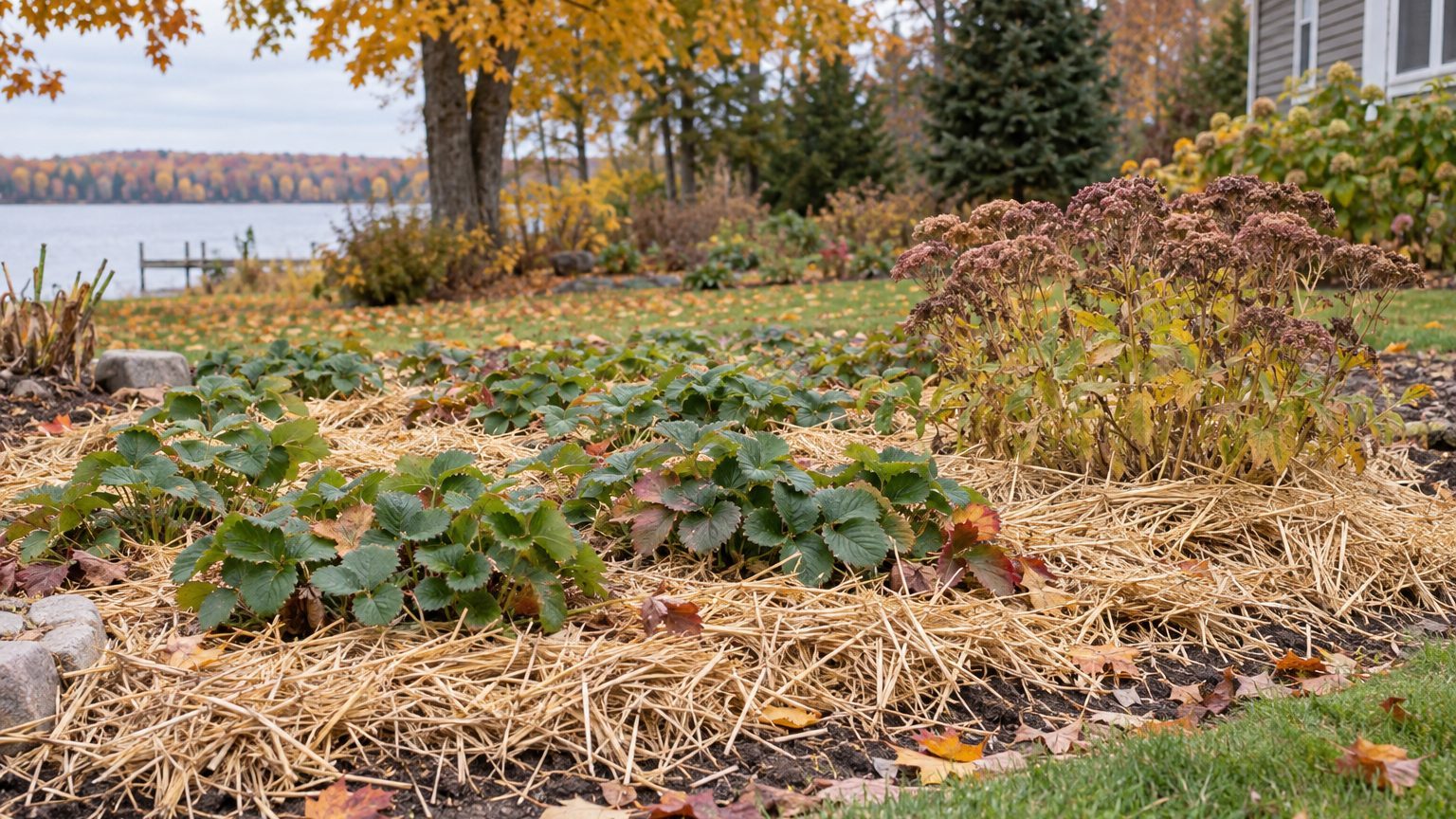

In Illinois, winter mulch for strawberries and perennials goes on after the ground begins to freeze, not before. NOAA’s 1991-2020 normals for Chicago put the first fall freeze (32°F) between October 24 and November 3, so the mulching window opens after that stretch, once the soil turns cold and stiff. Mulch is there to keep frozen soil frozen, not to keep plants cozy. Spread it in September and you invite rot and rodents.
When to put winter mulch down in Illinois
Why the freeze comes first
Roots don’t die from cold alone. What hurts a shallow-rooted plant is the swing: soil that freezes on a cold night, thaws on a sunny afternoon, and freezes again. Each cycle expands and contracts the top few inches of ground, and a strawberry crown or a freshly planted perennial can be pushed upward a little at a time until its roots hang in open air. Gardeners call it heaving, and it can finish a plant by February without a single dramatic cold snap.
Chicago’s numbers show why this is a real risk in Illinois. NOAA’s 1991-2020 Climate Normals give a mean daily minimum of 18.8°F for the coldest month. That is an average night, not a record low, and it is well under freezing. The ground freezes here, and it also thaws here, which is the combination that heaves plants.
A blanket of mulch evens out those swings. It works best when the soil is already cold, because then it holds the frost in place instead of holding autumn warmth against the crown. Spread it over warm soil and it does the opposite of what you want: it keeps the crowns damp and mild, which suits rot fungi and nesting mice.
The window, in practice
Start from the first frost. According to the NOAA NCEI normals for the Chicago airport station, the first 32°F freeze lands between October 24 and November 3 (that is the 30 to 70 percent probability band). A single light frost does not freeze the ground, though. The mulching window opens after that range, once several hard freezes have followed and the soil surface is crusty and stiff in the morning and does not fully soften by afternoon. It stays open until the ground is frozen solid or heavy snow arrives.
Plan to mulch after the October 24 to November 3 first-freeze window has passed, once the soil surface stays stiff through the day. In most Chicago-area yards, that puts the job in the weeks beyond that window, often a Thanksgiving-weekend chore.
Those dates come from an airport weather station, so treat them as the reference-city figure, not a statewide guarantee. Suburban and rural gardens often see the first fall frost one to two weeks earlier than the airport does. In the colder north of the state, fall jobs shift earlier; in the milder south, the calendar slides later. Let the soil make the final call, and look up your own county in First and Last Frost Dates in Illinois before you pick a weekend.
Strawberries
What the crowns need
A strawberry plant’s growing point, the crown, sits right at the soil surface. Nothing protects it except whatever you put there. Bare cold dries the crown and kills the buds that will become next June’s berries, and heaving lifts the plant out of the ground. Both problems grow worse in a winter with little snow, since snow is the best natural mulch there is. Illinois gets plenty of winters when it doesn’t stick around.
Strawberries also need a little cold before the covering goes on. The plants harden off in fall as the days shorten and the temperatures drop, and they stop actively growing. Cover them before that process finishes and you interrupt it. This is another reason to hold off until after the first-freeze window of October 24 to November 3 at the Chicago reference station, and until the ground itself has started to firm up.
Straw, depth, and spring removal
Clean straw is the standard choice, and for good reason. It is light, it lets air through, and it springs back instead of packing into a wet sheet. Look for straw, not hay, since hay carries seed heads that will turn your strawberry bed into a lawn of grass and weeds. Whole oak and maple leaves tend to mat down, so if you use leaves, shred them first.
The facts I can cite on depth come from NC State Extension, which says: “A 2-inch to 3-inch layer of mulch suppresses most annual weed seeds and makes it easy to hand-pull any that do germinate.” That passage is about weeds, not strawberries, but it gives the right order of magnitude. Strawberry straw settles after the first snow and rain, so lay it loosely and cover the crowns and the space between them evenly. Do not pile it high. More is not better, and a thick, soggy layer is a lot worse than a thin one.
Spring is where people slip. Pull the straw back off the crowns when new growth starts to show, usually as the last spring frost approaches, not after. Leaves that emerge under mulch come up pale yellow, and that is your cue. Rake the straw into the aisles instead of hauling it away. If a late frost threatens, you can pull it back over the plants for the night, which is also what protects open blossoms. The full growing guide is at Growing Strawberries.
Perennials and borderline plants
The USDA Plant Hardiness Zone Map (2023 edition, built on 1991-2020 normals) runs from zone 5a to 7b across Illinois. Zones are based on a single variable, the average annual extreme minimum temperature, so they tell you whether a plant survives the coldest night but not whether it survives the thaw and refreeze. The map covers the whole state, and your yard’s zone depends on where in Illinois you live, so find yours before you decide who needs mulch.
Most established perennials that are rated for your zone don’t need winter mulch. A mature, deep-rooted plant has already been through a few winters and will sleep through another one. The plants that benefit are these:
- Perennials planted in late summer or fall, whose roots haven’t had time to anchor.
- Shallow-rooted plants such as coral bells and hardy mums, which are known for heaving out of the ground.
- Borderline plants rated for your zone only at the low end, including some roses and woody herbs like lavender.
For a tender woody herb, mulch is half of the plan. The other half, covering and siting, is laid out in Getting Perennial Herbs Through the Winter.
A ring, not a pile
Depth guidance comes again from NC State Extension, and it is the same order as for weeds: “Provide a 3-inch layer of mulch to reduce water loss and maintain uniform soil moisture and temperature around roots.” That line is about trees, but it is the best figure on record for a ring around a root zone. Stay within the 2-inch to 3-inch range and do not go deeper.
Shape matters as much as depth. Lay mulch in a ring around the crown, leaving a gap of bare soil at the base of the plant. Mounded directly on a crown, mulch holds moisture against the stems and gives rot an easy start. The same mistake kills trees, and the result is called a mulch volcano. For the broader technique, see Mulching Without Killing the Plant.
Mulch new and borderline perennials after the ground starts to freeze, with a ring 2 to 3 inches deep that stops short of the crown. Established, zone-appropriate plants can skip it, and leaving fall leaves where they drop beneath shrubs often does the job for free.
| Plant type | Needs winter mulch? | Best material | Main risk |
|---|---|---|---|
| Strawberries | Yes, in Illinois | Clean straw | Leaving it on too long in spring |
| New fall-planted perennials | Yes | Shredded leaves or straw | Heaving in the first winter |
| Borderline woody plants | Often | Straw or bark ring | Rot from mulch against the stem |
| Established hardy perennials | Usually not | Fallen leaves | Smothering evergreen foliage |
What goes wrong
Early, matted, and moldy
Mulching too early is the most common error, and it looks harmless until spring. Crowns that spent October and November wrapped in straw over warm soil stay soft and green when they should be dormant. By March, some are mushy at the base. Prevent it by waiting for the first-freeze window at the Chicago reference station (October 24 to November 3) to pass, and for the ground to stiffen.
Matting is the quieter cousin. Wet whole leaves, especially maple and sycamore, pack into a gray, slimy sheet that blocks air and holds water against the crown. Shred them with a mower first, or switch to straw. If you find a matted layer in late winter, fluff it with a fork on a mild day.
Voles and the forgotten blanket
Voles love thick, undisturbed cover because they can tunnel beneath it all winter, out of sight of hawks, and chew on crowns and bark. Mulch applied too early gives them months to settle in. Late application, a ring that stays clear of woody stems, and a tidy edge reduce the problem. Look for runways, small round holes, and gnawed bark near the base of shrubs, and pull the mulch back if you find them.
The last mistake comes in spring, when nobody thinks about mulch anymore. Check the strawberry bed as the last spring frost nears, and uncover the crowns when you see pale new growth. A bed left covered for weeks past that point turns leggy and pale, and the plants flower late. Put it on your calendar next to the first spring chores, not in memory.
Common questions
Can I mulch strawberries in October?
Not in the Chicago area, where the first 32°F freeze arrives between October 24 and November 3 according to NOAA’s 1991-2020 normals. An October covering sits over warm soil and invites rot. Wait until the ground is cold and stiff, which is later than most gardeners expect.
Do I need to mulch perennials that are hardy in my zone?
Established ones usually don’t need it. New plantings, shallow-rooted plants, and borderline woody ones do. The USDA map (2023) runs from 5a to 7b across Illinois, so check where your yard falls first.
How deep should winter mulch be?
NC State Extension gives “a 2-inch to 3-inch layer” for weed control and “a 3-inch layer” for moisture around roots. Stay in that range and keep it off the crown and stems.
When do I take the mulch off?
Pull it back from strawberry crowns as new growth appears in spring, ahead of the last frost, and keep it close by for cold nights. For perennials, rake the ring away from the crown as the soil warms. The rest of the state’s seasonal timing sits in the Illinois guides, and your own county’s frost dates will be the best guide to the exact weekend.