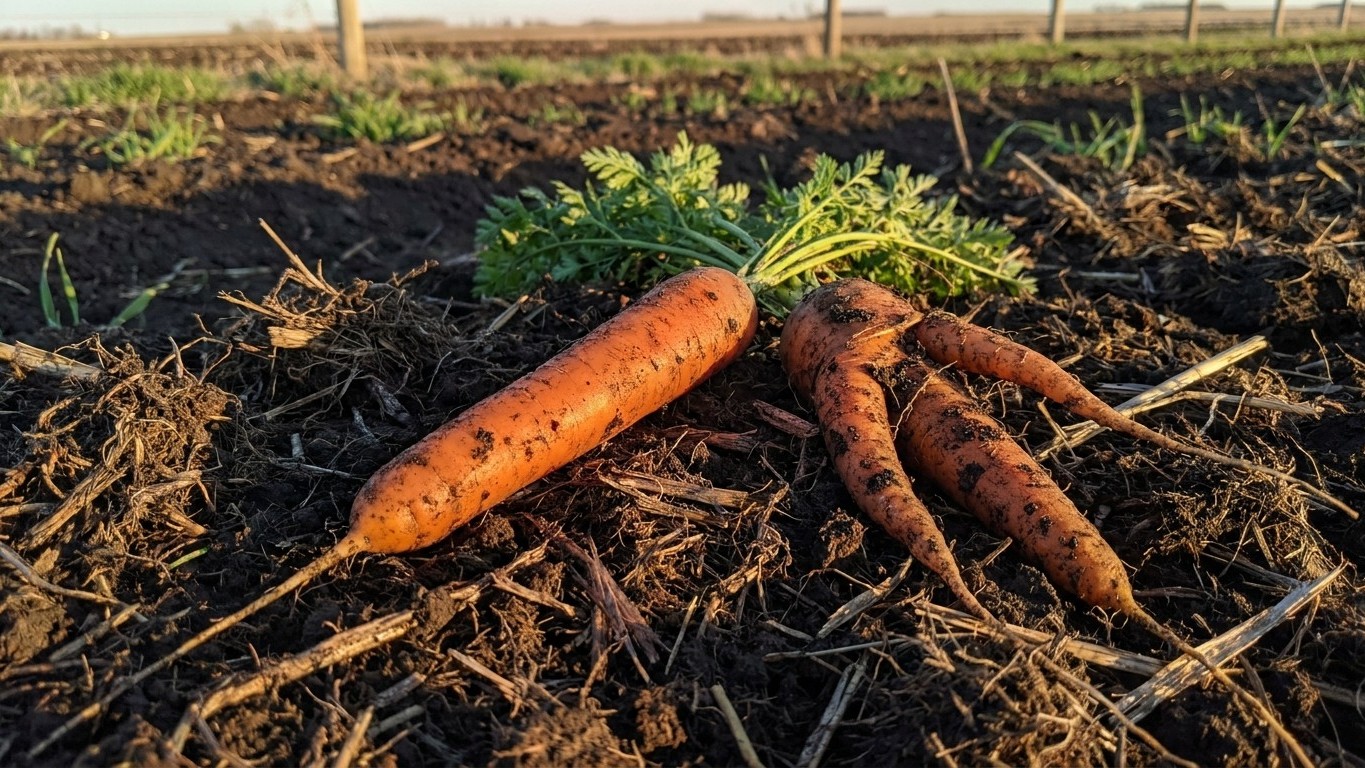

In Rhode Island, what ruins a carrot crop is more often the ground and the weather than anything with teeth: forked roots, seed that never comes up, cracked roots, carrots gone soft in storage. That is what this page covers. The sourced facts behind it hold no insect names or calendar dates, so none are given here. Timing of pests is a question for your local extension office.
The short answer
Start with the soil USDA lists as representative of the state: the Narragansett series, an Inceptisol, which means a young soil that hasn’t developed strong horizons yet. The surface runs about 34 percent sand, 6 percent clay and 60 percent silt, a loam to silt texture. Organic matter sits around 4.0 percent, the surface pH is about 5.3 (strongly acid), and drainage is well drained. Those are USDA’s representative values for the surface layer of the series as mapped, not a reading from a worked garden bed.
Now set that against what carrots want. Utah State University Extension describes the ideal as deep, sandy, well-drained soil rich in organic matter, and says heavy or rocky soil makes the root fork. Narragansett ground clears the drainage bar. Clay is only 6 percent, so this isn’t the sticky, brick-making soil that splits a root into legs. The silt is the part to watch. It is finer than sand and can pack down, and a packed layer is exactly what a root wanders around.
So, will a carrot fork in it? On paper, less than in true clay country, and the well-drained class is a real advantage. But the percentages say nothing about stones, and stones are the other half of the forking story. A root that hits a rock forks just as surely as one that hits a hardpan.
What answers the problem, if you have it? Utah State’s guidance for heavy soil is plenty of compost and double digging. Loosen the bed well below the depth of the seed row, work the compost through it, and pull the stones as you go. If the digging turns up a layer you can’t break, or a patch that stays wet, a raised bed filled with loose, compost-rich soil is the cleaner fix. Switching varieties is not. The source names none, and no variety rescues a root in rock.
One caution before you trust any of this. A state spans hundreds of soil series, and Narragansett is a starting point, not a diagnosis. River bottoms, hill country, and any lot a builder has scraped or filled can look nothing like it. The same goes for the pH: 5.3 describes the mapped surface of a series, not your bed, so a soil test is the only way to learn your own number. For a fuller look at the forking question, see Will Carrots Fork in Rhode Island Soil?
The test that settles it in your own garden
Your soil is not the state’s. An afternoon with a spade tells you more than any map, and none of it costs anything. Do it where the carrots will actually grow, and do it when the ground is workable, not soaked.
- Dig a test hole. Use a spade and go down as far as you reasonably can. Set the soil on a tarp in the order it came out, so you can see the layers.
- Look at the depth. Note where the dark, crumbly topsoil ends and something paler or harder begins. Carrots need loose ground for the whole length of the root, so a thin topsoil over a firm layer is a forking warning.
- Count the stones. Sift a few handfuls through your fingers. Frequent stones, or one big rock in the hole wall, mean you should clear the bed by hand or build a raised one. The sources give no safe stone count, so judge by whether a straight root could pass.
- Feel the texture. Wet a handful until it holds together and rub it between finger and thumb. Gritty means sand. Smooth and floury means silt, which is what the Narragansett series leans toward. Sticky and slick that rolls into a firm ribbon means clay, and the forking risk climbs.
- Watch the water. Fill the hole, let it drain, then fill it again and watch. Water that vanishes steadily points to good drainage. Water that sits long after the rest of the yard has dried out points to a compacted or heavy layer, and a raised bed is the safer route.
- Send off a soil sample. Your hands can judge structure but not acidity. A lab test gives your actual pH and organic matter, and tells you whether the bed needs amending before seed goes in.
Read the results together. Loose and deep with no stones means you can sow straight into it, with compost worked in. Dense or stony means double digging, or a raised bed if digging doesn’t solve it.
What goes wrong here
Carrots are sown in place, never transplanted, so whatever happens in the row happens to the crop that stays there. The days to harvest count from seeding, 70 to 100 of them. The usual failures, and what to do about each:
- Forked or stubby roots. Heavy or rocky ground is the cause, per Utah State Extension. Silt that has packed down counts as heavy. The remedy is plenty of compost and double digging before you sow, stones removed, or a raised bed if the native ground won’t loosen.
- Poor germination in a hot spell. Carrot seed is slow to come up, and a bed that dries out during that wait gives you a patchy row. Keep the seed line evenly moist until the seedlings show, shade it if the weather turns hot, and pick your sowing window carefully. When to Sow Carrots in Rhode Island: Counting Back From the Last Frost walks through how to count it.
- Splitting from uneven water. A dry stretch followed by a soaking rain or a heavy watering can crack roots as they swell. Well-drained ground like Narragansett dries quickly, which makes the swings sharper. Water on a steady schedule and mulch the bed to even things out. The sources give no watering amounts, so watch the soil rather than a number.
- Acid ground. The mapped surface of the representative series is strongly acid, about pH 5.3. The sources give no target pH for carrots, so I won’t invent one. A soil test on your own bed shows whether lime is needed, and the lab’s recommendation beats a guess.
- Losing the harvest after it’s pulled. Clemson Cooperative Extension advises harvesting carrots about 65 to 75 days after planting and storing them at 33 °F with high humidity to prevent wilting. That is just above freezing, colder than a typical cellar, and a warmer spot means sprouting and softening much sooner. Cut the tops off first. Leaves keep drawing moisture out of the root, which is why bunched carrots with tops on keep only about 10 to 14 days, while trimmed roots keep far longer. Clemson’s fact sheet is at hgic.clemson.edu.
Common questions
Will carrots fork in Rhode Island soil?
It depends on your bed. The state’s representative soil is well drained, low in clay at 6 percent, and high in silt at 60 percent, so it is not the worst case. Stones and compacted layers are what cause forking, and only a test hole in your own garden will show them. Compost and double digging, or a raised bed, are the fixes.
What insects eat carrots here, and when do they show up?
The facts behind this page don’t carry insect names or calendar dates, so none are offered here. Your local extension office can tell you which pests are active in your area and when to watch for them.
How long do carrots take from seeding?
Plan on 70 to 100 days, counted from seeding. Carrots are sown where they grow and aren’t transplanted, so there is no transplant date to count from. Clemson Extension gives a shorter window of about 65 to 75 days after planting for harvest, so begin checking roots at the early end.
How should I store carrots after harvest?
Cut the tops off first, since leaves pull moisture from the root. Then store the roots at 33 °F in high humidity to prevent wilting. Bunched carrots with the tops left on keep only about 10 to 14 days, according to Clemson Extension. More on the crop overall is in Growing Carrots in Rhode Island.