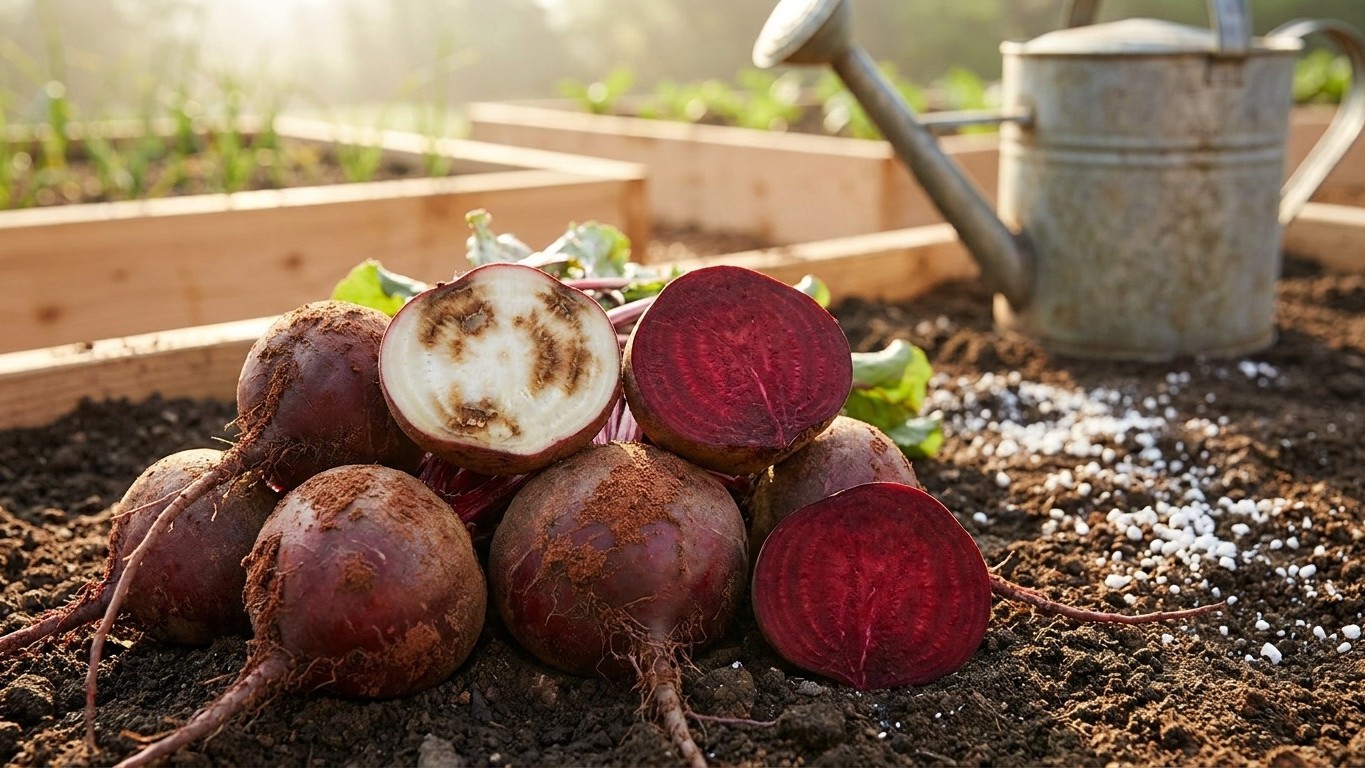

In Manitoba, the things that eat into a beet crop are mostly weather and ground, not bugs. Thirst in the first six weeks sends plants to flower instead of building a root. Heat above 85 F, combined with thirst, turns the root woody. A root cellar kept too cold brings black spot and rot. All three have sourced numbers behind them. A dated calendar of insect and animal pests is not published in the sources behind this page, and guessing at one would do you no good.
The short answer
Start with the ground. Canada has no official provincial soil the way each US state names a state soil, so there is no single series to cite. What the national soil survey (Agriculture and Agri-Food Canada, Canadian Soil Information Service) offers instead is a dominant profile. Across 2,535 mapped soil components in Manitoba’s agricultural regions, the commonest soil order is Chernozem, the deep, dark grassland soil of the prairies, rich in organic matter and naturally fertile. It covers 41 percent of the mapped surface, with Gleysolic next. The median surface layer is loam to silt: 45 percent sand, 24 percent clay, 31 percent silt. Organic matter sits around 5.5 percent, the pH is about 7.6 (alkaline), and the drainage class is imperfectly drained.
Set that against what Utah State University Extension says beets want: deep, sandy, well-drained soil rich in organic matter. Depth and organic matter, the province’s ground tends to supply. Sand at 45 percent is a workable share, but 24 percent clay plus imperfect drainage means water lingers after a heavy rain instead of draining away. That cuts both ways. A soil that holds moisture can soften a dry week, and it can also sit wet after a storm. The same Extension guidance caps compost at no more than 1 inch per 100 sq ft, and a soil already near 5.5 percent organic matter hardly needs a thick blanket on top. The Beet Soil in Manitoba: What the Root Will Meet page goes deeper on what the root actually meets below the surface.
One caution matters more than any number above. A province spans hundreds of soil series, and this profile is a starting point, not a diagnosis. River bottoms, muskeg, and any lot a builder has scraped or filled will behave completely differently. The survey also covers farmland regions only, so the far north is not represented. And 7.6 is the median of mapped surfaces, not your pH. A soil test on your own bed gives the only number that counts.
Then there is heat. The brief for this page called for the number of days a year Winnipeg passes 90 F, and that figure is not published in the data behind it, so I won’t invent one. The threshold the Extension source uses is 85 F: heat above that, paired with water stress, makes the root woody. That is a separate failure from bolting. Bolting comes from water stress in the first six weeks, when the plant is young. Woodiness comes later, from heat plus thirst on a root already swelling. Fixing one does not fix the other.
Beets are sown in place, so the 60 to 80 days to harvest run from seeding, not from any transplant date. That clock is what the next section lays over Manitoba’s spring.
The six weeks that decide it here
The last spring frost at the Winnipeg Richardson station falls on average on May 23 (Environment and Climate Change Canada, Canadian Climate Normals). That is a mean date, not a safe date. In one year out of two, the last frost comes later. Treat May 23 as the middle of a window. Also, Canadian normals run on a different 30-year period than the US frost figures used elsewhere on this site, so don’t line them up to the day. And one airport station is not a province: northern and upland districts run weeks behind Winnipeg.
Sowing two to three weeks before the last frost puts seeding around May 2 to May 9 on an average year. The When to Sow Beets in Manitoba page covers how to adjust that window for your own spring. Counting six weeks from those dates carries the critical stretch from early May to somewhere between mid and late June. That is the period the Extension source ties to premature flowering: water stress in the first six weeks.
What does a Manitoba spring usually do in those weeks? No spring rainfall record is published on this page, so take this as a description of risk, not a measured pattern. Prairie springs tend to swing, with warm, windy stretches that dry the top inch of soil fast, followed by cool, wet spells. The bolting risk sits in the dry swings. A seedling row that goes thirsty for several days in late May is the textbook setup for premature flowering, and no amount of watering in July undoes it. The source names water stress as the cause, and I am not adding other triggers it doesn’t support.
Loam to silt with a fair amount of clay is forgiving here, since it holds what it gets. Even so, the practical move is steady, even moisture through the first six weeks, checked by your finger an inch or two down rather than by the calendar.
Do the harvest arithmetic too. Seeding on May 2 and counting 60 days lands on July 1. Seeding on May 9 and counting 80 days lands on July 28. So the root is swelling through late June and July, which is exactly when heat above 85 F becomes possible. That is the woodiness window, and it is a different problem from the bolting one. Water stress and heat together are what make the root woody. Early thirst alone is not.
For the full picture of the crop beyond pests and weather, see Growing Beets in Manitoba.
What goes wrong here
- Bolting after early thirst: plants flower instead of rooting up when water stress hits in the first six weeks from seeding. Remedy: keep the top few inches evenly moist from sowing through mid or late June, and mulch the row once seedlings are up.
- Woody roots after heat: heat above 85 F with water stress makes the root tough. This is not the same failure as bolting. Remedy: water deeply and steadily through July, and harvest at the early end of the 60 to 80 day range rather than leaving roots to sit.
- Wet feet in imperfectly drained ground: the dominant profile holds water after heavy rain, and the ideal bed is well-drained. Remedy: if your bed stays soggy, raise it or build up the row, and confirm with a soil test rather than assuming.
- Too much compost: more than 1 inch per 100 sq ft goes past the guidance, and a prairie soil already near 5.5 percent organic matter needs little. Remedy: stay under the cap, or skip it if a test shows plenty.
- Storing too cold: for topped roots the target is 33 to 36 F at about 98 percent humidity. At 32 to 34 F the source reports more black spot and rot than at slightly warmer temperatures. Colder is not better here, unlike most root crops. In a pit or cellar, stay above 31 F and below 41 F.
- Storing with leaves on, or keeping the small roots: bunched beets last only about 10 to 14 days at 32 F, so top them first. Large roots keep much better because they lose water and shrivel more slowly. Save the big ones for storage and eat the small ones first.
- Chewing pests: no dated calendar of what eats beet tops or roots in Manitoba is published here, so none is given. Remedy: check leaves and row edges weekly and ask a local provincial agriculture office what is active in your district that season.
Common questions
When is the best time to sow beets in Manitoba?
Two to three weeks before the last frost, which on average at the Winnipeg station falls on May 23. That points to roughly May 2 to May 9 in an average year. Half of years see frost later than May 23, so the date is the middle of a window, not a guarantee.
Does Manitoba’s dark prairie soil need compost for beets?
Often not much. The dominant profile averages about 5.5 percent organic matter. If you add any, keep it to no more than 1 inch per 100 sq ft. Your own soil may differ from the median, so test it first.
How long do beets take to mature?
Sixty to eighty days from seeding. Beets are sown in place, so the count starts when the seed goes in the ground, not at any transplant date.
What is the right temperature to store beets?
For topped roots, 33 to 36 F at about 98 percent humidity, per the USDA handbook on commercial storage (USDA Agricultural Handbook 66). The same source says 32 to 34 F brings more black spot and rot. Cut the tops off first, and choose your largest roots for long storage.