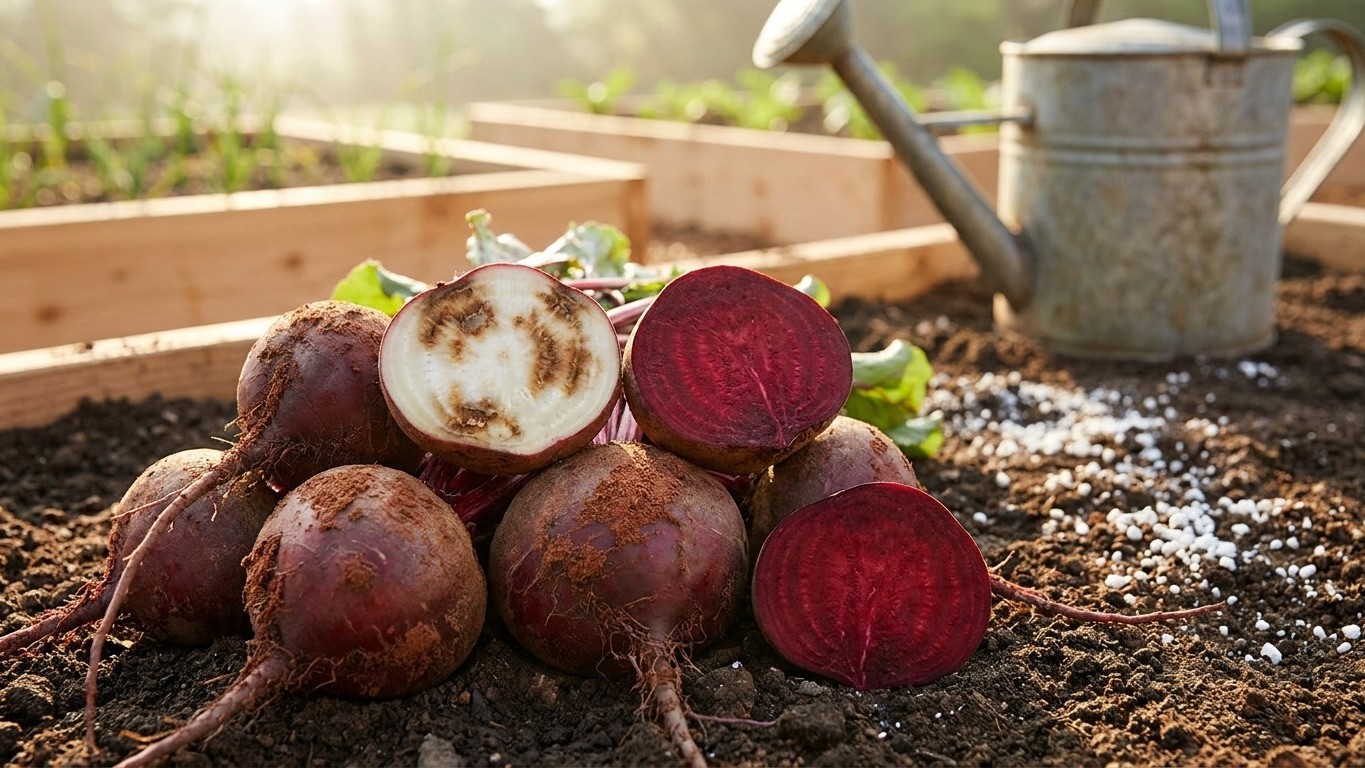

In Massachusetts, a beet crop is mostly eaten by thirst and heat, not by anything with a mouth. Dry weather in the first six weeks sends plants toward flowering. Heat above 85 F on dry roots turns them woody. A too-cold cellar then finishes off what survived. Those are three separate failures with three separate fixes. (Insect pests are outside the sourced facts for this page.)
The short answer
Start with the ground. The official state soil is the Paxton series, an Inceptisol, which is a young soil that hasn’t built strong horizons yet. USDA records for its surface layer show 61 percent sand, 7 percent clay and 32 percent silt, with organic matter around 5.5 percent and a surface pH of about 5.5, slightly acid. It is classed as well drained. Those figures are representative values from USDA’s Soil Data Access for the major components of the series (265 of them), not a measurement of anyone’s vegetable bed.
For a beet, that profile reads well on paper. Utah State University Extension describes the ideal as deep, sandy, well-drained soil rich in organic matter, and Paxton ticks each box. The catch is the flip side of good drainage. With only 7 percent clay, water has little to cling to and moves through quickly, so a root zone can go from damp to dry faster than a gardener expects. The 5.5 percent organic matter helps hold some moisture back. The same extension guidance caps amendments at no more than 1 inch of composted organic matter per 100 sq ft, so piling on compost to fix dryness isn’t the answer.
One big caution. A state spans hundreds of soil series, and this is a starting point, not a diagnosis. River bottoms, hill country and any lot a builder has scraped or filled can differ completely from Paxton. Your pH could be higher or lower than 5.5. A soil test gives you your own number, and the Beet Soil in Massachusetts: What the Root Will Meet page walks through what to do with it.
Then there’s heat. The brief for this page asks how many days a year the reference city, Boston’s Logan station, passes 90 F. That count isn’t published in the verified facts here, so I won’t guess at one. What the sourced guidance does give is a lower threshold: heat above 85 F combined with water stress is what makes the root woody. A 90 F tally would undercount the days that matter. Treat any warm, dry stretch late in the crop’s life as the danger window, and remember that Logan is a waterfront station, so an inland garden shouldn’t borrow its numbers.
Keep two failures apart in your head. Water stress early in life causes premature flowering. Heat plus water stress later causes woodiness. “Keep it watered” covers both only loosely, because the timing, and what you lose, differ.
The six weeks that decide it here
Beets are sown in place, straight into the bed. There’s no transplant to give you a head start, so the 60 to 80 days to harvest run from the day the seed goes in. Sowing 2 to 3 weeks before the last spring frost is the usual target, and NOAA NCEI climate normals put the last frost at Logan between April 1 and April 8 (that’s the 30 to 70 percent freeze-probability band for 32 F). Count back and the coastal sowing window lands roughly between March 11 and March 25.
Count forward and the picture sharpens. Six weeks after those dates takes you to somewhere between April 22 and May 6. So for a coastal gardener, the stretch that decides bolting is late March through the first week or so of May. A beet sown in that window is on the clock for harvest roughly from mid-May to mid-June, 60 to 80 days after seeding.
What does Massachusetts spring usually do across those weeks? Swing. Cool, damp spells alternate with dry, breezy ones, and a week can feel like early March on Monday and mid-May by Friday. That pattern matters because water stress in the first six weeks is the trigger for premature flowering, and a sandy, well-drained surface sheds moisture quickly once a dry gap sets in. The bolting risk doesn’t sit in a hot month. It sits in the dry gaps of a cool one, when the bed looks fine from above and the seedling roots are already short of water.
Logan is also the mildest spot in the state. Inland suburbs and the Berkshires frost later in spring, so the same 2 to 3 weeks before the last frost means a later calendar date for them, and a different six-week window. Work out your own last-frost date first, then count. The When to Sow Beets in Massachusetts page covers how the dates shift by region.
The practical move is simple, if a little dull: check the bed during dry spells in those six weeks by pushing a finger an inch or two down, not by looking at the surface. If it’s dry down there, water. Once the plants are established and the weeks have passed, the failure you’re guarding against changes from flowering to woodiness, and the watering logic shifts toward the warm days ahead. For the wider picture of the crop here, see Growing Beets in Massachusetts.
What goes wrong here
- Bolting after a dry early stretch. Water stress during the first six weeks pushes beets to flower prematurely. On sandy, well-drained ground the surface dries fast, so check moisture at finger depth during any dry week from sowing through early May, and water when it’s dry.
- Woody roots in warm weather. This is the later failure: heat above 85 F combined with water stress. Roots that mature into a hot, dry spell turn tough. Steady moisture during warm weather is the remedy, and harvesting before the heat settles in also helps.
- Over-amending to fix dry soil. Extra compost feels like a cure for sand, but Utah State University Extension advises no more than 1 inch of composted organic matter per 100 sq ft. Stay under that and let the soil test, not the wheelbarrow, drive further changes.
- Assuming the state soil is your soil. Paxton’s surface pH of about 5.5 is a regional figure, not yours. Fill, scraped lots and river-bottom ground can behave differently. A soil test shows your actual pH and tells you whether anything needs adjusting.
- Storing roots too cold. Colder is not better with beets, which is the opposite of what most root crops want. USDA Agricultural Handbook 66 says more black spot and rot occur at 32 to 34 F than at slightly warmer temperatures. For topped roots, the target is 33 to 36 F at 98 percent relative humidity. Cellars and clamps should stay between 31 F and 41 F.
- Storing them with the leaves on. Bunched beets, tops still attached, keep for about 10 to 14 days at 32 F and above 98 percent relative humidity, and no longer. For anything beyond two weeks, cut the tops off first.
- Storing the small ones. Large roots keep much better than small ones because they lose water and shrivel more slowly. Eat the small roots first and set aside the big ones for the cellar.
Common questions
Why did my beets send up flower stalks in spring?
Water stress in the first six weeks after seeding is the cause named in the Utah State University Extension guidance. In Massachusetts, that means dry stretches in roughly late March through early May on the coast, later inland. A sandy, well-drained bed can dry out quickly even when the weather feels cool.
Are woody beets the same problem as bolting?
No. Bolting is premature flowering triggered by early water stress. Woodiness is a tough root caused by heat above 85 F combined with water stress, and it comes later in the crop’s life. A bed can avoid one and still suffer the other, so watch moisture at both stages.
What about insects and other pests?
The verified facts behind this page cover soil, water, heat and storage, and they say nothing about insect pests or diseases in the field. Your local extension office is the right place to ask about pest pressure in your town, since I won’t invent claims about it here.
Should I store beets as cold as possible?
No. Topped beets do best at 33 to 36 F and 98 percent relative humidity, and USDA Agricultural Handbook 66 reports more black spot and rot at 32 to 34 F. Pits and cellars should stay between 31 F and 41 F. You can read the full storage chapter in USDA Agricultural Handbook 66. Bunched beets with leaves last only 10 to 14 days, so top them first, and save the biggest roots for storage because they shrivel more slowly than small ones.