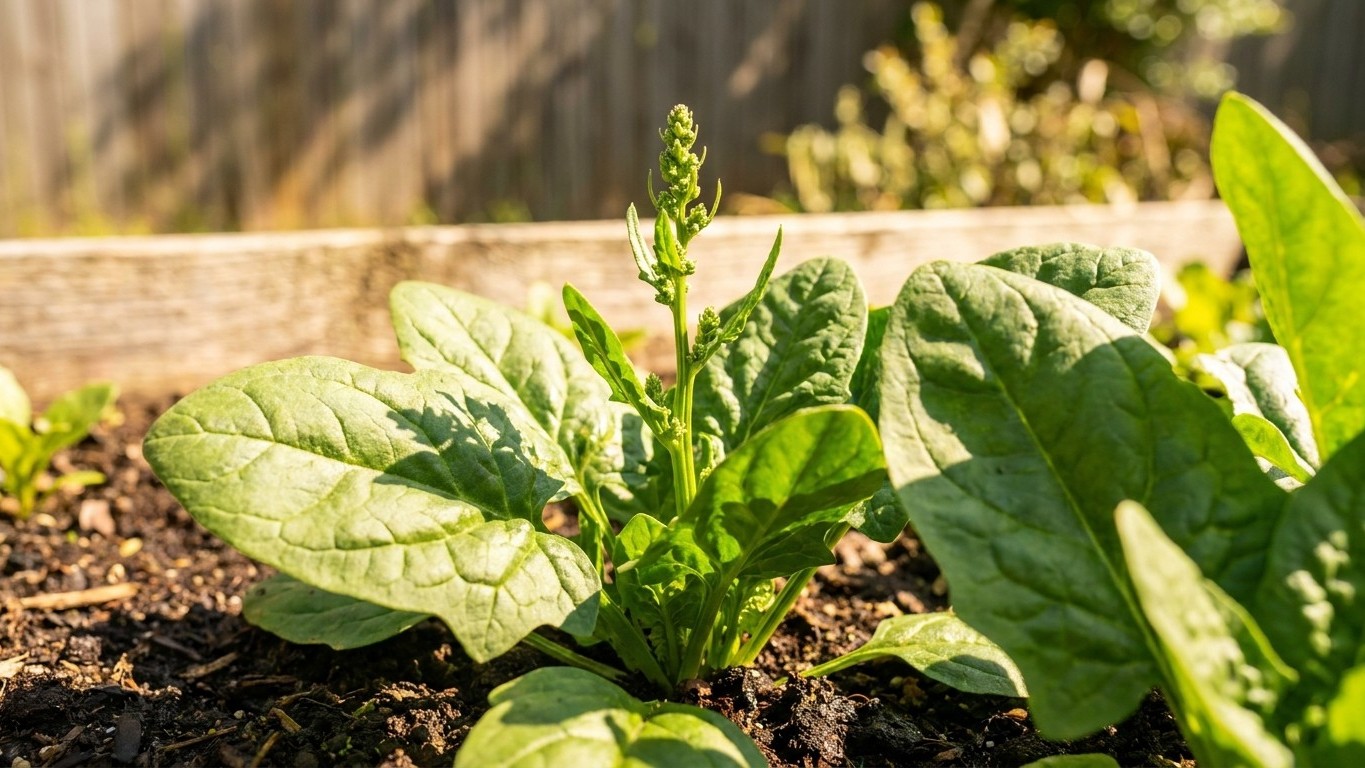

In Mississippi, spinach runs out of calendar long before anything chews it. Heat past 75 F and long days both push the plant to flower, and the longest day of the year here brings 14 h 07 of daylight, so even a mild summer won’t rescue a spring crop. That leaves two short windows: late winter into spring, and autumn once the soil drops below 80 F. This page counts both. The full crop guide is Growing Spinach in Mississippi. Pests are not covered, because the sources behind this page publish no pest data.
The short answer
On the longest day of the year, the reference city of Jackson gets 14 h 07 of daylight. That figure is calculated from the station’s latitude and counts only the geometric horizon, so real daylight runs about seven minutes longer. The days stretch toward that peak all through spring, and spinach is reading them.
Utah State University Extension states it flatly: spinach bolts during long days and warm temperatures. Long days alone are enough to trigger flowering. A cool, wet June in Mississippi changes what the thermometer says, but it doesn’t change the sun’s schedule. The plant still gets its long days, and a cool summer does not buy extra weeks. (A cool northern summer doesn’t buy them either, if the days there are long enough.) The brief version: Will Spinach Bolt Early in Mississippi? It can, and this page explains why.
So which one is the limit here, day length or heat? Both. They stack, and Mississippi supplies plenty of each.
Heat first. The reference station averages 71.1 days a year at 90 F or higher. That is more than ten weeks’ worth of days, scattered through the year and clustered in summer. Spinach grows best where temperatures do not exceed 75 F, and that number does double duty. It is the ceiling for good growth and also the point where the leaves turn bitter. Same number, two consequences. It is not a calendar date, either. It is a thermometer reading, and in a Mississippi spring it arrives on its own schedule.
Warm soil is a third pressure, and it hits at a different time of year. Seed germination is reduced when the soil is above 80 F. That barely matters in February. It matters a great deal in September, which is why the autumn crop is blocked by warm soil, not by cold.
One caution on the dates used below. Last and first frost come from NOAA NCEI climate normals for the Jackson airport weather station: the last spring frost falls between March 6 and March 22, and the first fall frost between November 7 and November 22. Those are reference-city figures, not a statewide guarantee. Suburban and rural gardens typically see the last spring frost later and the first fall frost earlier, often by one to two weeks, and more at elevation. Check the figures for your own county before you mark a calendar.
How long the spring window really is
The standard advice is to sow spinach two to three weeks before the last frost. Against the Jackson range, that puts sowing between roughly February 13 (three weeks before March 6) and March 8 (two weeks before March 22). The sowing window itself is only about three and a half weeks wide. The growing time after that is shorter than most people hope.
Here is how to work out your own spring, in order:
- Find your county’s last frost. The Jackson range of March 6 to March 22 is the starting point, not the answer. If you garden outside the city, add a week or two to both ends.
- Count back two to three weeks. That is when seed goes in the ground. In Jackson terms, mid-February to the first week of March. A garden with a later frost sows later.
- Treat 75 F as the stop sign. Growth stops being good above it, and the leaves turn bitter. The sources here don’t date when Jackson crosses 75 F, so a thermometer in the shade near the bed is the honest tool.
- Harvest as you go, not at the end. The source publishes no days-to-maturity for spinach, so there is no verified number of weeks to wait. Start cutting leaves once the plants are big enough to use, because every week left in the bed is a week closer to heat and bolting.
- Pull the bed when it flowers. A plant that has bolted won’t go back to leaf production. Use that space for something that likes the heat.
Add it up and the usable spring is a matter of weeks, not months. It opens when frost is nearly done and closes when the days warm past 75 F. With 71.1 days a year at 90 F or higher, heat has a head start in Mississippi, and the lengthening days are already pushing the plant toward flowering while the weather is still pleasant. That is why spring sowing here favors the early end of the range. A gardener who sows in the first week of March instead of mid-February gives up days at the front of a window that is already short.
The autumn crop, and when the soil lets you sow
Autumn is the better season for spinach in Mississippi, but it comes with two obstacles that work in opposite directions. One holds the window shut in late summer. The other slams it in November. The planting dates are covered in When to Sow Autumn Spinach in Mississippi. Here is the reasoning behind them.
Warm soil blocks germination
Utah State University Extension reports that seed germination is reduced above 80 F soil. Air temperature is not the same thing. Soil in a Mississippi garden holds heat well after the afternoon highs ease, and in late summer it can stay above that line even when the nights start to feel pleasant. A bed that is warm to the touch at planting depth is a poor bet for a seed that germinates badly when hot.
The trap is the date on the calendar. Early September feels like fall to a lot of people, but the rule is about soil, not the month. In a hot region the window opens when the soil falls below 80 F, not when the calendar says so. A cheap soil thermometer pushed in a couple of inches deep, read in the morning, settles the question better than any date.
Frost closes the window
The other end is the frost that ends the season. The reference-city first fall frost falls between November 7 and November 22. Rural and suburban gardens often see it a week or two earlier, so your own date may sit near the start of that range or before it.
The source gives one rule for a fall crop: plant 50 to 75 days before the date you want to harvest. It publishes no days-to-maturity for spinach, so that range is all there is to work with. Count back from a realistic harvest date. Take November 7, the early end of the Jackson range. Fifty days back lands on about September 18, and 75 days back on about August 24. For November 22, the later end, the same count gives about October 3 and September 8.
Read those dates against the soil rule and the squeeze is clear. The early part of the count falls in the warm-soil zone, so in practice the usable sowing days are the ones where the soil has cooled and the count still clears the frost. Today is October 1. A sowing made now would reach harvest between roughly November 20 and December 15 by that same count, which is past the reference frost range. A garden that frosts earlier would run out of calendar sooner still.
Four varieties are named in the source: Bloomsdale, Melody, Teton and Olympia. It publishes no data about any of them, such as bolt resistance or maturity, so there is nothing here to rank them by.
Common questions
Does a cool summer give spinach more time in Mississippi?
No. Long days alone trigger flowering, and the longest day here brings 14 h 07 of daylight. Cool weather helps with heat and bitterness, but it does not change the day length. The two pressures stack, so a cool spell can delay trouble but not cancel it.
Which variety should I plant?
The source names Bloomsdale, Melody, Teton and Olympia and publishes no data about any of them. Whether one bolts later, matures faster or tolerates heat better is not documented in the sources used here, so any ranking would be a guess. Ask your county extension office what has performed locally, and treat the sowing date as the bigger lever.
How do I know when the soil is cool enough in fall?
Measure it. Germination is reduced when soil is above 80 F, so wait until a soil thermometer, read a couple of inches down, sits below that line. Then check the count: 50 to 75 days from sowing must land before your county’s first fall frost. The reference-city range of November 7 to November 22 is a starting point, and rural gardens often run one to two weeks earlier.
How long does harvested spinach keep?
Treat two weeks as a ceiling, not a plan. UC Davis Postharvest says optimum conditions are 32 F and 95 to 98 percent relative humidity, and that spinach “will not maintain good quality for more than 2 weeks.” Decline is faster at 41 to 50 F, which is about what a home refrigerator door holds. Store it at the back of the bottom shelf, the coldest spot, in a bag or container that holds moisture. The details are in the UC Davis spinach fact sheet.