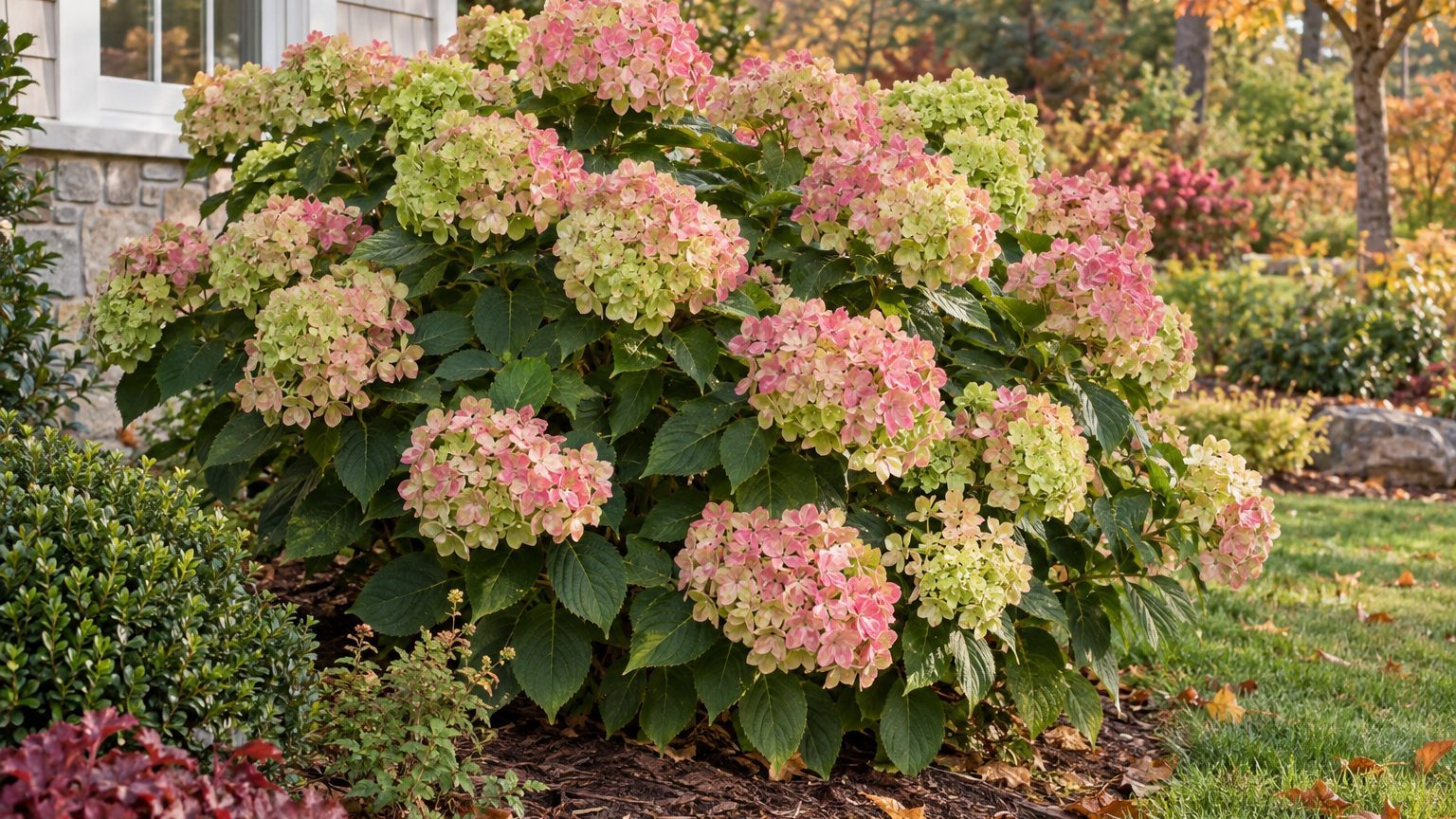

Pistachio is a bigleaf hydrangea, a mop-head bred for dark rose and lime-green blooms and sold as a reblooming variety. It has no days-to-maturity figure, because a shrub does not ripen in one flush the way a tomato does. What decides success is whether last year’s flower buds survive winter and spring where you garden. This page crosses that one fact with hardiness and care, and it says plainly where the catalogue never measured anything.
What Pistachio actually is
The mechanism starts the summer before you see a flower. Bigleaf hydrangeas form their buds on last year’s wood, so the blooms you get in June were already sitting on the stems through the winter. Anything that kills those buds, whether a hard cold snap, a late spring frost or a spring pruning, removes the flowers for the year. That single habit explains most of the care advice below.
The source, the North Carolina Extension Gardener Plant Toolbox entry for hydrangea, lists USDA zones 6a through 11b for this type, and describes the cultivar as a rose-and-lime-green mop-head that reblooms. Bigleaf hydrangeas run 3 to 6 feet tall and wide, so plan a footprint that size, not the footprint of a nursery pot. The same source rates the growth rate as rapid for bigleaf and the maintenance as low.
Two things the catalogue does not give. There is no days-to-maturity figure, from transplant or from anywhere else. And the source gives no staking guidance for this cultivar, so none is claimed here.
What Pistachio is good for

Not the kitchen. The source documents no flavor note or culinary use for Pistachio. Bigleaf hydrangea is documented as toxic, but only if eaten in large quantities.
The mechanism is chemical. Bigleaf hydrangea carries hydracyanosides, a type of cyanogenic glycoside, in the bark, flowers, leaves and stems. Eating a large amount can bring on nausea, stomach pain, vomiting and sweating. The same source flags it as a problem for cats, dogs and horses. This is not a reason to rip the shrub out. It is a reason to keep it out of the salad bowl and to know where a curious dog might chew.
So what is it good for? Color and structure, mostly. The source does not say how many flushes to expect or how a second one behaves, so treat the first flush on last year’s wood as the one you can count on.
Bigleaf does best in dappled sun or partial to deep shade, and the source says to protect it from afternoon sun. That makes it a candidate for the north side of a house, the edge of a woodland bed, or a spot shaded by a taller tree. The source also notes that native bees nest in dead hollow stems of hydrangeas and advises leaving stems standing, cut to 12 to 24 inches, until they disintegrate. A tidy gardener and a bee-friendly gardener can disagree about that, and I side with the bees.
Where it ripens in time, and where it is a gamble
The catalogue gives no days to maturity and no frost-window figures for named weather stations, so there is no honest table of reference cities here. What you can do is run the arithmetic for your own yard in three steps.
First, check your zone against the type’s range. Pistachio is listed for USDA 6a through 11b, so a garden in zone 5 or colder sits outside that range, even though the genus as a whole is listed from 3a through 9b. Second, look at the gap between your average last spring frost and the date your hydrangeas leaf out. Buds that formed last summer are still tender when growth starts, and a frost in that gap is what turns a good winter into a bloomless June. Third, count your spring pruning: if you cut a bigleaf back in March, you have already lost the flowers, whatever the weather did.
The comparison with other types shows why the answer depends on type:
| Type | Flowers on | Hardiness in the source |
|---|---|---|
| Bigleaf / mop-head (Pistachio) | Last year’s wood | USDA 6a-11b |
| Panicle | Current season’s growth | USDA 3a-8b |
| Smooth (e.g. Annabelle) | New wood | The hardiest of the genus (no zone range given here) |
| Climbing | Old wood | Not given here; very slow to start flowering |
The practical reading: in the warm end of the range, Pistachio has the most comfortable margin, because buds on last year’s wood rarely meet a killing cold. Toward the cold edge of 6a, it becomes a gamble that you replay every spring. The source calls the panicle type a good substitute for the mop-head where the mop-head is not winter hardy, so colder gardens have an out. The pages on Tardiva Hydrangea: When to Plant the Tomatoes That Ripen All at Once and Bobo Hydrangea: When to Plant the Tomatoes That Ripen All at Once cover panicle options, and the Hydrangea Varieties hub lines them up side by side. The Climbing Hydrangea Hydrangea: When to Plant the Tomatoes That Ripen All at Once page is the one to read if you want a very different, slow-starting plant on old wood. Exact frost dates and pruning timing for your zone belong on the per-state pages.
The two ways a season goes wrong
The source gives no heat or cold-set thresholds for bigleaf hydrangea, so none are borrowed from tomatoes. A hydrangea has its own two failure modes, and both come back to last year’s wood.
The first is cold damage to the buds. A mop-head can come through winter looking alive, with green growth in spring, and still produce nothing because the buds formed the previous summer were killed. A late frost after the plant has woken up does the same thing. This is why the zone range and your local last-frost timing matter more for Pistachio than any rate of growth.
The second is pruning at the wrong moment. Because flowers sit on old wood, cutting back in late winter or spring removes them. A panicle, by contrast, flowers on the current season’s growth and can be cut back hard in late winter. For this cultivar the rule is to prune right after flowering.
Which one matters more? Cold damage, because you can control the pruning but not the weather. Pruning errors are fixable next year, while a killed bud set is gone until the plant makes new wood and buds. Sun matters too: the source says to protect bigleaf from afternoon sun, and heat and dryness stress could compound cold damage by weakening the plant going into winter. That last link is an observation, not a documented figure.
What it resists, and what it does not
The catalogue entry for Pistachio lists no disease resistance at all, neither high nor intermediate. Treat it as unprotected, because silence is not a rating.
The source names a short list of diseases for the genus: leaf spot, bacterial wilt and powdery mildew. It names rust and bud blight on panicle hydrangeas specifically, which is not a bigleaf concern in this source. Powdery mildew and leaf spot are the ones most likely to show up as spotting or a white film on leaves. Spacing plants so air moves between them and watering at the base, not overhead, are sensible habits, but they reduce risk and do not remove it.
The source lists aphids, scales, nematodes and mites and calls them rarely a problem. Deer damage the plant, though the source also lists deer under resistance to challenges on the genus page, and the two entries disagree. What gardeners observe is that hydrangeas get browsed, so do not count on deer resistance. If deer visit your yard, fence or protect new growth, since browsing the buds on old wood can cost you the season’s flowers.
Growing it without the usual mistakes
The plan is to protect the buds and keep the roots comfortable. Bigleaf is shallow-rooted, and the source says it benefits from mulch. Soil can be clay, loam or sand, with good drainage; occasionally wet is acceptable.
Give it room for its full 3 to 6 feet in both directions, and place it where afternoon sun is blocked. Planting too close to a wall or a neighbor invites you to prune it back, and cutting at the wrong time is the mistake this plant invites. Never apply panicle advice, such as a hard cut in late winter, to a bigleaf.
Color and feeding
Bigleaf flowers shift with soil pH: blue below about 5.5, pink above about 6.5, and purple in between. Pistachio is catalogued as dark rose and lime green, and the source does not document whether it turns a clean blue, so expect the type’s rule to apply but not a guaranteed shade. Aluminum sulfate acidifies the soil and lime makes it more alkaline, and the plant needs available aluminum, which acidity releases.
Kitchen remedies disappoint. The source mentions coffee grounds and citrus peel as ways to turn flowers blue, but that is a widely held belief, not a method. The pH shift from coffee grounds is very small, so very little aluminum becomes available. Feeding matters as well: high-phosphorus fertilizer locks aluminum up in the soil, which pushes blue toward pink.
If you want more plants, the source lists stem cuttings and layering for propagation. Seed is documented only for panicle types.
Common questions
Is Pistachio hydrangea edible?
No. Bigleaf hydrangea is documented as toxic if large quantities are eaten, and it is also a problem for cats, dogs and horses. The source records no flavor or culinary use.
Will Pistachio bloom in my zone?
The type is listed for USDA 6a through 11b, so a garden in that range can grow it. Whether it blooms in a given year depends on whether the buds on last year’s wood survive winter and late frost. Your state page gives local detail.
Does the color change with soil?
Yes, for bigleaf. Flowers lean blue below about pH 5.5 and pink above about pH 6.5. Coffee grounds barely move pH, so soil testing and aluminum sulfate are the reliable levers, and high-phosphorus fertilizer pushes toward pink.
Do deer leave it alone?
Do not count on it. The source lists deer as damaging hydrangeas, and browsing is what gardeners observe. Browsed buds on old wood can mean a season without flowers.