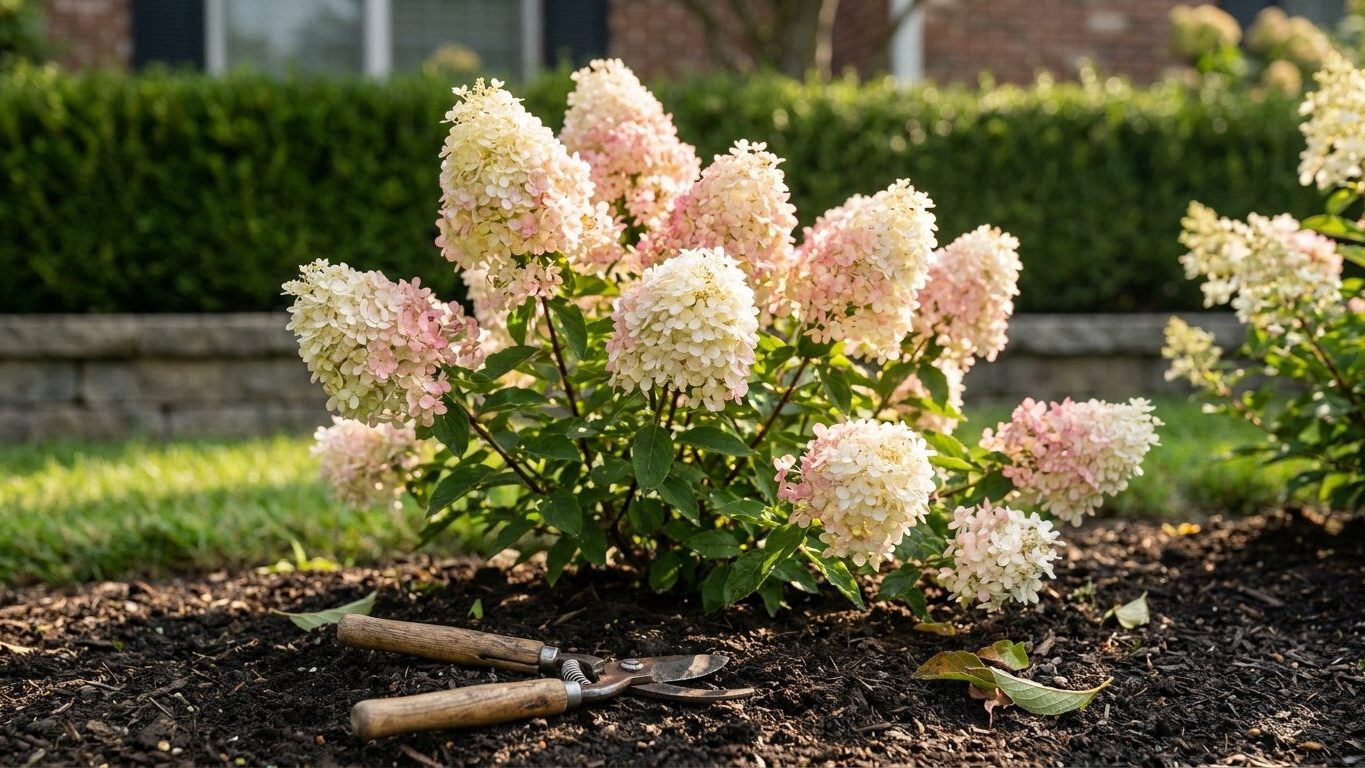

Bobo is a dwarf panicle hydrangea, hardy from USDA zone 3a through 8b, and it flowers on the current season’s growth rather than on wood set the year before. That single fact decides almost Everything else: where it survives winter without special protection, how hard you can cut it back, and why its flower color has nothing to do with your soil.
What Bobo actually is
Bobo belongs to Hydrangea paniculata, the panicle group, and the North Carolina Extension Gardener Plant Toolbox lists its hardiness as USDA zones 3a to 8b, the same range as the species. The source describes the cultivar plainly: “panicule nain, tres florifere,” a dwarf panicle that blooms heavily. That matters because full-size panicle Hydrangeas run 8 to 25 feet tall, and the source doesn’t give an exact height for Bobo itself beyond the dwarf descriptor, so treat “compact” as the confirmed fact and any specific inches you see elsewhere as unverified here.
The bloom habit is the real headline. Panicle hydrangeas flower on wood grown that same spring, which the source calls “bois de l’annee.” Because of that, Bobo can be cut back hard while the plant is dormant without losing the coming season’s blooms, a freedom that bigleaf and oakleaf hydrangeas simply don’t have. Which month to do that cutting depends on your winter length and zone, so save the calendar decision for your state guide rather than a national one.
Color is the other fact worth settling early. Bobo’s flowers open white to cream and age through pink into tan as the season runs its course, and none of that shift is driven by soil pH. That coloring shows up on a schedule, not on a chemistry test.
What Bobo is good for

A dwarf panicle solves a specific problem: it gives gardeners the toughness and full-sun tolerance of panicle hydrangeas without the space commitment of an 8-foot shrub. The source notes that panicle hydrangea is “a good substitute for the mop-head hydrangea in areas where that species is not winter hardy,” and it’s the only hydrangea type the toolbox says takes full sun well. Bigleaf hydrangea needs zone 6a or warmer and prefers dappled shade, so anyone gardening colder than that, or working a bed that bakes in afternoon sun, has been steered toward panicle types by the plant itself. Bobo just does that job at a smaller footprint, which fits foundation plantings, small-yard borders, and large containers where a full-size paniculata would outgrow the space in three seasons.
The dense, aging flower heads also make Bobo a practical choice for cut and dried arrangements, since the color shift from cream to tan happens on the stem whether you leave the flowers outside or bring them in. Because the plant flowers on new wood, a hard annual cutback that would ruin a bigleaf hydrangea’s bloom year has no such cost here, so gardeners who want tight, controlled shapes near a porch or walkway can prune for form without gambling on flowers.
Low maintenance is the other selling point in the source’s own ranking: the genus overall rates low on care once established, and panicle hydrangeas grow rapidly compared to some of their cousins, meaning a young plant fills in fast. What Bobo won’t do is reward you for fussing over soil acidity in hopes of blue flowers. That effort belongs to bigleaf and mountain hydrangeas, not this one, and spending it here changes nothing but your schedule.
Where it ripens in time, and where it is a gamble
Zone 3a to 8b covers most of the continental United States outside the coldest interior pockets and the hottest coastal strip of the Deep South. Reading a hardiness range is simple arithmetic: find your zone, and if it falls inside 3a to 8b, the source’s documentation backs your planting decision without qualification. Fall outside it in either direction, and you’re working past what’s been verified.
On the cold end, zone 3a reaches into the Upper Midwest and the northern Plains, places like Minneapolis, Minnesota, which typically sits around zone 4b to 5a on the USDA map, comfortably inside Bobo’s documented range. Denver, Colorado, in the 5b to 6a band, and Richmond, Virginia, around zone 7a, both fall well within the same window. Atlanta, Georgia, sits near 7b to 8a, close to the range’s upper edge but still inside it.
The trouble starts past 8b. Charleston, South Carolina, and Houston, Texas, both run around zone 9a, and Miami, Florida, sits near 10b. All three are outside the range the source documents for panicle hydrangea. That’s exactly the territory where the source’s own comment about substitution flips direction: bigleaf hydrangea is rated to zone 6a through 11b, so in the hottest parts of the Gulf Coast and peninsular Florida, the mop-head types pick up where Bobo’s documented hardiness runs out.
| Region | Reference city | Typical USDA zone | Fits Bobo’s 3a-8b range |
|---|---|---|---|
| Upper Midwest | Minneapolis, MN | ~4b-5a | Yes, comfortably inside |
| Mountain West | Denver, CO | ~5b-6a | Yes |
| Mid-Atlantic | Richmond, VA | ~7a | Yes |
| Piedmont South | Atlanta, GA | ~7b-8a | Yes, near upper edge |
| Coastal Lowcountry | Charleston, SC | ~9a | Outside documented range |
| Gulf Coast | Houston, TX | ~9a | Outside documented range |
| South Florida | Miami, FL | ~10b | Outside range; bigleaf zone instead |
The two ways a season goes wrong
A hardiness zone tells you whether the plant survives winter. It doesn’t tell you the whole story of a good bloom season, and panicle hydrangea has failure modes on both ends of the map that the zone number alone won’t show.
At the cold edge, around 3a, winters routinely kill Bobo’s stems back to the ground or close to it. That’s not a disaster for flowering the way it would be for a bigleaf hydrangea, because Bobo blooms on wood grown fresh that spring, not on stems that survived winter. What the source doesn’t quantify is how a short northern growing season interacts with bloom timing in extreme cases, so treat that as a real variable your state’s climate page can speak to than a national one can.
At the warm edge, above 8b, the documentation simply stops. The source doesn’t say what happens to Bobo in zone 9 or 10 winters, whether the plant survives, blooms poorly, or behaves normally. Given that panicle hydrangeas are shallow-rooted and rely on mulch to buffer soil temperature and moisture, gardeners past 8b are working without a documented safety margin rather than against a specific, named limit. For a plant whose whole identity rests on flowering reliably from new growth, the cold-edge risk is the dieback itself, survivable, while the warm-edge risk is the open question of whether the plant thrives at all.
What it resists, and what it does not
The source lists disease pressure at two levels: genus-wide problems that apply to hydrangeas generally, and issues called out specifically for panicle types. Across the genus, the toolbox names leaf spot, bacterial wilt, and powdery mildew. For paniculata specifically, it adds rust and bud blight to that list. Nowhere does the source grade Bobo, or panicle hydrangea generally, as resistant to any of these; it simply names them as known problems for the type, which means the practical assumption should be exposure, not immunity.
On pests, the picture is calmer. Aphids, scales, nematodes, and mites are all listed, but the source calls them “rarely a problem” for the genus. Deer are a different matter entirely. The same source lists deer as a damage agent on one part of its listing and mentions resistance to challenges elsewhere on the genus page, which is a contradiction worth naming rather than smoothing over. The honest read is that hydrangeas get browsed by deer in practice, so calling any type “deer resistant” overstates what’s documented.
Nothing in the source claims Bobo or panicle hydrangea carries elevated resistance to any of these diseases or pests beyond the rest of the genus. If a nursery tag or a garden center claims otherwise, that claim isn’t backed by the extension source used here.
Growing it without the usual mistakes
Because Bobo flowers on the current season’s wood, the single most common mistake gardeners bring over from bigleaf hydrangea, pruning lightly out of fear of losing next year’s flowers, doesn’t apply here and actually works against you. A hard cutback while the plant is dormant clears old growth and tends to produce a fuller flush of new stems and blooms, though the exact timing depends on your local frost pattern and belongs on a state-specific page rather than a national guide.
Soil is forgiving by the source’s own description: Bobo tolerates clay, loam, or sand, and a pH anywhere from acid through alkaline, provided drainage is decent (occasional wetness is fine, standing water is not). Since color doesn’t shift with pH for this cultivar, skip the aluminum sulfate and lime treatments entirely. That effort belongs to bigleaf and mountain hydrangeas, and using it here just wastes a season’s fertilizing budget on a plant that won’t respond.
Both macrophylla and paniculata are shallow-rooted, so a mulch layer around Bobo does real work, buffering soil temperature swings and holding moisture the roots can’t reach deep for themselves. Propagation runs through stem cuttings or layering, and paniculata is one of the few hydrangea types that also grows reliably from seed. If you value the plant for wildlife as well as looks, leave spent stems standing at 12 to 24 inches through winter rather than cutting to the ground; native bees use those hollow stems to nest, and they’ll disintegrate on their own over time.
Common questions
Does Bobo hydrangea change color like other hydrangeas?
No. Color response to soil pH is a bigleaf and mountain hydrangea trait. Bobo, as a panicle hydrangea, opens white to cream and ages to pink and then tan regardless of soil chemistry.
When should I prune Bobo hydrangea?
It flowers on current-season wood, so it can be cut back hard while dormant without losing that year’s blooms. The exact month depends on your winter length and zone, which is a decision better made from your state’s growing guide than from national averages.
Is Bobo hydrangea toxic to pets?
The documented toxicity in the source applies specifically to Hydrangea macrophylla, the bigleaf type, and only in large quantities. Bobo is a panicle hydrangea, a different species, and the source doesn’t extend or test that toxicity finding for paniculata, so no toxicity data exists here either way.
How big does Bobo hydrangea get?
The source describes it as a dwarf panicle cultivar without giving exact mature dimensions. For context, the species range for panicle hydrangea generally runs 8 to 25 feet, but Bobo is bred to stay well under that, and precise figures for this cultivar aren’t part of the documented source.