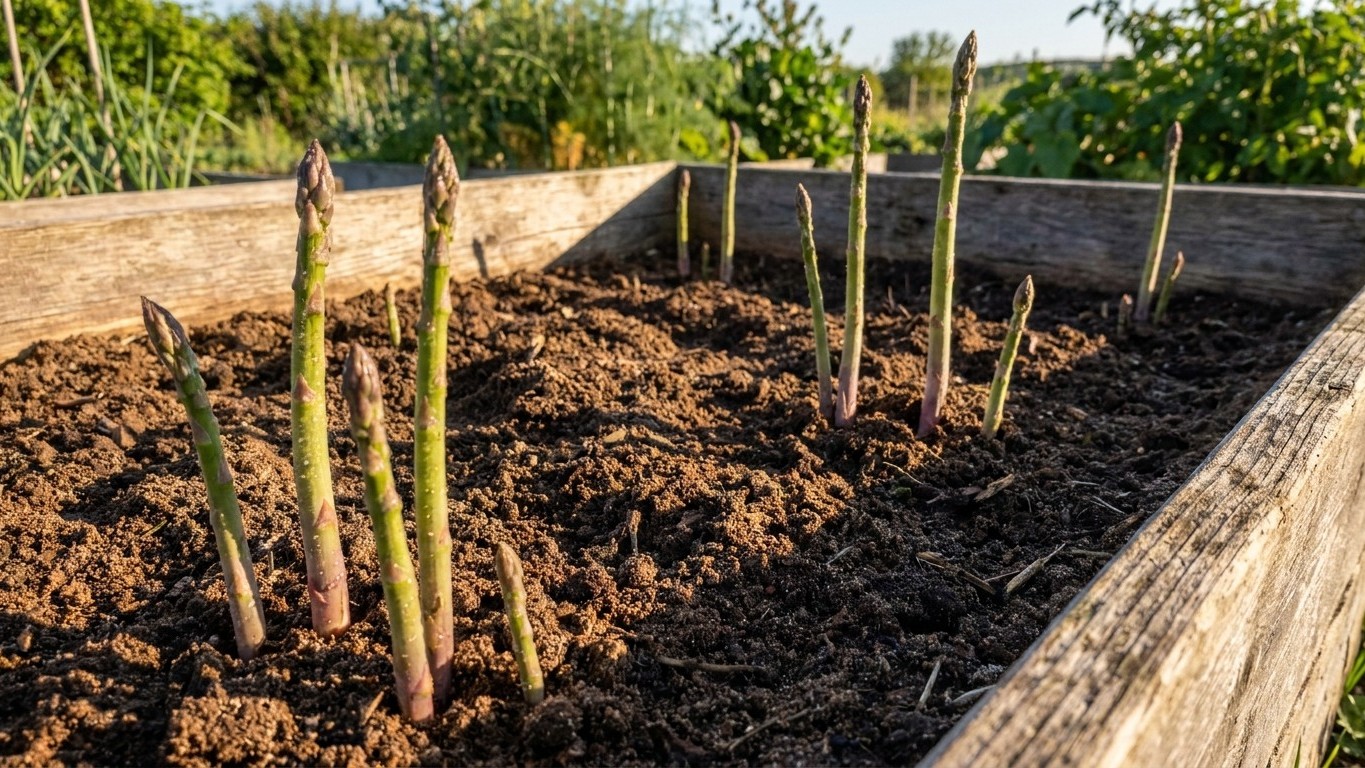

The sources behind this page name no pests and give no calendar for them, so any list of insects with dates would be invented. They do pin down the clock a Minnesota bed runs on. Crowns go in around late April, nothing is harvested until year 3, and the bed then produces for 10 to 15 years. The first appetite to hold back is your own. For insects, ask your county extension office. Growing Asparagus in Minnesota covers the wider picture.
The short answer
An asparagus bed is the one planting on this site that you choose for 10 to 15 years. Utah State University Extension, the source for this page, asks for one thing from the ground: that it drains. Most soils will do, it says, provided they are well drained. Crowns go into 8-inch furrows, so they sit at the bottom of a trench, which is the first place standing water collects. In a tomato bed, heavy soil is a nuisance you amend each season. Here it is a decision you can’t undo.
Minnesota’s state soil is the Lester series, an Alfisol, which is a forest soil of moderate fertility that holds nutrients reasonably well. USDA records the representative surface values across 251 mapped components. The texture is loam to silt, at 39 percent sand, 24 percent clay and 37 percent silt. Organic matter is about 3.0 percent, surface pH is about 6.6 (near neutral), and the soil is well drained. Nothing in those numbers points to a soil that sits wet. On this evidence the state’s dominant ground drains well enough for a long-lived bed.
But a state soil is a starting point, not a diagnosis. Lester represents Minnesota. It is not the ground under your fence line. River bottoms, hill country and any lot a builder has scraped or filled can behave completely differently, and Minnesota spans hundreds of soil series. Treat the numbers above as what the region’s ground tends to do, then get your own from a soil test. The 6.6 is a figure for the series’ mapped surface, not your pH. The Utah State source says nothing about pH for asparagus, so don’t read 6.6 as a target either.
If your spot does not drain, move the bed. Fixing a wet site after the crowns are in means digging up a plant that has already cost you years. The cheaper test comes first. Dig a hole where the bed would go, fill it with water and watch. If it drains slowly, that is a warning. The other option is a bed built up above the surrounding grade, which is my suggestion, not something the source covers. Either way, decide before planting.
For a sense of the commitment, nothing is harvested until year 3. The 10 to 15 productive years begin after that. For the soil question in more depth, see Will Minnesota Soil Hold an Asparagus Bed for Fifteen Years?
Will the summer here water it for you?
Partly. The bed wants 1 to 2 inches every other week for the first two years, then every three weeks after that. The Twin Cities reference station normals (NOAA NCEI, thirty-year averages) show about 13.0 inches of rain across June, July and August, out of 31.6 inches for the whole year. That is roughly 41 percent of the annual total landing in three months. By month, June brings 4.58 inches, July 4.06 (the driest of the three) and August 4.34.
Spread evenly, 13.0 inches over a summer works out to about an inch a week, or roughly 2 inches per fortnight. On paper that meets the top of what the bed asks for. Rain doesn’t arrive evenly, though, and these are normals for one station, not a forecast and not your garden. Here is how to turn them into a routine:
- Years one and two: aim for 1 to 2 inches every other week, counting rain and hose water together.
- Put a rain gauge on the plot. It settles the question better than any regional average, because slopes, tree cover and city blocks all shift what a garden actually receives.
- Subtract what fell. In a fortnight that matches the normal, you add little or nothing. In a dry stretch, you supply the full 1 to 2 inches yourself.
- Discount the storms. A single thunderstorm mostly runs off rather than soaking in, and days at or above 90°F drive evaporation. An inch in the gauge after a downpour is worth less than an inch from a slow, steady rain.
- From year three: stretch the interval to every three weeks.
Soil changes the arithmetic. Lester sits between sand and clay, so it neither dumps water within the day nor holds it for a week. A sandy lot in the same county would need water more often, because rain passes through a sandy surface quickly. A clay lot holds it longer, which is another reason drainage decides the bed’s fate before watering does.
When to put the crowns in
Early spring. In the Twin Cities, the last 32°F freeze falls around April 17 to April 30, based on NOAA NCEI normals (the 30 to 70 percent probability band, so it is an average and not a promise). Early spring planting there lands in the same weeks as that last freeze. A late cold snap in May is entirely possible, and a mean date can’t rule it out.
The Twin Cities are the mild south of Minnesota. Northern Minnesota runs two to three weeks tighter at both ends of the season, so a northern gardener should expect to plant later than the dates above. Treat the Twin Cities window as the earliest reasonable reference, not the statewide rule. The timing guide for planting crowns in Minnesota goes further on how to read your own frost dates.
Crowns go into 8-inch furrows, and the furrow fills in gradually over the year, not all at once. Backfill 2 inches every other month. Rushing it buries the crown under soil it can’t yet push through. The trench is deep because the plant will live there for a decade or more, so it is worth planting once and carefully.
Seed is the alternative route. The source behind this page gives no sowing date for seed, so none is offered here. It names four varieties and says only whether each is male or female. Jersey Giant and Jersey Knight are all-male. UC 157 F1 and Purple Passion are male and female. Nothing is published on flavor, yield or any reason to prefer one over another, and I won’t invent one. No nursery is recommended here either.
Common questions
Which insects eat asparagus in Minnesota, and when?
The sources used for this page don’t say, and a guessed pest calendar would be worse than none. What is published is the setup that gives a bed its best chance: well-drained ground, steady water for the first two years, and no harvest until year 3. For pests, your county extension office is the right next call.
When can I start picking spears?
Not until year 3. Then harvest for 4 weeks, the following year for 6, and the year after that for 8. Don’t soften that into taking a few spears early. The end-of-harvest rule is a spear, not a date: stop when most of the spears are thinner than a pencil.
Does the variety matter?
The source names four, with sex only: Jersey Giant and Jersey Knight (all-male), UC 157 F1 and Purple Passion (male and female). It publishes no flavor, yield or other reason to pick one, so any ranking would be opinion.
How do I keep cut spears fresh?
The window is narrow, and both edges bite. UC Davis Postharvest gives an optimum of 32 to 35°F with 95 to 100 percent relative humidity. Above 50°F, spears toughen within hours. At about 31°F or below, they freeze and collapse on thawing. In a home kitchen, standing the butts in water or wrapping them damp is the practical way to reach that humidity, since spears lose water fastest through the cut end. The full figures are at the UC Davis Postharvest fact sheet for green asparagus.