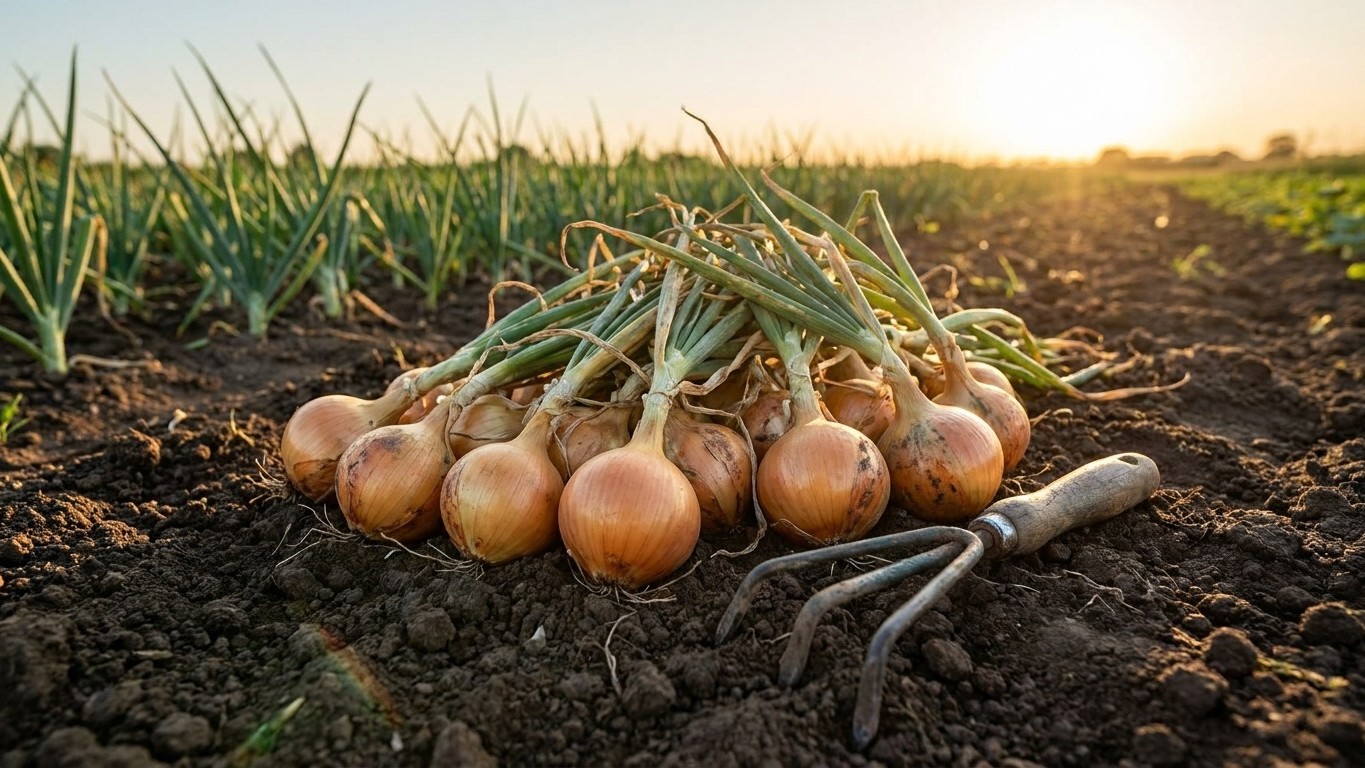

Lift onions in Maine when the tops fall over and the necks go soft, not on a date. Then cure them: spread the bulbs somewhere dry and airy until the necks are tight and the skins turn papery. Only after that do they go into storage. Skip the curing and bulbs that looked perfect in the garden start rotting well before winter ends. Maine’s long summer days favor onions that keep, and the weather in the weeks after lifting decides how well they do.
The short answer for Maine
Portland, the reference city for the figures on this page, sits at 43.65 degrees north. Its longest day, at the June solstice, runs 15 h 15 of daylight. That number matters more than any temperature reading, because day length, not warmth, tells an onion to stop making leaves and start making a bulb. A short-day variety starts bulbing at about 12 hours. A long-day variety waits for 14 to 16. Portland’s 15 h 15 falls inside the long-day window, so long-day onions bulb here, and they do it in midsummer, after a long stretch of leaf growth. (The daylight figure is calculated at the geometric horizon, so real daylight runs about seven minutes longer.)
That sequence explains the harvest. Each leaf the plant grows before bulbing begins becomes one layer of the bulb. Big, healthy tops in June mean a big bulb in August. Once bulbing is done, the plant has nothing left to do, and the tops give the signal.
Reading the tops
Lift when most of the tops have flopped over and started to yellow, and the necks (the soft stem just above the bulb) have gone slack. Pick a dry day. Ease the bulbs out with a garden fork rather than yanking by the tops, since bruises and nicks are where rot starts later. Leave the tops on. A calendar date for lifting is not published here, because it depends on your planting date and variety, so let the plants set the day.
Curing, step by step
Curing comes before storage, always. Lay the bulbs in a single layer where air moves and rain cannot reach: a covered porch, a garage with the door open, a barn bay, a screen propped on sawhorses. The goal is a tight, dry neck and papery outer skins. Nothing else tells you the job is finished, and the time it takes swings with the weather, longer in a muggy August than a dry one. When the necks are tight, trim the tops and roots, brush off loose dirt (no washing), and move the bulbs to storage.
Ideal storage conditions, according to Clemson Cooperative Extension, are between 45 °F and 55 °F, and 50 to 60 percent humidity. Onions want it dry. That is the opposite of carrots and other roots, and the reason one cellar corner rarely suits both.
What will not work here
The failure in Maine runs opposite to the one in the Deep South. Southern gardeners who plant long-day onions get leaves all season, no bulb, then rot, because the day never gets long enough. At 15 h 15 on the longest day, a Maine garden does not have that problem. Its problem is the reverse: short-day types, which bulb at about 12 hours, switch on early, while the plant is still small, and stay small. Day length passes 12 hours in spring, long before a Maine onion has grown a full set of leaves. The bulb is whatever the plant managed to build by then.
Here is what to leave out, and why:
- Granex-type short-day onions (the Vidalia family): bulbing starts at about 12 hours, so they size up early and stay small, and their low sulfur content means they do not keep.
- Texas Grano-type short-day onions: same trigger, same result, a small early bulb from a plant that never had time to grow tops.
- Any onion transplanted late: planting late does not delay the harvest, it shrinks it. Day length triggers bulbing on schedule whatever the plant’s size, and that size is the size of the bulb.
- Uncured bulbs carried straight to the cellar: wet necks are open doors for rot, and one bad bulb can spoil a crate.
- Onions stored beside carrots, beets or potatoes in a damp root cellar: the humidity that keeps roots crisp is far above the 50 to 60 percent onions need.
For a list of long-day varieties that suit this state, see The Best Onion Varieties for Maine. For the broader picture of growing them here, start with Onions in Maine.
What changes across Maine
Maine is not one latitude. The state stretches a long way north of Portland, and a bit south of it along the New Hampshire line. The exact latitudes for your town are not published here, so look yours up; every figure in this article belongs to Portland at 43.65 degrees north. What the difference does is shift the details, not the group of onion you grow.
| Where | Latitude and longest day | What it changes |
|---|---|---|
| Portland (reference) | 43.65 degrees north, 15 h 15 | Long-day onions bulb in midsummer; baseline for all advice here |
| Further north (inland, Aroostook, the western mountains) | Higher latitude, so a longer longest day than 15 h 15 | Long-day types are safer still; the real pressure is a shorter season, so lifting and curing happen sooner and under cooler nights |
| Far southern coast | Slightly lower latitude, so a slightly shorter longest day | Still comfortably long-day territory; a bit more room before the season closes |
The far north gets more summer daylight than the south, which is why northern gardens grow long-day onions without trouble. A Maine grower near the Canadian border will not drift into the short-day group. The shift is practical: transplants have less time to get big before bulbing, the lifting window comes earlier, and curing happens in cooler air. A coastal reader and a northern one can plant weeks apart in the same year and both be right.
Frost dates are also different in each corner of the state, and this page does not carry a figure for any of them. Treat any state-wide date you read, including ones from elsewhere, as a starting point and not a rule for your garden.
Sweet now, or onions that last
You cannot have both from one onion. The sharp bite comes from volatile sulfur compounds, and those same compounds protect the bulb in storage. A sweet variety carries fewer of them: better raw, but it will not last the winter. The University of Missouri Extension puts it plainly in its onion guide (G6355): “As a rule, ‘sweet’ onions do not store as well as the more pungent types.”
Day length lines up with this trade. Short-day types run sweeter and long-day types keep longer. A southern garden hands you onions to eat soon. A northern one hands you onions that feed you into March. Maine, with its 15 h 15 longest day at Portland and more as you go north, sits firmly on the long-keeping side.
Picture the pantry in March. A well-cured, long-day crop kept at 45 °F to 55 °F and 50 to 60 percent humidity should still have firm, dry-skinned bulbs in the basket, sharp when raw and mellow once cooked. Any sweet types you grew will be long gone or soft, which is why you eat those first, in the weeks after curing. Sort the crop at lifting time: thick necks, nicks or any sign of damage go to the kitchen counter. For what chews on bulbs before they ever reach the cellar, see What Eats Onion in Maine, and When.
Checking this against your own garden
The numbers above belong to Portland. Before you rely on them, spend an hour this week confirming what applies to your own plot:
- Look up your latitude, especially if you garden well north of Portland, and compare it with 43.65 degrees north.
- Find your local frost dates through your county extension office. In Maine, that means University of Maine Cooperative Extension. This page does not publish a frost date.
- Check the seed packet or plant tag for the day-length group, and set aside anything labeled short-day.
- Put a thermometer and a hygrometer in the spot where you plan to store onions, and see whether it holds 45 °F to 55 °F and 50 to 60 percent humidity.
- Find your curing spot now: dry, airy, out of the rain, with room for a single layer.
A state is a big place, and Maine’s cellars range from bone dry to dripping. Your own readings beat any state-wide figure.
Common questions
How do I know the onions are ready to lift?
Watch the tops. When most have fallen over and begun to yellow, and the necks have softened, the bulbs have finished growing. Lift on a dry day and handle them gently.
How long does curing take?
This page does not publish a number of days, because it depends on the weather. The test is the bulb: the neck is tight and the outer skins are papery. Damp, cool weather stretches the process, so give it more time and good air movement.
Can I store sweet onions through winter?
Do not count on it. Sweet onions have fewer of the sulfur compounds that protect a bulb in storage, so they soften sooner. Eat them first and save the pungent ones for later.
Can onions share a cellar with carrots and potatoes?
Not well. Onions want 50 to 60 percent humidity, the opposite of what carrots and other roots need. Keep the onions in the driest, airiest spot you have, apart from the damp crops.