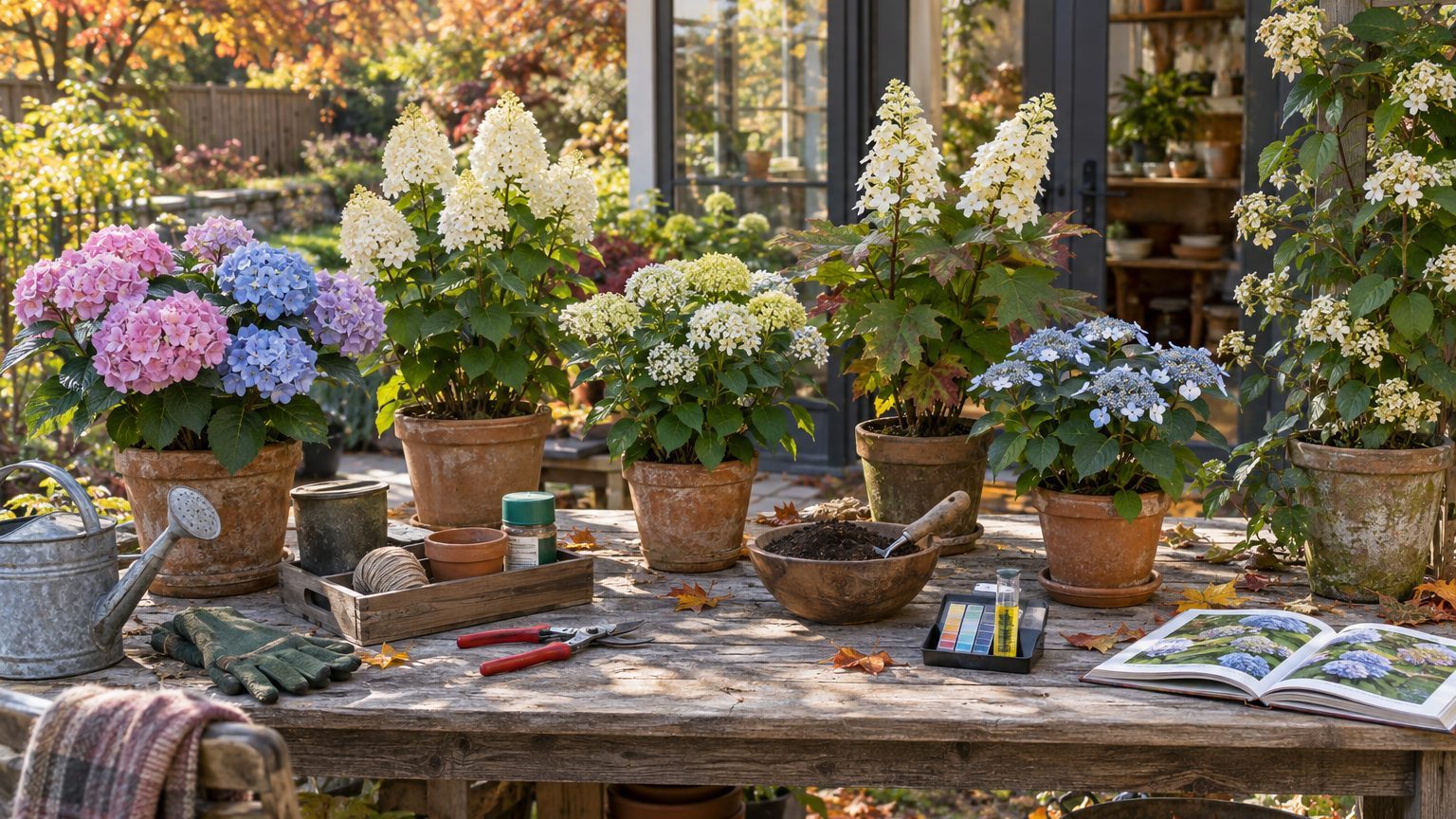

Hydrangeas come in six main types, and they disagree on almost everything: when they set buds, how much cold they take, how much sun they tolerate, and whether soil pH can change their color. Bigleaf, panicle, smooth, oakleaf, mountain and climbing each need their own handling. Advice that says “hydrangeas” without naming one will be wrong for somebody. Name yours first, and the rest of the care follows.
Why this matters
The split that matters most is where the flowers come from. Bigleaf (H. macrophylla), oakleaf, mountain and climbing hydrangeas bloom on old wood. Their buds form the summer before, so a late frost or a spring prune removes the flowers along with the stems. The shrub still leafs out and looks healthy, which is why this mistake can go unnoticed for a full season. Panicle and smooth hydrangeas bloom on the current season’s growth. A panicle can be cut back hard in late winter and still flower that year.
Hardiness splits the same way. The genus as a whole is listed for USDA zones 3a through 9b, according to the NC State Extension Gardener Plant Toolbox, but that range hides the real picture. Bigleaf is listed for 6a to 11b, while panicle runs 3a to 8b. Two neighbors can both say they grow hydrangeas and share almost no advice. Sun needs differ too: panicle is the only type that takes full sun well, while bigleaf wants dappled sun or shade and protection from afternoon sun. Your zone and your type together decide the local answer, and the per-state pages in this series cover that part. For the basics of keeping any of them alive, see How to Grow Hydrangeas.
When to do it
Identify the type before you cut, feed or amend anything. The best moment is when the plant is fully in leaf and the first flowers are open, because flower shape and leaf shape are both visible then. If you inherited the shrub with the house, one full bloom cycle will tell you more than any guess made from bare winter stems.
Then watch the growth pattern. On old-wood types, buds swell along last year’s stems in spring, and any stem that died back over winter takes its flowers with it. On new-wood types, fresh shoots rise from the base or from low on the stems, and flower buds appear at the tips later. That difference sets your pruning moment: for old-wood types, right after the flowers fade, so next year’s buds have time to form. For panicle, late winter while the plant is still dormant.
One patience note. Climbing hydrangea is very slow to start flowering, so a vine with no blooms after a few years may simply be young rather than mistreated. And color treatments belong on the calendar only for bigleaf and mountain. Check the type before you buy anything to change soil pH.
How to do it

Read the plant
Start with the clues you can see. Bigleaf carries either a round ball of flowers (mop-head) or a flat cluster with a ring of showy florets around smaller ones (lacecap). Panicle grows as a big shrub, 8 to 25 feet, with cone-shaped flower clusters. Smooth hydrangeas, Annabelle being the familiar example, carry large rounded heads on a hardy, new-wood plant. Oakleaf has lobed leaves shaped like an oak’s and turns wine red in autumn. Climbing hydrangea is a vine that clings to walls and trunks with aerial rootlets. Mountain hydrangea (H. serrata) is easily mistaken for a lacecap bigleaf, so the nursery tag is the best tiebreaker.
| Type | Blooms on | Size | Cold tolerance | Color follows pH? |
|---|---|---|---|---|
| Bigleaf (H. macrophylla) | Old wood | 3-6 ft tall and wide | USDA 6a-11b | Yes |
| Panicle (H. paniculata) | Current season’s growth | 8-25 ft | USDA 3a-8b | No |
| Smooth (H. arborescens) | New wood | Not published here | Hardiest of the genus | No |
| Oakleaf (H. quercifolia) | Old wood | To about 5 ft | Not published here | No |
| Mountain (H. serrata) | Old wood | Not published here | Buds take late frost better than bigleaf | Yes |
| Climbing (H. petiolaris) | Old wood | 15 ft and more | Not published here | No |
Match the care to the type
With the type named, set the pruning rule first. Old-wood types get only light shaping after flowering. Panicle and smooth can take a hard cut in late winter. When you cut stems back in fall or winter, leaving 12 to 24 inches standing gives native bees somewhere to nest, since they use dead hollow stems and the stubs can stay until they disintegrate. For the cut-by-cut detail, see Deadheading Hydrangeas: Where to Cut Without Losing Next Year.
Next, mulch. Bigleaf and panicle are both shallow-rooted, and both benefit from a mulch layer. Soil itself is forgiving: clay, loam or sand all work as long as drainage is good, and occasional wetness is acceptable.
Last, color, and only if you grow bigleaf or mountain. Flowers run blue below about pH 5.5, pink above about pH 6.5, and purple in between. Aluminum sulfate acidifies the soil, and lime makes it more alkaline. The full method is in How to Turn Hydrangeas Blue or Pink, and What Actually Works.
What goes wrong

The most common failure is one rule applied to every plant. A spring cleanup that suits a panicle strips the buds from a bigleaf. The result is a lush shrub with no flowers, and the cause is only clear in hindsight: stems cut to a uniform height, no buds on the old wood. If that sounds familiar, Why Your Hydrangea Has Leaves but No Flowers walks through the other causes.
The mistake that looks like extra care is dosing every hydrangea with aluminum sulfate. Panicle, smooth, oakleaf and climbing hydrangeas do not change color with pH. They go white, cream, pink or green as the season ages, whatever the soil. You can acidify the bed all summer and a panicle will never turn blue. The only thing you will have changed is the soil.
Kitchen remedies disappoint for a related reason. Coffee grounds and citrus peel are widely believed to turn flowers blue, and the NC State source repeats that they can acidify soil enough to do it. The pH shift from coffee grounds is very small, though. What the plant actually needs is available aluminum, which acidity releases. Aluminum sulfate does both jobs at once, which is why it works and the grounds mostly do not.
Feeding can undo blue as well. A high-phosphorus fertilizer locks aluminum up in the soil and pushes blue flowers toward pink, so a feeding choice shows up as a color problem. Sun is the other quiet culprit: bigleaf in strong afternoon sun suffers, while panicle in deep shade sulks.
Finally, do not assume deer will skip them. The source lists deer as a damaging pest and also lists them under resistance on the genus page. The two entries disagree, and what gardeners observe is that hydrangeas get browsed. Leaf spot, bacterial wilt and powdery mildew are the diseases the source names, with rust and bud blight added for panicle. Aphids, scales, nematodes and mites are called rarely a problem.
Doing it differently
Sometimes the better move is to switch types rather than fight the climate. Where bigleaf is marginal for winter cold, the NC State Extension Gardener Plant Toolbox calls panicle “a good substitute for the mop-head hydrangea in areas where that species is not winter hardy.” If your bigleaf keeps losing its buds to late frost, mountain hydrangea is the closer swap, because its buds take late frost better. Smooth hydrangea is the hardiest of the genus and the safest pick for the coldest sites.
Space and sun change the choice too. Oakleaf stays to about 5 feet and adds wine-red autumn foliage. Climbing hydrangea suits a wall or a big tree trunk, if you can wait for it. Panicle, at up to 25 feet, can be cut back hard each year to keep it in bounds, and it is the one to choose for a spot with full sun.
If you share the yard with pets or horses, know that only H. macrophylla is documented as toxic, and only when large quantities are eaten. Bark, flowers, leaves and stems contain hydracyanosides (cyanogenic glycosides), and symptoms include nausea, stomach pain, vomiting and sweating. Ordinary garden contact is not the concern.
To make more of a plant you like, use stem cuttings or layering. Panicle can also be grown from seed.
Common questions
How do I tell which hydrangea I have if the tag is gone?
Use leaf shape, flower shape and size. Lobed oak-like leaves mean oakleaf, a clinging vine means climbing, cone-shaped clusters on a tall shrub mean panicle, and round or flat-ringed heads on a shrub of 3 to 6 feet point to bigleaf. If you are still unsure, wait for one full bloom before pruning.
Will every hydrangea turn blue if I acidify the soil?
No. Only bigleaf and mountain hydrangeas respond to pH. Panicle, smooth, oakleaf and climbing types age through white, cream, pink or green regardless of soil.
Do coffee grounds make hydrangeas blue?
It is a popular belief, but the pH shift from grounds is very small. The plant needs available aluminum, which acidity releases, and aluminum sulfate is the reliable route. High-phosphorus fertilizer works against you by locking aluminum up.
Which type takes full sun?
Panicle is the only hydrangea that takes full sun well. Bigleaf prefers dappled sun or shade and needs protection from afternoon sun.