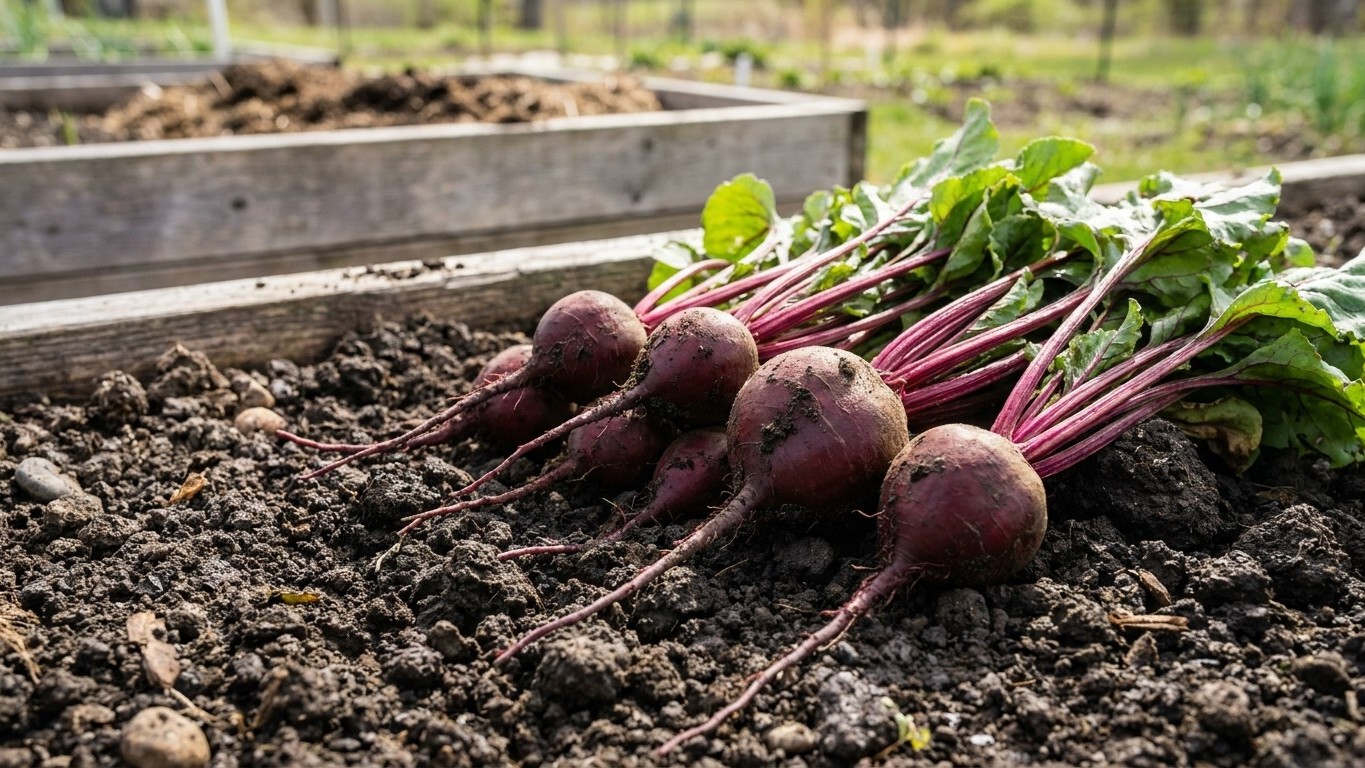

In Montana, beets mostly lose to weather and water. Thirst in the first six weeks sends plants to flower, heat above 85 F on dry ground turns roots woody, and a cellar that is too cold rots the harvest. Those are the failures with sources behind them. This page carries no insect or wildlife calendar for the state, so it does not invent one. For a general overview of the crop, start with Growing Beets in Montana.
The short answer
What the state soil says to a beet
Montana’s official state soil is the Scobey series, a Mollisol: deep, dark prairie ground of the type that built the Corn Belt. USDA NRCS records its surface horizon at 35 percent sand, 31 percent clay and 34 percent silt, with organic matter of about 2.0 percent and a surface pH of about 7.0, near neutral. The drainage class is well drained. Those are representative values across 36 mapped components of the series, queried from the Soil Data Access database. They describe a mapped surface layer, not a worked garden bed, and not your pH.
Utah State University Extension describes the beet’s ideal as deep, sandy, well-drained soil rich in organic matter. Scobey meets one of those three. It drains well, which is the hardest trait to fix. It is not sandy, though. With 31 percent clay it counts as clayey, and clayey ground tends to hold water after a rain and then crust or harden as it dries. A beet seedling pushing through a crust, or a root swelling against compacted ground, is the picture to keep in mind. Organic matter near 2.0 percent is modest, but the same extension guidance caps amendments at no more than 1 inch of composted organic matter per 100 sq ft. More is not better.
One caution matters more than any number above. A state spans hundreds of soil series, so Scobey is a starting point, not a diagnosis. River bottoms, hill country and any lot a builder has scraped or filled can be completely different. A soil test gives your own figures, and Beet Soil in Montana: What the Root Will Meet walks through what to do with them.
Heat, and the number this page does not have
Billings is the reference city here. The count of days a year it passes 90 F is not published on this page, so there is no figure to quote. The more useful threshold comes from Utah State University Extension: heat above 85 F combined with water stress makes the root woody. Any day over 90 F also clears that 85 F line, so the days that count are more numerous than a 90 F tally suggests.
Woodiness belongs to the later part of the crop, when the root is sizing up and summer heat arrives. It is a different failure from bolting, which comes from water stress early on. A grower can avoid one and still get the other. A bed watered carefully in May and left to dry out in a July heat wave will not bolt, but its roots can still turn tough.
The six weeks that decide it here
Where the sowing window lands
Beets are sown in place, straight into the bed, and the 60 to 80 days to harvest run from seeding. The usual advice is to sow 2 to 3 weeks before the last spring frost. For Billings, NOAA NCEI climate normals put the last 32 F freeze between April 29 and May 10, within the 30 to 70 percent probability band. Counting back from that band gives a sowing window of roughly April 8 to April 26. The When to Sow Beets in Montana page covers how to refine that for your own valley.
Billings is one of the milder valleys, though. Mountain valleys elsewhere in Montana can frost in any month, so a gardener at higher elevation should treat the Billings band as the gentlest case, not the average one.
What spring does to those six weeks
Add six weeks to that sowing window and the critical stretch runs from about May 20 to June 7. Spring across Montana swings. Warm spells give way to cold snaps, wind pulls moisture out of an open bed, and rain tends to arrive unevenly rather than on a schedule. This page does not publish a rainfall figure for the period, so no number is offered here.
That pattern puts the bolting risk in late May and early June. Utah State University Extension names water stress in the first 6 weeks as the cause of premature flowering. A seedbed sown in mid-April can sit damp and cold for weeks, then dry out fast when the first warm, windy stretch arrives. On clayey ground like Scobey, that dry-down can leave a crust right when seedlings need steady moisture. The plant reads the stress as a signal to flower instead of building a root.
Harvest comes later. Sixty days from an April 8 sowing is early June. Eighty days from an April 26 sowing is mid-July. The tail end of that range is when heat becomes the main threat, and woodiness takes over from bolting as the thing to watch. The roots sown earliest finish before the hottest weather, which is one more reason to hit the early end of the window.
What goes wrong here
In the row
- Bolting from early thirst. Water stress in the first 6 weeks triggers premature flowering. The remedy is steady moisture from seeding through roughly early June, watering before the surface dries and cracks instead of after. A thirsty plant that flowers will not size up a good root, and it will not go back.
- Woody roots from later heat. Heat above 85 F with water stress makes the root tough. This is a separate failure from bolting, and it needs its own response: keep the bed evenly moist through hot spells in June and July, and pull roots at a good size instead of leaving them to sit in the heat.
- Crusted, compacted clay. On clayey ground, a hard surface can block seedlings and a dense bed can push roots out of shape. Work in a thin layer of composted organic matter, never more than 1 inch per 100 sq ft, and check against a soil test before adding anything else.
- Late freezes. Billings can see its last 32 F freeze as late as May 10, and mountain valleys can frost in any month. Cover young seedlings when a freeze is forecast, and treat the April sowing window as a gamble that pays off most years in the milder valleys.
After harvest
- Storing bunched beets. With leaves attached, beets keep only about 10 to 14 days at 32 F and above 98 percent relative humidity, according to USDA Agricultural Handbook 66. Top them first. Roots stored with their greens do not last past that window.
- A cellar that is too cold. Here the usual root-crop rule reverses. The same handbook reports that storage at 32 to 34 F produces more black spot and rot than slightly warmer conditions. The target for topped roots is 33 to 36 F at 98 percent humidity. Pits and cellars should stay between 31 F and 41 F, never below or above.
- Storing the small roots. Large roots keep much better because they lose water and shrivel more slowly. Save the big ones for storage and eat the small ones first.
Common questions
Is there a pest calendar for beets in Montana?
Not on this page. The verified data here covers soil, heat, water stress and storage, so it does not name insects or animals or give dates for them. For local pest pressure, a county Extension office can speak to your valley.
Does the Scobey soil description apply to my garden?
Maybe, maybe not. It represents the state, but Montana spans hundreds of soil series. River bottoms, hill ground and filled lots can differ completely. Treat the Scobey figures as a hint about what ground in the region tends to do, then get a soil test for your own numbers.
Are bolting and woody roots the same problem?
No. Bolting comes from water stress in the first 6 weeks and sends the plant to flower. Woodiness comes later, when heat above 85 F meets water stress and the root turns tough. They happen at different stages and need attention at different times.
How cold should stored beets be kept?
Topped roots do best at 33 to 36 F and 98 percent humidity. Colder is not better: 32 to 34 F brings more black spot and rot. If you use a pit or cellar, keep it between 31 F and 41 F, and store the large roots, since they shrivel more slowly than small ones.