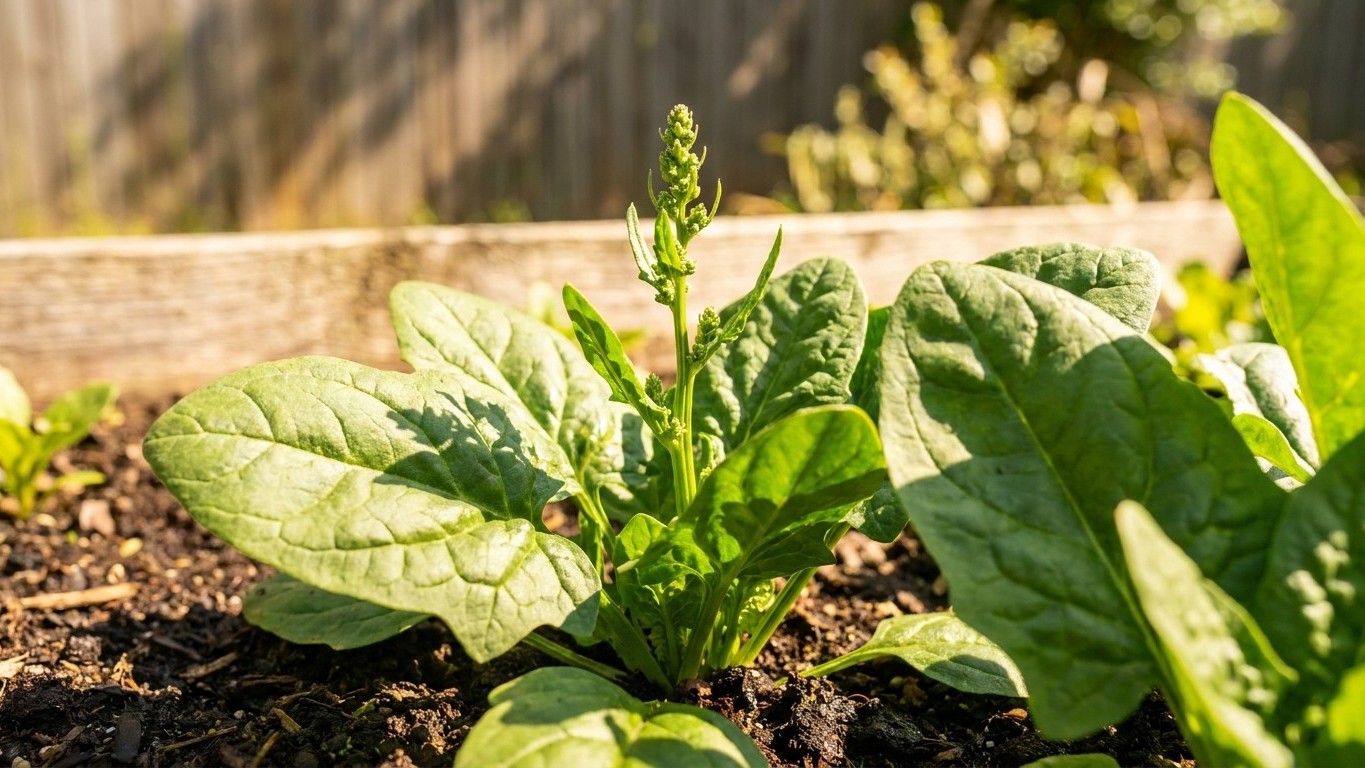

In Ohio, the thing that eats spinach on schedule is the calendar, not an insect. Long days and warm air push the plant to flower, and once it does the leaves turn bitter and the harvest ends. Ohio has both triggers. That leaves two real windows: a short spring one and a fall one that opens late. The facts here don’t cover insect pests, so this page sticks to timing.
The short answer
On the longest day of the year, Ohio gets 14 h 51 of daylight (calculated for the Columbus reference city, using the geometric horizon, so real daylight runs about seven minutes longer). That number matters because, according to Utah State University Extension, spinach bolts during long days and warm temperatures. Long days alone are enough to start the flowering. Warmth speeds it up, but a cool spell does not cancel it.
So a cool, rainy summer does not buy extra weeks. A gardener in northern Ohio who gets a mild June is still working against 14-plus hours of light. The plant reads the day length, not the weather forecast.
Which one is the limit here, day length or heat? Both. Day length is the constant: every spring day is longer than the last until the solstice, and spinach keeps getting the signal to flower. Heat is the variable that decides how fast things fall apart. Spinach grows best where temperatures do not exceed 75 F, and that same number is where bitterness starts. One figure, two consequences: growth slows and flavor turns.
Columbus averages 15.3 days a year at 90 F or higher (NOAA NCEI Climate Normals, 1991-2020). That sounds modest, and it undersells the problem. A day at 90 F is the extreme end. The 75 F ceiling is fifteen degrees lower, so the number of days that are bad for spinach is far larger than the number that make a weather report. The 15.3 figure is a measure of how much heat load Ohio summers carry, not a count of the days spinach suffers.
One honest gap: the source says long days trigger bolting but publishes no specific hour count for spinach. I won’t invent a threshold. What can be said is that the longest day here is 14 h 51, and every week of spring pushes toward that peak. The sooner the crop is in and cut, the better. For a fuller look at how the flowering plays out in the garden, see Will Spinach Bolt Early in Ohio?, and for the overall picture of the crop, Growing Spinach in Ohio.
How long the spring window really is
Spinach is sown 2 to 3 weeks before the last spring frost. In Ohio’s zone 6a, Ohio State University Extension puts that frost between May 5 and May 15. The arithmetic takes a few steps.
- Find the opening. Three weeks before May 5 is April 14. That is the earliest sowing date the rule allows.
- Find the late edge. Two weeks before May 15 is May 1. Sowing after that is already cutting into your harvest time.
- Add the growing period. The source publishes no days-to-maturity for spinach, so I can’t tell you what date the first cutting lands. Leaf crops are harvested young, and the sowing-to-eating gap is a matter of weeks, but the exact count is not published here.
- Find the closing. Growth stops being good above 75 F. This is a temperature, not a calendar date. No source here says when Ohio crosses it in any given year, and it moves from one spring to the next.
Put in words, the usable spring is the stretch from a mid-to-late April sowing until the first run of days in the mid-70s. That is a matter of weeks, not months. A cold April stretches it. A warm May squeezes it. Because the closing edge is set by air temperature, the best tool is a thermometer in the shade near the bed, not a date circled on the wall calendar.
The window also has a hidden second clock. Even if a cool May keeps the thermometer under 75 F, the days are already near their longest by late May and June, and day length alone triggers flowering. So the cool spell that tempts you to leave spinach in the ground is exactly when the plant is quietly deciding to bolt. Harvest generously while it is still sweet.
If you can only plant once, plant early. A row sown at the front of the April range gets the most cool, shorter-day weeks. One sown at the back of it, around May 1, is racing the same clock with less head start. For a closer look at the second chance on the calendar, see When to Sow Autumn Spinach in Ohio.
The autumn crop, and when the soil lets you sow
Fall flips the logic. Days are shortening, so day length stops working against the crop. The obstacles now are warm soil at the start and frost at the end.
The first obstacle: soil that is still too warm
Spinach seed germination is reduced when soil is above 80 F. That is the blocker for an early fall sowing, and it is warmth, not cold, that stops you. A bed in full sun can hold heat well after the air has started to cool. Ohio’s 15.3 days a year at 90 F or higher are concentrated in summer, and the ground carries that heat into late summer.
The window, then, opens when the soil falls below 80 F. The source gives no Ohio date for that, and it varies with sun, mulch, and how much rain you’ve had. A soil thermometer pushed a couple of inches down is the honest answer. Watering the bed and shading it before sowing can help cool it, but the number on the thermometer decides.
The second obstacle: the frost that ends the season
Ohio State University Extension puts the first fall frost between October 5 and October 15 in zone 6a. The rule for a fall crop is to plant 50 to 75 days before the date you want to harvest. Counting back from the frost window as a deadline gives a clear range:
- From October 5, 75 days back lands on July 22.
- From October 15, 50 days back lands on August 26.
So on paper, sowing runs from late July to late August. In practice, the early end of that range runs straight into the warm-soil problem. A July 22 sowing is likely to meet soil well above 80 F, where germination drops. The workable part of the range is the later portion, once the thermometer says the bed has cooled. If you choose a harvest date earlier than the frost, count back from that date instead, using the same 50 to 75 days.
Four varieties are named in the source: Bloomsdale, Melody, Teton, and Olympia. The source gives no data on any of them, so there is nothing here to say about which bolts later or matures faster. Ask the seed packet, not this page.
Common questions
Do bugs, deer, or rabbits eat spinach in Ohio?
The facts behind this page cover timing, not pests, so I won’t name culprits or dates for them. What can be said is that the biggest scheduled loss is bolting, which happens to every planting that stays in too long, whatever the wildlife does.
Will a cool summer let me grow spinach longer?
No. Ohio’s longest day is 14 h 51, and long days alone trigger flowering. Cool weather slows the damage and keeps the leaves sweeter a little longer, but it does not remove the day-length signal.
Which variety should I plant?
Bloomsdale, Melody, Teton, and Olympia are the four named in the source. No performance data is published for any of them, so the comparison isn’t available here.
How long does harvested spinach keep?
Spinach is highly perishable. UC Davis Postharvest says the best conditions are 32 F with 95 to 98 percent relative humidity, and that it will not keep good quality for more than 2 weeks. Treat that as a ceiling, not a plan. At 41 to 50 F, which is common in distribution and close to what a fridge door holds, it yellows faster. Store it at the back of the bottom shelf, not in the door. See the UC Davis Postharvest spinach fact sheet for details.