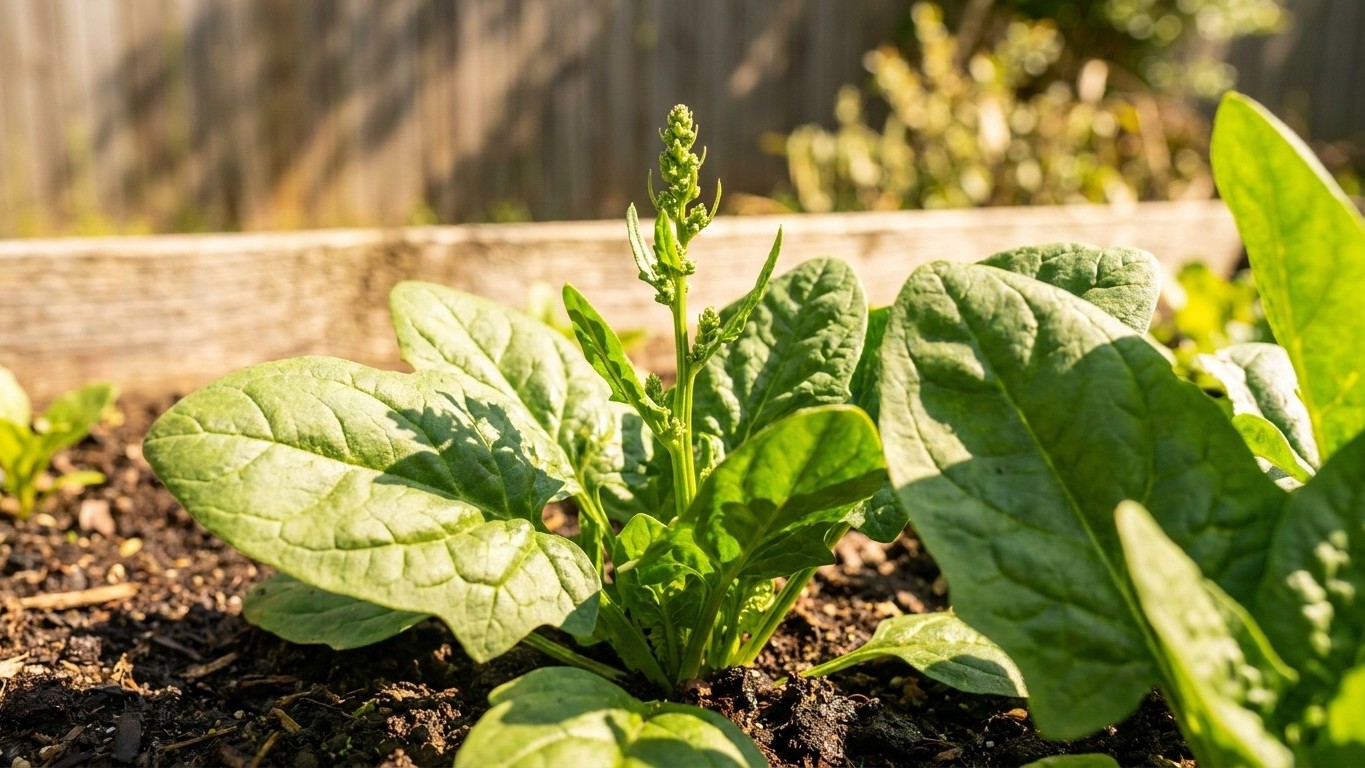

Three things eat a spinach crop in Texas, and none of them has legs: lengthening days, heat above 75 F, and, in autumn, soil too warm for seeds to sprout. Insects are not the subject here, because the sources behind this page cover the calendar, not pests. Every date below comes from Houston, the mild Gulf end of a state that spans four USDA zones, so read it as one worked example. For the whole crop, start with Growing Spinach in Texas.
The short answer
The longest day of the year in Houston carries 13 h 56 of daylight. The Homestead Post calculated that figure from the latitude of the weather station behind the climate normals, and it does not count the roughly seven extra minutes that atmospheric refraction adds. Almost fourteen hours of light is a lot for a leaf crop, and the reason is that spinach bolts, meaning it sends up a flower stalk and quits making good leaves, during long days as well as warm temperatures. Utah State University Extension, the authority behind this page, lists both triggers.
Day length: the part no cool summer fixes
Long days alone are enough to make spinach flower. That has a surprising consequence. In a place with a mild summer, you might expect a few bonus weeks of tender leaves, but a cool spell does not cancel the light. The plant reads the length of the day, and the day is the same length whether the afternoon hits 72 F or 98 F. The source publishes no hour count for where the trigger starts, so I won’t invent one. What I can say is that Houston’s June days are long, and the days keep lengthening through spring while the crop is trying to finish.
Heat: the part Houston has plenty of
Spinach grows best where temperatures do not exceed 75 F. That number does double duty. It is the ceiling for good growth, and it is also the point where the leaves turn bitter. Now set it against the NOAA NCEI climate normals for Houston: an average of 102.4 days a year reach 90 F or more. Counted one by one, that is more than fourteen weeks of 90-degree days. They are scattered across the year, not stacked in one block, but the pattern is clear. Warm weather arrives early and leaves late.
So is the limit here day length, heat, or both? Both, and in spring they push in the same direction at the same time, because the days stretch out while the afternoons climb. That double squeeze is why a Texas spinach crop ends abruptly instead of fading. In autumn the pressure reverses. Day length is easing, so bolting is not the main worry. The obstacle is warm soil, which I cover below. For the early-flowering question in more detail, see Will Spinach Bolt Early in Texas?
How long the spring window really is
The spring window is the gap between the earliest sensible sowing date and the day the weather crosses 75 F. The front edge is a date you can look up. The back edge is not, and that asymmetry shapes the whole season.
The arithmetic, step by step
- Find the last frost. At the Houston airport station (IAH), the NOAA NCEI climate normals put the last spring freeze, within a 30 to 70 percent probability band, between February 4 and March 1.
- Back up two to three weeks. Spinach goes into the ground that far ahead of the last frost. Counting back from those two dates gives a sowing stretch from about mid-January to mid-February. Hobby airport runs about two weeks milder than IAH, so a gardener on that side of town can slide everything earlier.
- Find the back edge yourself. Growth stops being good above 75 F, but 75 F is a temperature, not a date. This page publishes no date for when Houston’s daytime highs settle above it, so watch your own forecast and mark the week highs stop dipping below that line.
- Count the weeks between the two marks. Sowing at the front of the range, mid-January, gives the longest run. Sowing in mid-February gives back only what the calendar has left.
- Expect it to be short. With heat building this early and days lengthening alongside it, the usable spring here is a stretch of weeks, not a season. Plan on a quick, early harvest, and treat bitterness or a rising flower stalk as the signal to pull the row.
What the arithmetic leaves
The honest summary is that the Houston spring window opens in mid-winter and closes well before the true heat of summer, and the closing date is the one nobody can hand you in advance. Away from the coast, the dates change a lot. The Panhandle freezes months later in spring and months earlier in autumn than Houston, and North Texas and the Hill Country sit on their own schedules. Do not borrow the January dates above for a garden in Amarillo.
The autumn crop, and when the soil lets you sow
Autumn is the better season for spinach in most of Texas, but the calendar works in an odd way. Two separate obstacles bracket the sowing window, and neither one is the cold you might expect.
Obstacle one: soil still too warm to germinate
Seed germination is reduced above 80 F soil, according to Utah State University Extension. Air temperature and soil temperature are different numbers, and soil lags behind. With air reaching 90 F or more on 102.4 days a year in Houston, early autumn soil is a fair bet to still be above the line even after the first cooler mornings. The source publishes no date when Texas soil drops below 80 F, so the practical tool is a soil thermometer pushed a couple of inches into the bed in the morning. In a hot region, the window opens when the soil falls, not when the calendar says fall. The sowing details are in When to Sow Autumn Spinach in Texas.
Obstacle two: the frost that ends the season
The back end is easier to pin down. At the Houston IAH station, the NOAA NCEI climate normals put the first fall freeze, in the same 30 to 70 percent band, between December 1 and December 19. The source’s only rule for a fall crop is to plant 50 to 75 days before the date you want to harvest. It publishes no days-to-maturity for spinach itself, so this is a planting guide, not a growth timeline.
Count back from those two frost dates and the envelope looks like this:
- Harvest by December 1: sow between about September 17 and October 12.
- Harvest by December 19: sow between about October 5 and October 30.
Put the two obstacles together and the earliest dates in that envelope will probably be blocked by warm soil, so the real sowing window runs from whenever the soil thermometer reads below 80 F until roughly late October. The frost dates are probabilities, not guarantees, and a freeze can land outside the band. Hobby airport’s two-week mildness pushes the whole envelope later. Farther north, the same arithmetic shifts months earlier.
Common questions
Does a cool summer give spinach extra weeks in Texas?
No. Long days alone trigger flowering, and Houston gets 13 h 56 of daylight on the longest day. Cooler weather can slow the process, but it does not cancel the light, so the weeks do not come back.
Can I use these Houston dates anywhere in Texas?
No. The dates here, February 4 to March 1 for the last spring frost and December 1 to December 19 for the first fall frost, describe the mild Gulf end of the state. Texas covers four USDA zones, and the Panhandle, North Texas, and the Hill Country each need their own frost dates. Even inside Houston, Hobby airport runs about two weeks milder than IAH.
Which spinach variety handles Texas best?
The source names four varieties: Bloomsdale, Melody, Teton, and Olympia. It publishes no data about any of them, such as bolt resistance, days to harvest, or heat tolerance, so I can’t rank them or describe them. Check a local county extension office for performance in your area.
How long does harvested spinach keep?
Treat two weeks as a ceiling, not a plan. UC Davis Postharvest says spinach is highly perishable and “will not maintain good quality for more than 2 weeks,” and that is at 32 F with 95 to 98 percent relative humidity (UC Davis Postharvest Technology Center). At the 41 to 50 F that many fridges and distribution chains actually run, leaves yellow and decay faster. Keep the bag at the back of the bottom shelf, not in the door, where the temperature swings most.