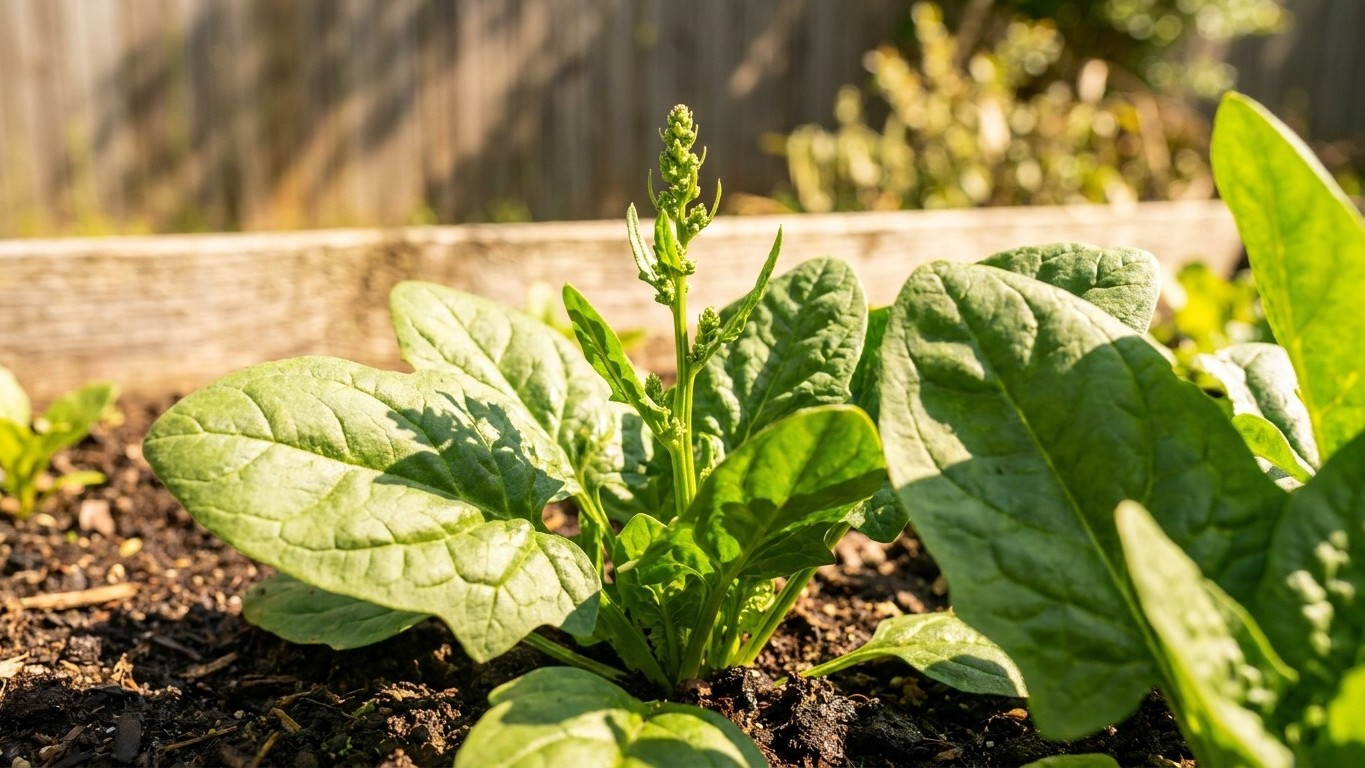

Near Houston, spinach bolts early for two reasons at once: the days get long enough to trigger flowering on their own, and the heat piles on before the plant has time to size up. The reference station shows 13 hours 56 minutes of daylight on the longest day, and the region logs 102.4 days a year at 90°F or hotter. Between those two pressures, spinach here gets a short spring run and an even shorter, soil-dependent autumn one.
The short answer
Start with that daylight number: 13 hours 56 minutes at the summer solstice, measured at the Houston reference station. For spinach, long days aren’t a bonus, they’re a trigger. Flowering, what gardeners call bolting, is switched on by day length as much as by warmth. So even in a year with a mild, cloudy summer, spinach planted too close to the solstice will still throw up a seed stalk once the days stretch past a certain point, because the plant is reading the calendar through its leaves, not checking a thermometer.
That’s the mechanism working against Texas gardeners even before heat enters the picture. And heat enters the picture hard here. Spinach grows best where temperatures stay under 75°F, and that ceiling is also the point where the leaves start turning bitter, even before the plant visibly bolts. With 102.4 days a year reaching 90°F or higher at the reference station, the region blows past that 75°F comfort zone for a large share of the growing calendar, not just at the peak of summer.
So which one is the limiting factor here, day length or heat? Both, and they arrive in a one-two sequence. In spring, heat usually closes the window first: temperatures climb past 75°F well before the days get long enough on their own to force bolting. By early summer, day length takes over as the dominant trigger, locking in flowering even if a stray cool spell shows up. Neither factor buys the other back. A cool week in May doesn’t undo the fact that the days are already long. A short day in early spring doesn’t undo the fact that soil and air are already warming past the comfort range.
What this means practically is that spinach in this part of Texas is a crop of edges, not a crop of the open season. It has to be grown in the narrow bands where day length is still short-ish and temperatures haven’t yet climbed past that 75°F mark, which is exactly why both a spring sowing and a fall sowing exist for this crop here, rather than one long summer-long run the way you might grow tomatoes or peppers.
How long the spring window really is
Working out the usable spring stretch means stacking two numbers most gardeners never think to compare: the last frost date and the point where spinach’s own heat ceiling kicks in.
- Sowing timing starts from frost. The rule of thumb for spinach is sowing 2 to 3 weeks before the last frost. At the Houston-area reference station, the last spring freeze falls somewhere between February 4 and March 1. Counting back 2 to 3 weeks from that range puts a realistic sowing window in mid-January through mid-February, depending on exactly where in that freeze range your particular spring lands.
- Germination and early leaf growth happen in cool soil, which spinach tolerates well and even prefers, so those first few weeks after sowing aren’t the constraint. The plant is fine in cold, damp February soil in a way it will never be fine in July soil.
- The constraint shows up as spring turns to true spring. Once daytime highs start pushing past that 75°F ceiling, growth quality drops and bitterness starts building in the leaves, well ahead of any visible bolting. Given how quickly the Gulf Coast climate warms, and given that this station already logs over a hundred days a year at 90°F or above, that 75°F line gets crossed early, not in midsummer.
- Put those two boundaries together, the sowing window in January-to-February and the ceiling arriving within roughly six to eight weeks of that sowing, and the usable spring stretch for spinach here comes out measured in weeks, not months. It’s a short, front-loaded season: plant as early as soil and frost risk allow, then harvest hard and fast before the heat and the lengthening days close the door.
The autumn crop, and when the soil lets you sow
Fall spinach has its own math, and it runs backward from a harvest date instead of forward from a frost date. Utah State University Extension gives the sowing rule for a fall crop as 50 to 75 days before the date you want to harvest. No days-to-maturity figure is published for spinach beyond that window, so this 50-to-75-day range is the only planning tool available, whether the goal is a full harvest or a few early cuttings.
The soil is still too warm to germinate
The first obstacle isn’t cold, it’s heat lingering in the ground. Spinach seed germination drops off once soil temperatures rise above 80°F, and in a region logging 102.4 days a year at 90°F air temperature, soil holds that heat well past the point when the air itself starts to feel like fall. That means the fall sowing window doesn’t open on a fixed date on the calendar. It opens whenever soil temperature actually falls back under that 80°F mark, which for this region tends to land sometime in the September-to-October stretch, later than gardeners in cooler states might expect.
The frost that ends the season
The other boundary is the first fall frost, which at the Houston-area reference station falls between December 1 and December 19. Treating that range as a realistic harvest target and counting back the 50-to-75-day window from Utah State’s guidance puts a workable sowing window at roughly early October to mid-October, depending on where in the December frost range the season actually lands. That lines up well with when soil has typically cooled below the 80°F germination threshold, which is the useful confirmation: the two obstacles, warm soil and looming frost, roughly bracket the same few weeks in early autumn rather than fighting each other across a longer stretch.
Four spinach varieties come up often in general growing guidance: Bloomsdale, Melody, Teton, and Olympia. None of the sources behind these figures publish specific data comparing how these varieties perform against day length or heat in this region, so no claims about relative bolt resistance can be made here beyond naming them as commonly grown types.
Common questions
Does shade slow down spinach bolting in Texas?
Shade can lower leaf and soil temperature somewhat, which helps with the 75°F heat ceiling, but it does nothing about day length. Since long days trigger flowering on their own, shade alone won’t stop bolting once the daylight hours climb high enough, though it may buy a few extra days of usable leaf quality.
Can spinach be grown through summer in Texas with irrigation?
Water addresses drought stress, not the day-length and heat mechanisms that drive bolting. With 102.4 days a year at 90°F or higher and daylight reaching nearly 14 hours at the solstice, irrigation won’t keep spinach from flowering once those thresholds are crossed.
Is the spring or fall crop more reliable near Houston?
Neither window is generous, but the fall crop has one advantage: day length is shortening rather than lengthening as the season progresses, removing one of the two bolting triggers. The main fall obstacle is simply waiting for soil to cool below 80°F before sowing.
Do these frost dates apply across all of Texas?
No. These figures come from the Houston-area reference station, the mild Gulf Coast end of the state. Texas spans four USDA zones, and the Panhandle, Hill Country, and North Texas all freeze on very different schedules, so this is not a statewide planting calendar.