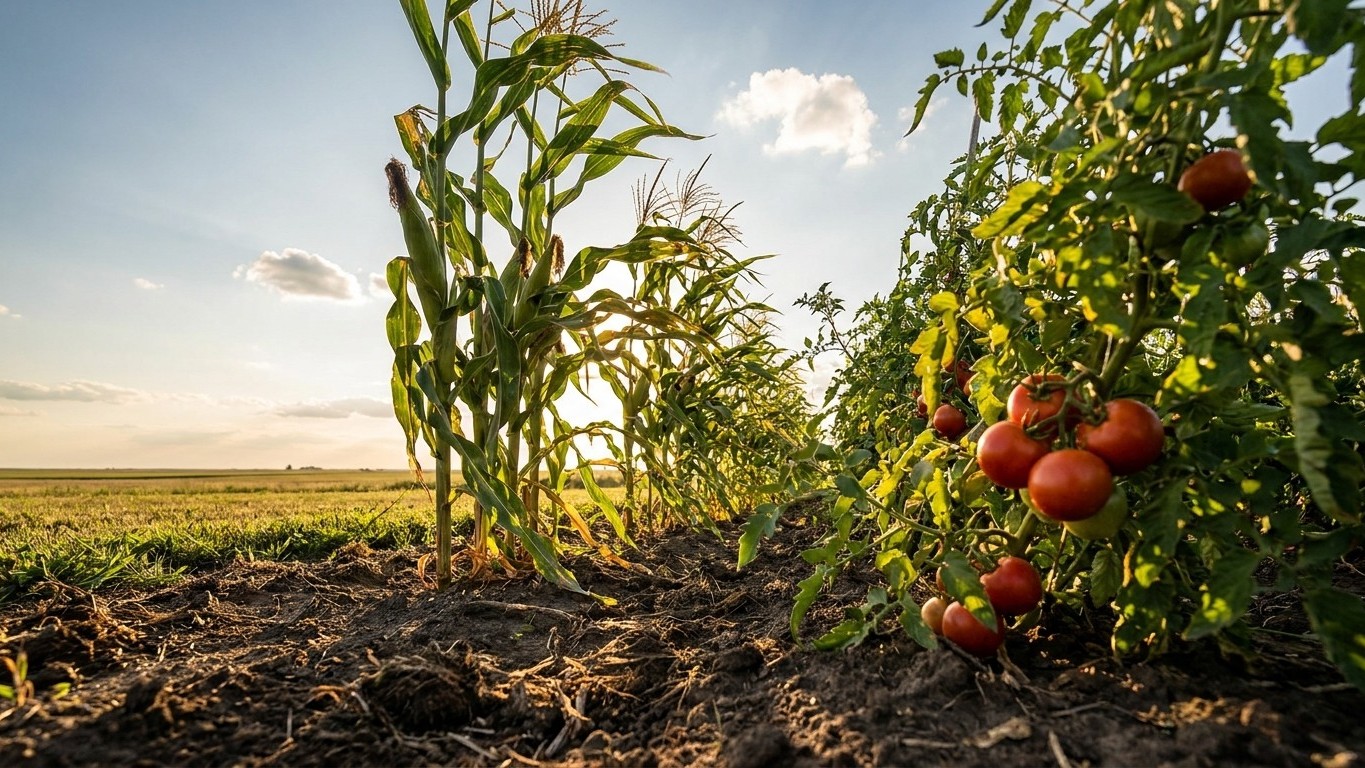

Sweet corn in Idaho goes in when the soil, measured 4 inches down, holds at about 60 F. That day arrives well after the last frost, not with it. The crop then needs 60 to 90 days from planting, and in the Boise valley that fits before fall frost. Ears are ready 17 to 24 days after silks first appear, and the sugar starts draining the hour they are picked. Higher, colder Idaho ground is a different calculation.
The short answer
Soil warms after the frost is gone
Soil at 60 F is not the last frost date. The two are separate events, and gardeners who treat them as one day are the ones replanting in June. At the Boise reference station, the last 32 F freeze falls between April 23 and May 7 (NOAA NCEI 1991-2020 Climate Normals, 30-70% probability band). Air temperature drives that date. Seed sits in soil, which lags the air by weeks. No calendar date for 60 F soil is published here, so the thermometer decides, not the almanac.
The reading has to be taken at depth. Clemson Extension says: “Do not plant before the soil temperature at the 4-inch depth is at least 50 ºF. Wait to plant extra-sweet varieties until soil temperatures reach 65 °F.” Utah State University Extension uses above 60 F as the working line for sweet corn in general. Those figures are not interchangeable. Fifty is the floor for ordinary sweet corn, and 65 is the line for extra-sweet (sh2) types. A supersweet seed sown at 50 F tends to rot instead of sprouting. That explains the gardener who succeeds one year and fails the next after changing only the seed packet.
Fall frost, then the fade
The first fall freeze at the same station falls between October 7 and October 21. Count the days from the end of the spring window to the start of the fall one and you get 153. From the start of spring to the end of fall, it is 181. Waiting for warm soil uses up part of that, but a 90-day crop still fits in the Boise valley with room to spare. Treat those dates as the middle of the odds, though, not as walls. A freeze can land outside a 30-70% band, and Boise is a low valley. Most of Idaho is higher and colder, with far shorter seasons.
Once ears are ready, the clock runs the other way. Boise averages 47.5 days a year at 90 F or more, and heat is what drains sugar out of a picked ear. Clemson Extension puts it plainly: “Sweet corn loses sugar from the kernel rapidly at high temperatures… Sweet corn can be stored under optimal conditions for about five days, but will lose sweetness with each day of storage.” Five days is a ceiling under ideal conditions, not a promise. The type matters too. Standard su loses sugar fastest, se holds it longer, and sh2 holds it longest. That is the practical reason to pick one type over another.
Does a late variety fit here?
Two different clocks answer this. Days from planting decide whether a variety fits the season. Days from silk emergence decide which week you pick. Only the first matters for this question.
A 60-day variety
Easy. Plant it as soon as the soil at 4 inches reaches 60 F, and it is finished long before the first fall freeze window opens on October 7. Even if a cold, wet spring pushes planting weeks past the last frost, 60 days leaves a wide cushion. The early type also helps in a hot stretch, since a short crop has fewer days to be caught by heat during pollination. If you plant a second round to stretch the harvest, keep the tassel timing in mind (more on that below). The planting calendar for each part of the state is in When to Sow Sweet Corn in Idaho.
A 90-day variety
In the Boise valley, yes, though with less slack. Take the tightest case: soil reaches 60 F after the last frost window has closed on May 7, and the first fall freeze arrives at the early edge on October 7. The gap is still 153 days before warm-up is subtracted, so 90 days survives a late planting. If you choose an extra-sweet type that wants 65 F soil, you are planting later still, so use the same arithmetic with that later start.
Higher ground is where the answer turns. Most of Idaho is higher and colder than Boise, and its frost-free stretch is far shorter. The figures for those places are not published here. Where the season is short, the 90-day variety probably does not fit, and a late planting makes it worse. Pick the shorter one, count back from your local first fall frost, and leave a margin. A half-ripe ear killed by frost does not finish in the kitchen. For general guidance, see Growing Sweet Corn in Idaho.
What goes wrong here
Most failures in this climate trace to three causes, and only the last has nothing to do with weather.
- Soil sown too cold. A sunny April afternoon tells you about the air, not the seed bed. Seed in soil that is too cold sits and rots, and extra-sweet seed is the least forgiving. Remedy: push a thermometer 4 inches down, wait for at least 50 F for ordinary types and 65 F for extra-sweet, and take the reading in the morning when soil is at its coolest. Do not plant by date.
- A variety too late for the season. Corn that has not matured when the first fall freeze arrives is lost, and the risk grows with elevation. Remedy: take the first fall freeze window (October 7 to October 21 in Boise, earlier in colder places), count back the 60 to 90 days on the seed packet plus the weeks lost waiting for warm soil, and choose a shorter variety if the numbers do not fit.
- Sweetness lost to the neighbors. Su, se and sh2 types lose their sweetness if they tassel at the same time, because cross-pollination turns sweet kernels starchy. That is a gardening problem, not a climate one. Utah State University Extension publishes no separation distance, so none is given here. Remedy: do not let different types tassel together. Grow one type, or stagger plantings so their tassels do not overlap, and plant corn in blocks of three or more rows so pollen reaches the silks.
Pests are a fourth risk, but they depend on timing as much as on climate. What Eats Corn in Idaho, and When covers that.
Common questions
Is 60 F soil the same as the last frost date?
No. The last frost date describes air temperature, and in Boise it falls between April 23 and May 7. Soil warms later. Plant by the 4-inch soil reading, not by the frost date.
How do I know an ear is ready to pick?
Look for three signs together: dry brown silks, husks that are still moist and green, and milky juice when you puncture a kernel. One sign alone misleads. As a rough guide, ears are ready 17 to 24 days after silks emerge, which tells you which week to start checking.
How long does picked corn stay sweet?
Under optimal conditions, about five days at most, and sweetness drops each day. Heat speeds the loss. Standard su types fade fastest, se types hold longer, and sh2 types hold longest, so chill ears promptly and eat the su corn first.
Can I plant two types in the same garden?
Yes, if they do not tassel at the same time. When su, se and sh2 types shed pollen together, sweetness is lost. Stagger the plantings or keep one type per season. No safe distance is published here, so timing is your tool. Also, a late-planted extra-sweet type needs 65 F soil, so it may tassel later than the others on its own.