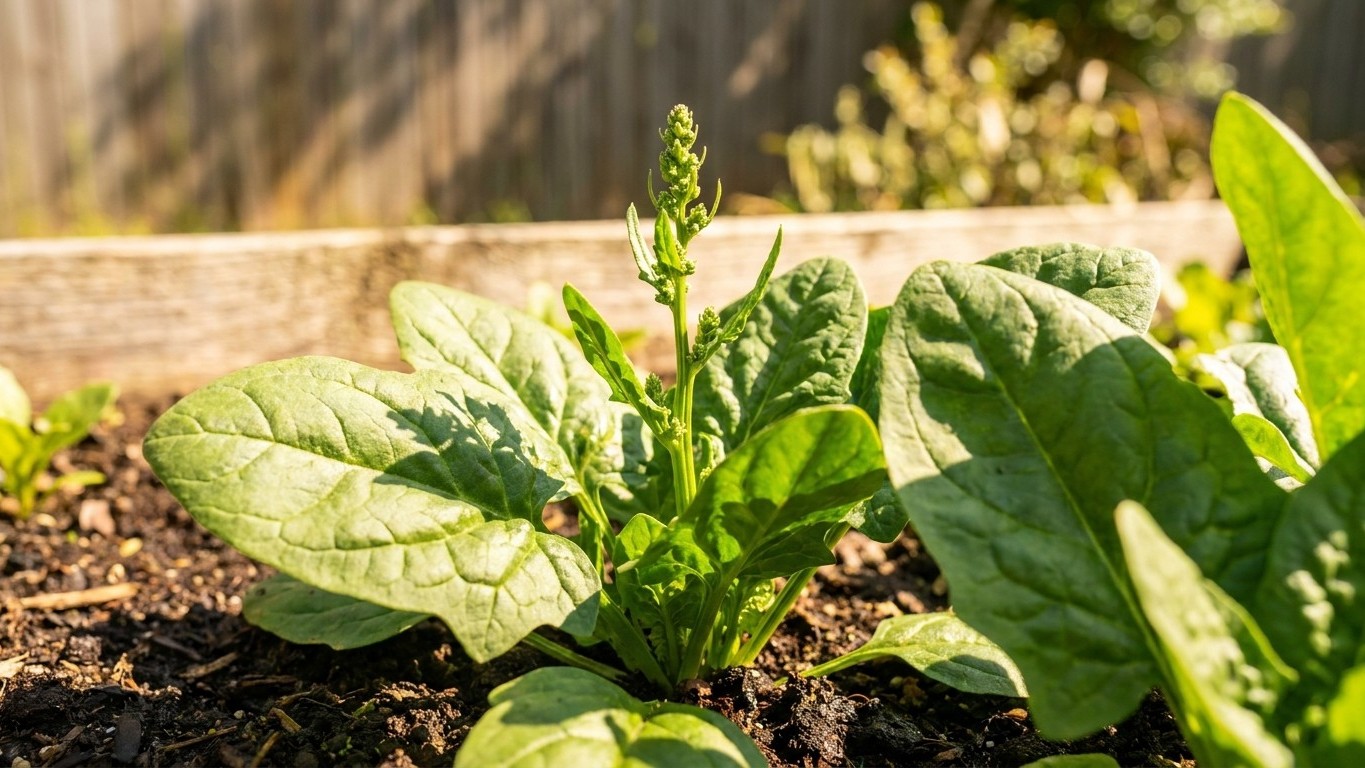

In Wisconsin, the thing that eats spinach is the calendar. Long days push it to flower, warmth above 75 F stops good growth and turns leaves bitter, warm soil in late summer blocks autumn seeds, and the first frost closes the season. A cool summer changes this less than gardeners hope. Below, each limit gets dates, using the Milwaukee climate normals as the reference. Insects and slugs are a separate subject. This page is about weather and the clock.
The short answer
Milwaukee gets 15 h 10 of daylight on the longest day of the year. That figure is geometric, so real daylight runs roughly seven minutes longer. Spinach reads those hours as a signal to flower, and once it flowers the harvest is over. Utah State University Extension puts it plainly: spinach bolts during long days and warm temperatures, and it grows best where temperatures do not exceed 75 F.
The surprising part is how little temperature matters to the day-length trigger. Long days alone are enough to make spinach flower. A June that stays in the 60s still delivers 15 hours of light, and the plant responds to the light. So a cool Wisconsin summer does not buy extra weeks of spinach. Gardeners in the northern half of the country often assume a mild summer will keep the crop going, and for lettuce or peas that hope has some basis. For spinach it does not hold up.
When the stalk rises, the leaves shrink, turn bitter and stop being worth picking. Tearing out the row and starting over is usually the better call, which is why Will Spinach Bolt Early in Wisconsin? treats the signs of bolting as a harvest-now warning rather than something to fix.
Day length and heat, both
So which one limits the crop here? Both, and they work differently. Day length is the wall you cannot negotiate with. Nothing you do in a backyard bed shortens the sun’s hours, and Wisconsin’s summer light is long enough to trigger flowering all by itself.
Heat is the second wall, and it is lower than most people expect. Milwaukee averages 7.0 days a year at 90 F or more, a modest count that makes summer here look gentle. But 90 F is not the number that matters to spinach. The ceiling is 75 F, and it does double duty: above it, growth stops being good, and above it, leaves turn bitter. One number, two consequences. A week of 80 F afternoons in May can hurt a spinach bed long before any 90 F day shows up.
The practical result is a crop that lives in two stretches, one in spring and one in autumn, with a gap through summer. Spring is bounded by the thermometer and the lengthening days. Autumn is bounded by warm soil at the start and frost at the end. The full growing picture for the state sits in Growing Spinach in Wisconsin. This page counts the weeks.
How long the spring window really is
Spinach gets sown 2 to 3 weeks before the last spring frost, and growth stops being good above 75 F. In Wisconsin the last frost lands between April 16 and April 29 in the NOAA NCEI 30-year climate normals for the Milwaukee station, a range that covers the 30 to 70 percent probability band. The window can be worked out in five steps.
- Find the frost range. April 16 to April 29 is the reference for Milwaukee. Inland and northern gardens run later, and the lakeshore tends to run a bit different, so use your own county’s number if you have it.
- Count back 2 to 3 weeks. From April 16, three weeks back is March 26. From April 29, two weeks back is April 15. Sowing therefore opens somewhere between late March and mid April, depending on where your garden sits in that range and whether the soil is workable.
- Treat the sowing band as three weeks wide. The gap between the early and late ends of that band is about three weeks, which is also roughly the amount of growing time you give up by waiting for a warm, comfortable afternoon to start. Every week of delay comes off the back end of the crop.
- Watch for 75 F, not a date. The ceiling is a temperature, never a calendar day. This page has no published date for when Wisconsin spring crosses it, so the honest method is to watch your own forecast. When daytime highs begin sitting at or above 75 F, growth is no longer good.
- Remember the light is still lengthening. As spring moves toward the 15 h 10 solstice, the flowering trigger builds alongside the heat. The window closes from both directions.
So how many weeks is that? The sowing window alone spans about three weeks, and the crop then has however many weeks of sub-75 F weather your spring supplies before the closing date. The source publishes no days-to-maturity figure for spinach, so any exact count of harvest weeks would be invented. What the numbers support is this: the usable spring is a matter of weeks, not months, and starting at the early end of the band is the only lever you control.
Seed packets may carry their own maturity estimates. Treat those as the seed company’s figure, not as a regional guarantee.
The autumn crop, and when the soil lets you sow
Autumn spinach reverses the problem. In spring you race rising warmth. In late summer you wait for the ground to cool, then race the frost. The rule from Utah State University Extension for a fall crop is simple: plant 50 to 75 days before the date you want to harvest. The details of timing by region are in When to Sow Autumn Spinach in Wisconsin. The logic is below.
Obstacle one: soil that is still too warm
Seed germination is reduced when soil is above 80 F. The block in late summer is warmth, not cold. A bed that has baked under August sun can sit well above that line even after the air feels pleasant, so seed sown too early can sit in the row and sprout poorly or not at all. Wisconsin’s 7.0 days a year at 90 F or more tell you the heat is not extreme here, but soil holds warmth longer than air does.
The window opens when the soil falls below 80 F, and a thermometer pushed an inch or two into the bed tells you more than the calendar does. Watering the bed before sowing helps cool it. This is also the point where shortening days start working in your favor, since the long-day signal that drives spring bolting is fading.
Obstacle two: the frost that ends the season
The first fall frost falls between October 17 and October 29 in the same NOAA NCEI normals for the Milwaukee station. That range is a lakeshore number. Lake Michigan delays the first freeze near the shore, inland southern Wisconsin typically freezes in early October, and the north freezes far earlier. Count back from the date that fits your garden.
Using the lakeshore range as the example, with 50 to 75 days before harvest:
- Harvest by October 17: sow between August 3 (75 days) and August 28 (50 days).
- Harvest by October 29: sow between August 15 (75 days) and September 9 (50 days).
Those windows start in early to mid August, the very weeks when the soil may still be above 80 F. That overlap is the real tension of the autumn crop, and it is why the soil temperature check matters more than any printed date. Inland and northern gardens should shift everything earlier by the amount their frost arrives earlier, which squeezes the window further.
Common questions
Does a cool summer keep spinach from bolting in Wisconsin?
No. Long days alone trigger flowering, and Milwaukee gets 15 h 10 of daylight on the longest day. Cool weather can delay the heat problem, but it cannot remove the day-length signal.
Which spinach variety should I plant?
Utah State University Extension names four varieties: Bloomsdale, Melody, Teton and Olympia. It publishes no data about any of them, so this page cannot say which resists bolting or tolerates heat better. Check the seed packet for the grower’s own claims.
How long does harvested spinach keep?
The UC Davis Postharvest Technology Center lists the optimum at 32 F and 95 to 98 percent humidity, and says spinach will not maintain good quality for more than 2 weeks. That is a ceiling, not a plan. At 41 to 50 F, closer to what a fridge door holds, leaves yellow much faster. Put it at the back of the bottom shelf, not in the door. More detail is in the UC Davis spinach fact sheet.
Is 75 F a date I can put on the calendar?
No. It is a temperature. It marks where growth stops being good and where leaves turn bitter, and when it arrives depends on the year. This page does not publish a Wisconsin date for it, so watch your forecast instead.