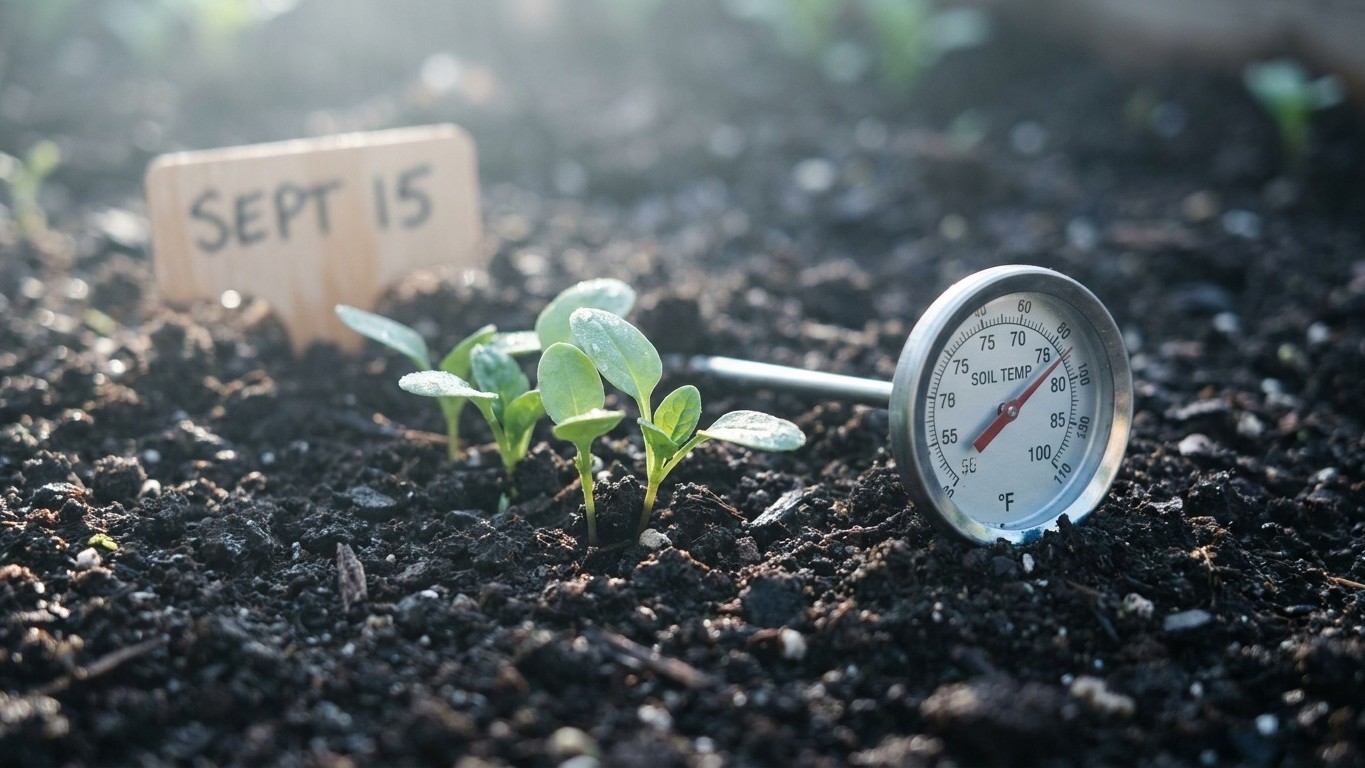

Autumn Spinach in Wisconsin goes in the ground roughly from early August through mid-September, counting back 50 to 75 days from the first fall frost. The exact week depends on where you sit against that frost range (October 17 to October 29) and on how quickly the soil has cooled from summer’s peak, since spinach seed germinates poorly once soil runs above 80 F.
The short answer
Wisconsin’s longest day brings about 15 hours and 10 minutes of daylight at the reference station. That number matters more for spinach than most gardeners realize, because spinach bolts under long days and warm temperatures together. A cool Wisconsin summer does not buy extra growing weeks the way it might for a heat-sensitive crop with no day-length trigger. The plant reads the calendar through daylight, and once the days stretch past a certain point, flowering starts whether the thermometer cooperates or not.
So which one actually limits spinach here, the day length or the heat? Both, but they hit at different moments. In June, when Wisconsin is closest to that 15-hour-10-minute peak, day length alone is enough to push spinach toward bolting even if the air stays mild. Meanwhile the state also logs an average of 7.0 days a year at 90 F or hotter, mostly clustered in July, and spinach growth stalls above 75 F long before the mercury reaches that extreme. That 75 F mark is not just a growth ceiling. It is also the point where leaves start turning bitter, so a plant that survives the heat without bolting can still disappoint at the table.
The practical result is a squeeze from two directions. Early summer closes the door through day length. Midsummer keeps it shut through heat. Only spring and autumn, when both the days are shorter and the air stays under that 75 F line, give spinach the conditions it actually wants. That is why Wisconsin gardeners grow spinach as two short crops bookending summer rather than one long season, and it is why the autumn sowing date has to be worked out separately from the spring one instead of just extending it.
None of this means spinach is a fussy crop, just a narrow-window one. Once you know that day length and heat are working against each other from roughly May through August, the rest of the calendar planning is mostly arithmetic: counting backward from frost dates and forward from the last one.
How long the spring window really is
Spring spinach in Wisconsin has to be timed against a frost that arrives, on average, between April 16 and April 29 at the reference station. Sowing happens 2 to 3 weeks before that last frost date, since spinach seed tolerates cold soil better than heat. Here is how that plays out across the season:
- Seed goes in the ground sometime between late March and mid-April, roughly 2 to 3 weeks ahead of the April 16 to April 29 last-frost window, while the soil is still cool from winter.
- Germination and early leaf growth proceed through April into May, while days are still well short of the 15-hour-10-minute peak and air temperatures mostly stay under the 75 F growth ceiling.
- By late May, day length is climbing fast toward its June peak, and the combination of longer days and warmer air starts pushing plants toward bolting.
- Harvest typically has to wrap up by early to mid-June, before the days grow long enough on their own to trigger flowering regardless of temperature.
That sequence leaves a usable spring window of roughly eight to ten weeks, from a late-March or early-April sowing to a harvest finished before June’s long days take over. It is a workable stretch, but not a generous one, and it explains why so many Wisconsin gardeners treat spring spinach as a quick, single cutting rather than a crop they keep picking all summer. Trying to stretch it later runs straight into the day-length wall described above, not into any lack of cold hardiness on the plant’s part.
The autumn crop, and when the soil lets you sow
Autumn spinach flips the problem. Instead of racing against lengthening days, the crop is racing against shortening ones and an oncoming frost, while the real obstacle to actually getting seed in the ground is the soil itself.
Soil still too warm to germinate
Spinach seed germinates poorly once soil temperature climbs above 80 F, and Wisconsin’s soil holds onto summer heat well into August, especially in a year that has logged some of those 7.0 average days at 90 F or higher. Sowing too early, in the thick of that heat, often means thin or patchy germination even if the calendar math for frost looks fine. The practical fix is patience: waiting until soil has started cooling from its midsummer peak before committing seed, rather than sowing strictly by date. Nothing in the available data sets an exact date when Wisconsin soil drops below 80 F, so the safest approach is to treat early August as the earliest realistic point and adjust later if the summer has run hot.
The frost that ends the season
On the other end, autumn’s usable growing period is capped by the first fall frost, which arrives between October 17 and October 29 depending on location, with lakeshore areas near Lake Michigan running later than inland southern Wisconsin. Since a fall spinach crop needs 50 to 75 days between sowing and harvest, counting back from that frost window gives a sowing range of roughly early August at the earliest to mid-September at the latest, depending on whether you are aiming for an early harvest or pushing right up to frost. A gardener near the lakeshore, working with the later end of the frost range, has a bit more room to sow into mid-September than someone inland who is closer to that early-October cutoff mentioned in the frost data’s caution note.
Put the two obstacles together and the realistic sowing window for Autumn Spinach in Wisconsin runs from early August, once soil has started cooling, through roughly mid-September, while there is still enough time left before frost to hit that 50-to-75-day mark. Four named varieties commonly discussed for fall planting are Bloomsdale, Melody, Teton, and Olympia, so choosing between them comes down to availability and personal preference.
Common questions
Can I just keep sowing spinach all summer in Wisconsin?
No. Once the days approach the June peak of about 15 hours and 10 minutes, spinach bolts regardless of temperature, so summer sowings almost always fail to produce a usable leaf crop before flowering takes over.
Why does warm soil matter more than cold for the fall crop?
Because the autumn sowing date is set by germination, not by frost tolerance. Spinach seed struggles to sprout once soil runs above 80 F, so the limiting factor in August is heat lingering in the ground, not any risk of cold.
Does living near Lake Michigan change my sowing dates?
Yes, somewhat. The lake delays the first fall frost along the shoreline, which can push the safe sowing window a little later into September than it would be for gardeners further inland who typically see frost in early October.
Is there a big difference between the four common spinach varieties for fall planting?
Bloomsdale, Melody, Teton, and Olympia are the varieties most often mentioned for autumn sowing, but no comparative data on maturity length or heat tolerance for any of them is published in the sources this article draws on, so the choice is largely a matter of what is available locally.