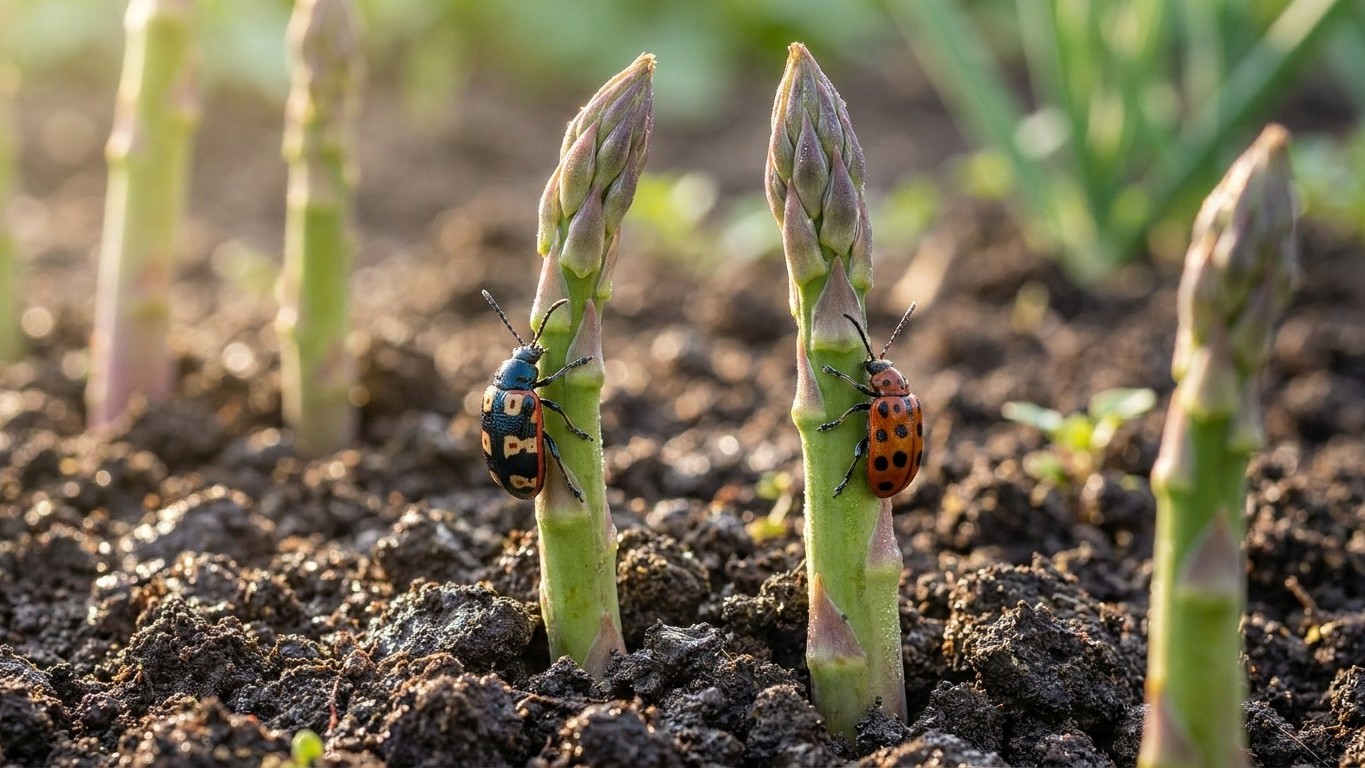

Stop cutting when most of the spears coming up are thinner than a pencil. That rule is an object, not a date. Nothing gets cut until year 3, and that first harvest runs four weeks, then six the next season, then eight. Cut spears keep best at 0 to 2°C (32 to 35°F) with the butts standing in water. What follows covers the ground, the water and the planting date that make those harvests possible on Prince Edward Island. The full overview is in Growing Asparagus in Prince Edward Island.
The short answer
A bed here is a 10 to 15 year commitment. Utah State University Extension, the only authority behind this page, sets one soil requirement: most soils will do, provided they are well drained. Everywhere else in the garden, a heavy or poorly draining soil is a nuisance you amend every season. With asparagus it is a decision you make once, before the crowns go in, and cannot undo.
What the Island’s ground tends to do
The most common soil in the Agriculture and Agri-Food Canada survey of the province is a Podzol, the acid, leached soil that forms under conifers, where rain has washed the bases out of the surface. It covers 33 percent of the mapped surface, and Gleysolic soil comes next. The median surface is sandy, at 66 percent sand, 7 percent clay and 27 percent silt, with about 2.2 percent organic matter. Its median pH is about 4.8, which is strongly acid. That is the province’s middle value, not your pH. The asparagus source says nothing about pH, so there is no target to quote. A soil test on your own plot gives the number that matters.
Does that drain well enough? The sand says yes. The survey’s drainage class for the dominant soil says imperfectly drained, which means water lingers for part of the year. Treat that as a maybe, not a pass. The Gleysolic soils in second place are the type that form where water sits. River bottoms and any ground a builder has scraped or filled will differ again, and the survey covers agricultural land, not every lot.
If your own spot holds water, there are two honest options. Dig a test hole where the furrow will go, fill it, and watch how long it takes to empty. If it lingers, build the bed up above grade or move to higher, sloping ground. The 8-inch furrow has to sit above the wet. Will Prince Edward Island Soil Hold an Asparagus Bed for Fifteen Years? walks through that decision in more detail.
What the years look like once drainage is settled
The crowns are planted in early spring and left alone. No spears are cut in year 1 or year 2. Year 3 brings the first harvest, limited to four weeks. Year 4 allows six, and after that eight. Cutting stops when most of the spears are thinner than a pencil, whatever the calendar says, and the thin ones that follow are left to grow on. A bed that is cut past that point is being drawn down rather than fed, and it has 10 to 15 years of work ahead of it.
Will the summer here water it for you?
A young bed wants 25 to 50 mm (1 to 2 inches) every other week for two years, then every three weeks. Here is how Island summers measure up against that, and what you add.
- Read the normals. At the Charlottetown A station, June through August brings about 274 mm (10.8 inches) of rain, out of 1158 mm (45.6 inches) over the full year. June averages about 99 mm (3.89 inches), July 80 mm (3.15 inches) and August about 96 mm (3.77 inches). July is the driest month. These are 30-year averages from Environment and Climate Change Canada, not a forecast, and a different part of the Island can run higher or lower.
- Do the arithmetic. Even in July, 80 mm spread over the month works out to roughly 36 mm (1.4 inches) per fortnight. On paper, an ordinary summer lands inside the 25 to 50 mm band without help from a hose.
- Subtract what the ground lets go. Paper rain is not root-zone rain. On a sandy surface, an inch passes through within the day. A single thunderstorm often runs off instead of soaking in, and hot days drive evaporation harder still. The reverse can also happen. On imperfectly drained patches, water sits and no watering is needed, but then drainage is the problem, not the hose.
- Add the gap, not the whole amount. In a fortnight when the gauge shows 25 mm or more, you add nothing. When it shows less, make up the difference, up to 50 mm in a fully dry stretch. In practice that means little in a normal summer and the full dose in a dry spell. For the first two years, check every other week. After that, every three weeks.
- Put a gauge on the plot. A straight-sided container set beside the bed settles the question better than any station average. A rain shadow, a slope or a nearby building can change what lands on your ground.
When to put the crowns in
Crowns go in early in spring, set into furrows 8 inches deep. Anchor that to the last spring frost, which averages around May 16 at the Charlottetown A station, according to Environment and Climate Change Canada. Read that as the middle of a window, not a safe date. In one year out of two the last frost falls later. Districts away from Charlottetown, particularly northern or upland ones, run weeks behind the station. Those frost normals are also averaged over a different period from the US figures you may see elsewhere, so don’t compare them directly.
The furrow is not filled in at planting. It is backfilled gradually through the year, 2 inches at a time, every other month, until the ground is level. Four rounds of that, and the bed is closed. Filling it all at once is the shortcut to skip.
Four varieties are named in the Utah State University Extension material, and the only thing it says about each is its sex. Jersey Giant and Jersey Knight are all-male. UC 157 F1 and Purple Passion are a mix of male and female. No flavour, yield or reason to prefer one is published, so any claim that one tastes better or yields more has to come from somewhere else. Name your own priorities, and buy from a nursery you trust.
Seed is the alternative to crowns. The sources behind this page give no sowing dates for the Island, so there is no date to invent here. It stands to reason that a plant grown from seed has to reach crown size first, which pushes the first harvest later. Plan the whole calendar from the crown schedule, and count year 3 from the day the plants are in the ground. Once spears start to emerge, they are not the only ones interested. What Eats Asparagus in Prince Edward Island, and When covers who shows up and when.
Common questions
Can I cut a few spears in year 2?
No. Nothing is harvested until year 3. The first cutting window is four weeks, which grows to six and then eight in later seasons. The wait is part of why a bed lasts 10 to 15 years.
How do I know it is time to stop cutting this season?
Look at the spears, not the calendar. When most of the new spears come up thinner than a pencil, stop cutting and leave them. There is no week number to count to, because it depends on how the bed is doing that year.
How should I keep spears after cutting?
The target is 0 to 2°C (32 to 35°F) with near-saturated air, between 95 and 100 percent humidity. Both edges bite. Above 10°C (50°F), spears toughen rapidly, within hours. At about -0.6°C (31°F) or lower they freeze, turning water-soaked and collapsing on thawing. In a home kitchen, the practical way to get that humidity is to stand the butts in water or wrap them damp, since spears lose moisture through the cut end faster than anywhere else. A fridge set near the cold end of the range does the rest.
Should I test the soil before planting?
Yes, and test the drainage too. The province’s dominant soil is acid, sandy and imperfectly drained, but that is the median across hundreds of soils, and your lot can differ from it in either direction. A test hole and a soil test cost far less than 15 years in the wrong spot.