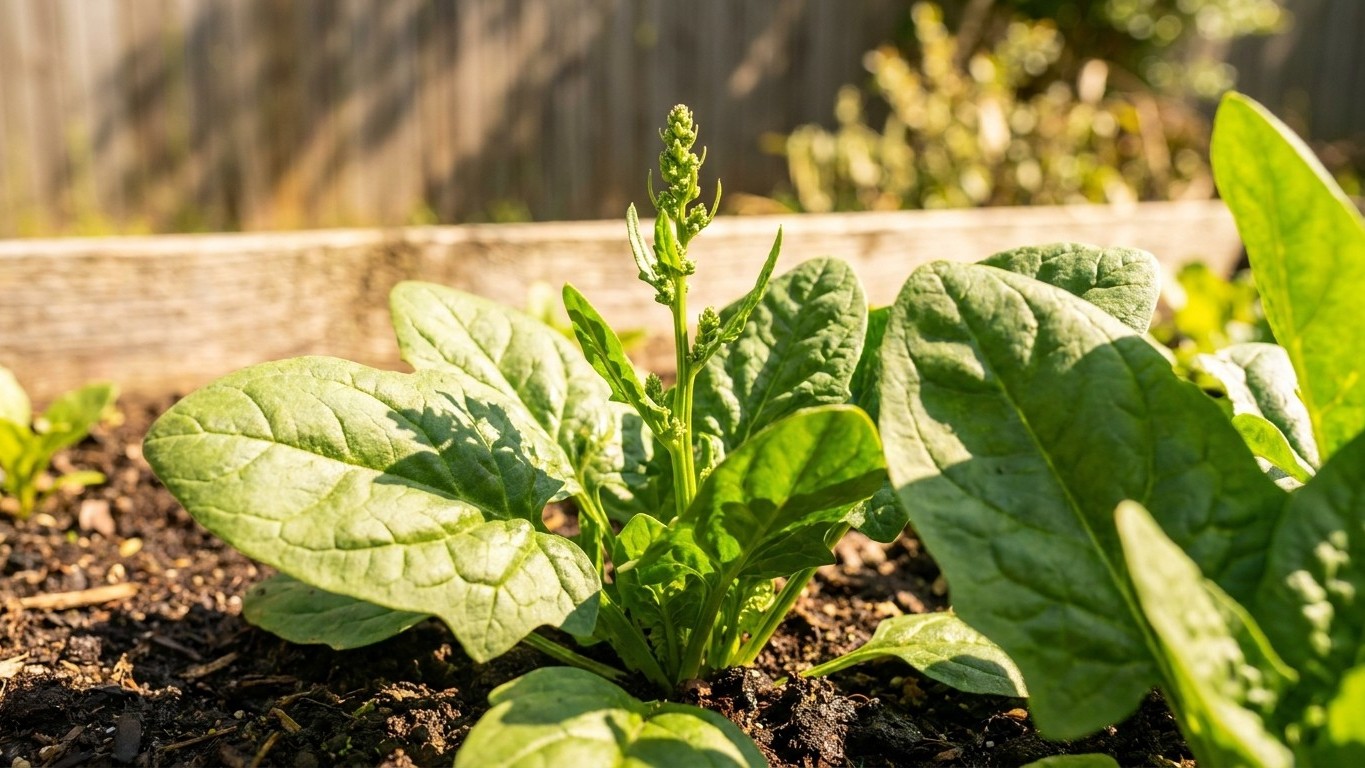

Cut New Jersey spinach while the plants are leafy and the weather is cool. That means spring, from the first pickings until daytime temperatures start nudging 75 F, and again in autumn until frost arrives. Once a flower stalk starts to rise, the cutting is over. Cut leaves then keep for 2 weeks at the very most, and only at 32°F. In an ordinary fridge, expect much less.
The short answer
On the longest day of the year, Newark gets 14 h 55 of daylight. That figure matters more to spinach than most gardeners expect. Spinach bolts during long days and warm temperatures, according to Utah State University Extension, and the day-length part works on its own. A cool summer does not rescue the crop. If the nights are mild and the afternoons stay in the 60s, the plant still reads the calendar and the sunrise, and it still heads toward flowering. Nothing in New Jersey’s climate buys extra weeks in June or July.
So the limit here is both day length and heat, and they stack. Spinach grows best where temperatures do not exceed 75 F. The reference station at Newark records a mean of 20.8 days a year at 90°F or more, which gives you a sense of how much heat arrives once spring ends. That 75 F line does two jobs: it is the ceiling for good growth and the point where leaves turn bitter. It is a temperature, not a date, so it moves with each year’s weather.
When to cut
Cutting time follows the plant, not a fixed number of days. The source we rely on publishes no days-to-maturity for spinach, so any figure you see on a seed packet or in a forum is not backed up here. What you can do is pick leaves once they are big enough to eat, keep picking while the weather stays cool, and cut the whole bed the moment the center of the plants begins to elongate or the forecast keeps sliding toward 75 F. A harvest that is bitter and tall is a harvest you waited too long for. For more on how fast that turn can happen, see Will Spinach Bolt Early in New Jersey?
The frost dates frame both ends of the season. At the Newark airport station, the last spring frost falls between March 29 and April 6, and the first fall frost between November 4 and November 16. Those come from NOAA NCEI climate normals for that one station. Suburban and rural gardens typically see the last spring frost later and the first fall frost earlier, often by one to two weeks, and more at elevation. Treat the Newark dates as a reference point, then check your own county’s numbers with your county extension office.
How long it keeps after cutting
Spinach is a short-lived vegetable once it leaves the garden. The UC Davis Postharvest Technology Center puts the optimum at 0°C (32°F) with relative humidity of 95 to 98%, and states that spinach “is highly perishable and will not maintain good quality for more than 2 weeks.” You can read the full entry on the UC Davis spinach fact sheet. Read that as a ceiling, not a promise. Wilting, yellowing, and decay increase after 10 to 14 days, and they come faster at 5 to 10°C (41 to 50°F), which is about what a home fridge delivers, especially in the door.
For a home kitchen, that means the back of the bottom shelf, the coldest and most stable spot, rather than the door shelves where every opening lets in warm air. Leaves cut on a cool morning and chilled quickly have the best shot at reaching the upper end of that range. Plan on eating the harvest within a few days anyway.
How long the spring window really is
Spring spinach has a start date you can calculate and an end date you cannot. The start comes from the frost dates. The end depends on the thermometer, and in New Jersey it tends to arrive quickly. Here is how the count works, step by step.
- Find your sowing window. Spinach goes in 2 to 3 weeks before the last frost. With the Newark station’s last frost between March 29 and April 6, that points to roughly March 8 through March 23. The window is about two weeks wide. A garden that frosts later, as many suburban and rural plots do, should slide the window later by the same one to two weeks.
- Sow into cold soil without worry. Seed germination drops off above 80 F soil, and nothing in a New Jersey March comes close to that. The soil is on your side at this stage.
- Pick as the leaves size up. No days-to-maturity is published for spinach, so the first cut happens when the leaves are worth eating, not on a countdown. Everything from that day forward is borrowed time against the warming weather.
- Watch for the 75 F line. Once daytime temperatures hover near 75 F, growth stops being good and bitterness enters the picture. The date this happens is not published here, and it shifts from one spring to the next, so keep a thermometer where the bed sits.
- Add the clock overhead. Days keep lengthening through spring toward that 14 h 55 peak. Long days alone trigger flowering, so the daylight pressure rises even in a cool May.
What that adds up to
Count it in words: a sowing window about two weeks wide that opens in the second week of March, followed by a stretch of cool weather that lasts until highs reach 75 F. In New Jersey that stretch is a matter of weeks of picking, not a season. The crop you get is the one that grows in the narrow gap between the frost-free soil and the first warm spell, so early sowing is not optional, it is the whole strategy.
This is also when insects and animals find the bed, which is its own planning problem, covered in What Eats Spinach in New Jersey, and When. For the overall growing picture, start with Growing Spinach in New Jersey.
The autumn crop, and when the soil lets you sow
Fall is the better second chance, but it has two obstacles, and they pull in opposite directions. One is heat that lingers in the ground after the air starts to cool. The other is the frost that ends the harvest. The sowing date sits between them.
Warm soil blocks the sowing
The trouble with an autumn crop is not cold. It is that late summer soil is still too warm to germinate seed. Germination is reduced above 80 F soil, and August and early September in New Jersey can easily keep a bed there, especially a sunny one with little cover. Seed that goes into soil like that may sprout poorly or not at all, which is a frustrating way to waste a packet.
In a hot region the window opens when the soil falls, not when the calendar says so. The soil temperature at which sowing becomes reliable is the 80 F line, and the date the soil crosses it is not published here. A cheap soil thermometer pushed an inch or two into the bed answers the question for your own garden better than any chart.
Frost ends the season, so count backward
The rule from Utah State University Extension is to plant 50 to 75 days before the date you want to harvest. Use the first fall frost as the realistic end of the harvest. At the Newark station that falls between November 4 and November 16. Counting back 50 to 75 days from November 4 gives September 15 down to August 21. From November 16, the same count gives September 27 down to September 2.
Put together, the sowing range runs from about August 21 to about September 27. The early end of that range collides with the warm-soil problem, so the later dates are usually the safer bet for germination. A garden that frosts one to two weeks sooner than the airport station should pull all of these dates earlier by the same amount, and that pushes the sowing closer to the warm soil, so the thermometer matters even more.
One thing works in your favor. Autumn days are getting shorter, so the daylight trigger that pushes spring spinach toward flowering fades instead of building. The heat and the clock that crowd the spring crop ease off in fall. What replaces them is the frost date, which is fixed and unforgiving.
Common questions
How do I know it’s time to cut my spinach?
Go by the plant. Pick leaves once they are big enough to eat, and cut the whole bed when the center begins to rise or when temperatures keep leaning toward 75 F. No days-to-maturity figure is published for spinach by the source used here, so a countdown from sowing would be a guess.
Will a cool summer let me keep spinach going into July?
No. The longest day in Newark runs 14 h 55, and long days alone trigger flowering, whatever the temperature does. Heat adds to the problem, but cooler weather does not cancel the day-length effect.
Which spinach variety should I plant?
The source names four: Bloomsdale, Melody, Teton, and Olympia. It gives no data about any of them, such as bolting resistance or days to harvest, so nothing here ranks one over another. Pick one, sow on time, and let your own results guide the next planting.
How long does cut spinach last in the fridge?
At 32°F with 95 to 98% humidity, UC Davis says spinach will not hold good quality for more than 2 weeks, and quality declines from 10 to 14 days onward. At 41 to 50°F, the range a fridge door actually delivers, the decline is faster. Store it at the back of the bottom shelf and treat 2 weeks as the absolute limit, not the plan.