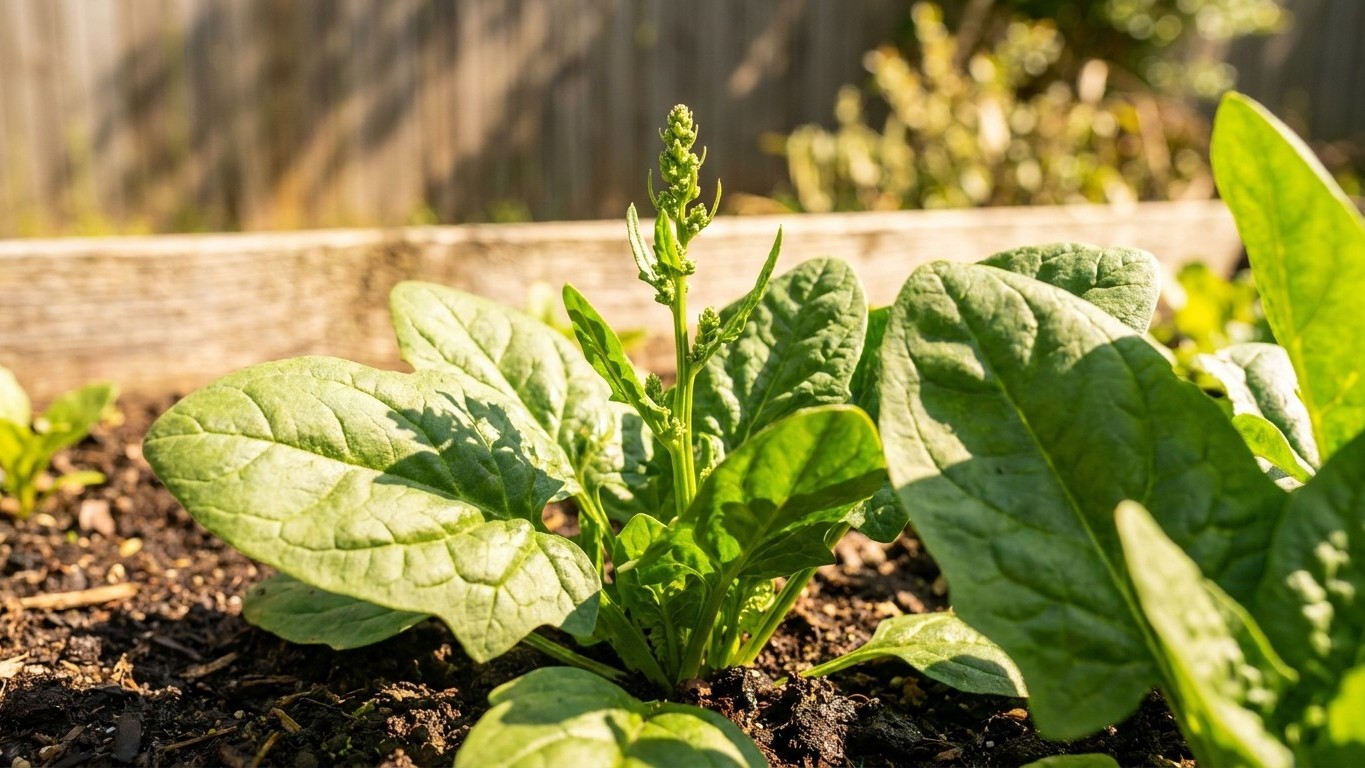

Spinach in New Jersey gets eaten by a few groups of pests. Chewers leave holes, sap-feeders curl and yellow the leaves, leaf-mining larvae tunnel inside the blade, and slugs work at night after rain. Timing follows the weather more than the calendar: spring seedlings are hit in the weeks after the last frost, and fall seedlings are hit while late-summer soil is still warm. Which species are around depends on your county.
Which pests attack spinach in New Jersey
Rutgers Cooperative Extension is the service that documents garden pests for the state, and its county offices are where a specific insect gets a name. The species active in a given county, and the products legally labeled for spinach in the state, are for the extension office to say.
Which pests belong on a spinach bed?
Four groups account for most of the damage on leafy greens like spinach.
- Slugs and snails. They chew ragged holes and leave slime trails. Seedlings in cool, damp spring and fall weather suffer most.
- Chewing insects. They cut small, round or irregular holes, often many per leaf. Larvae of moths and beetles are the usual culprits.
- Sap-feeding insects. They cluster on the underside of leaves and on the growing tip. The leaves curl, yellow and turn sticky.
- Leaf-mining larvae. They live between the two leaf surfaces and leave pale, winding tunnels or blotches. Mined leaves are still edible, but nobody wants them.
Larger animals such as deer and rabbits also take spinach, and they take all of it. If whole plants are clipped to the ground overnight, the cause is an animal and not an insect.
Which listed pests can you ignore on spinach?
Extension lists for the state cover a lot of ground, and plenty of it has nothing to do with a salad bed. Tree-boring insects and scale insects live in wood and on bark. They do not feed on a leafy annual, and spraying for them in the garden is wasted effort. Fruit-crop pests and lawn grubs, which eat turf roots, also leave spinach alone.
The mistake that costs the most is treating before knowing what is there. Identify the animal first, then decide whether anything needs doing, because spinach often finishes before a pest population builds.
When each one shows up, and what it does first
Spinach is a cool-season crop with a narrow stretch of good weather on each side of summer. At the Newark reference station, the mean last spring frost falls between March 29 and April 6 and the mean first fall frost between November 4 and November 16. Suburban and rural gardens usually see the last spring frost later and the first fall frost earlier, often by one to two weeks. Pests keep to that same cool window, so the useful clock starts at sowing and transplanting, not at a month name.
When do pests hit spring spinach?
Slugs and snails come first. Within the first couple of weeks after seedlings emerge, the first sign is usually a missing seedling or a small leaf chewed to the veins, with a shiny trail on the soil or the leaf. Cool, wet spells make it worse.
Sap-feeders follow as the weather warms toward the end of the cool window. Look for leaves that curl inward, a sticky shine, and stunted new growth. Leaf miners tend to show up once the plants have real leaves, a few weeks after emergence. What you see first is a pale, thin line or blotch under the leaf surface, and holding the leaf to the light makes it obvious.
Spring has a hard stop that has nothing to do with insects. Spinach flowers in response to long days as well as warmth, and the longest day at the reference city offers 14 h 55 of daylight. Plants that bolt are stressed, and stressed plants are less able to shrug off feeding. See Will Spinach Bolt Early in New Jersey? for how that plays out.
When do pests hit fall spinach?
The fall crop is sown into the tail end of summer. Seed germination drops when soil is above 80 F, so the sowing window opens when the soil cools and not when the air feels autumnal. The timing is covered in When to Sow Autumn Spinach in New Jersey.
Tiny fall seedlings meet whatever pests are still active from late summer. Chewing insects are the first problem, and the sign is a seedling cut off or stripped overnight. As nights cool and dew gets heavy, slugs return. Newark averages 20.8 days a year at 90 F or higher, and a hot spell after sowing leaves seedlings stressed, tender and easy targets. Growth is best where temperatures stay at or below 75 F. Once the first fall frost arrives, feeding slows sharply and the main concern becomes the animals that browse the bed.
Telling the damage apart from everything else
A spotted, yellow or holey leaf is not proof of an insect. Several non-pest problems look similar, and treating the wrong one wastes a crop that only has a few weeks. The table pairs common symptoms with their look-alikes and the sign that separates them.
| What you see | Possible causes | What settles it |
|---|---|---|
| Ragged holes, shiny trails | Slugs or snails. Hail or a hard rain can also tear leaves. | Trails on soil and leaf point to slugs. Torn, clean-edged leaves with no trail point to weather. |
| Small, round holes | Chewing insects. Mechanical damage from a trowel or a brush with a hose. | Look for frass (droppings) or the insect itself at dusk. Mechanical damage has no pattern. |
| Pale, winding tunnels or blotches | Leaf-mining larvae. A leaf spot disease. | Hold the leaf to the light. A larva or a tunnel with a dark line inside means a miner. A spot with a defined edge and no tunnel is more likely disease. |
| Yellow lower leaves, no holes | Nitrogen shortage. Soggy soil. Sap-feeders. | Check under the leaves for clusters of insects. If none, check drainage and when the bed was last fed. |
| Wilting at midday, perking up at night | Dry soil or heat. A root problem. | Dig a finger down 2 inches. Dry soil explains it. Moist soil and persistent wilting means look at the roots. |
| Tall central stalk, narrow leaves | Bolting. | The stalk itself is the sign. No spray fixes a bolted plant, because the plant has switched to making seed. |
Warm weather above 75 F also makes spinach bitter and pushes it to flower. A bitter, tough leaf with no damage is a weather problem, not an insect problem.
When the signs overlap, take a leaf with the damage, in a sealed bag, to the county Rutgers Cooperative Extension office, and ask them to name it.
What actually works here, and what is a waste of time
A physical barrier set at sowing beats nearly any treatment applied later. A floating row cover laid over the bed right after seeding keeps out flying insects before they find the crop. Edges need to be sealed with soil or boards, because a gap is an invitation. Pull the cover off once warm days arrive, since fabric traps heat and spinach goes downhill above 75 F.
On a short season the calendar does more than any product. Sowing as early as the soil can be worked in spring lets plants size up before the heat and the long days arrive. Sowing in fall once the soil has cooled avoids the stretch when seed will not germinate and seedlings are weakest.
Other cheap habits help. Water in the morning so leaves dry before night, because wet leaves and soil are what slugs want. Space plants so air moves through. Clear plant debris and boards where slugs hide, and rotate the bed. Hand-picking at dusk works well for a small bed.
Here is what wastes time. Spraying on a guess is the top offender, because a product aimed at one pest does nothing to another and the leaf miner is protected inside the leaf. Spinach is eaten within weeks of growing, so any treatment has to be labeled for spinach and respect the waiting period before harvest. That is label and state law, and it is why the extension office is the place to ask about products. Planting later in spring to dodge pests backfires, since heat and long days arrive and the crop bolts. Kitchen-cabinet sprays have no reliable track record, and some burn tender leaves.
Where to check this for your own county
Rutgers Cooperative Extension has an office in each county, staffed by people who see local garden problems every season. They can tell you which insects are active near you right now, whether a pest has been confirmed in your area, and what is currently approved for use on spinach in the state. That last question changes, so it needs a current answer.
Presence varies inside the state. Frost dates from the Newark reference station will not match a hillside garden in the northwest or a sandy plot in the south, and pest pressure does not match either. The weather station numbers tell you how long the cool window is, and they do not tell you what is feeding in your yard.
For the broader picture of the crop, start with Growing Spinach in New Jersey. Before you treat anything, photograph the damage and the underside of the leaf, bag a sample leaf, and call or visit your county office.
Common questions
Do pests start right when I sow in spring?
Slugs and snails are usually the first to find new seedlings, often within the first couple of weeks after emergence. Sap-feeders and leaf miners generally come later.
Will a row cover stop everything?
It stops flying insects that would lay eggs on the plants, but only if it goes on at sowing and the edges are sealed. It does not stop slugs already in the soil, and it can overheat the bed on warm days.
Is a yellow leaf always an insect?
No. Yellow lower leaves with no holes and no insects underneath point to a nutrient or drainage problem. Check the undersides of the leaves first, then the soil.
Can fall spinach escape pests?
Partly. Feeding slows after the first fall frost, but seedlings are most exposed in the weeks after sowing, when late-summer pests are still active. Sow when the soil has cooled and protect the bed from the start.