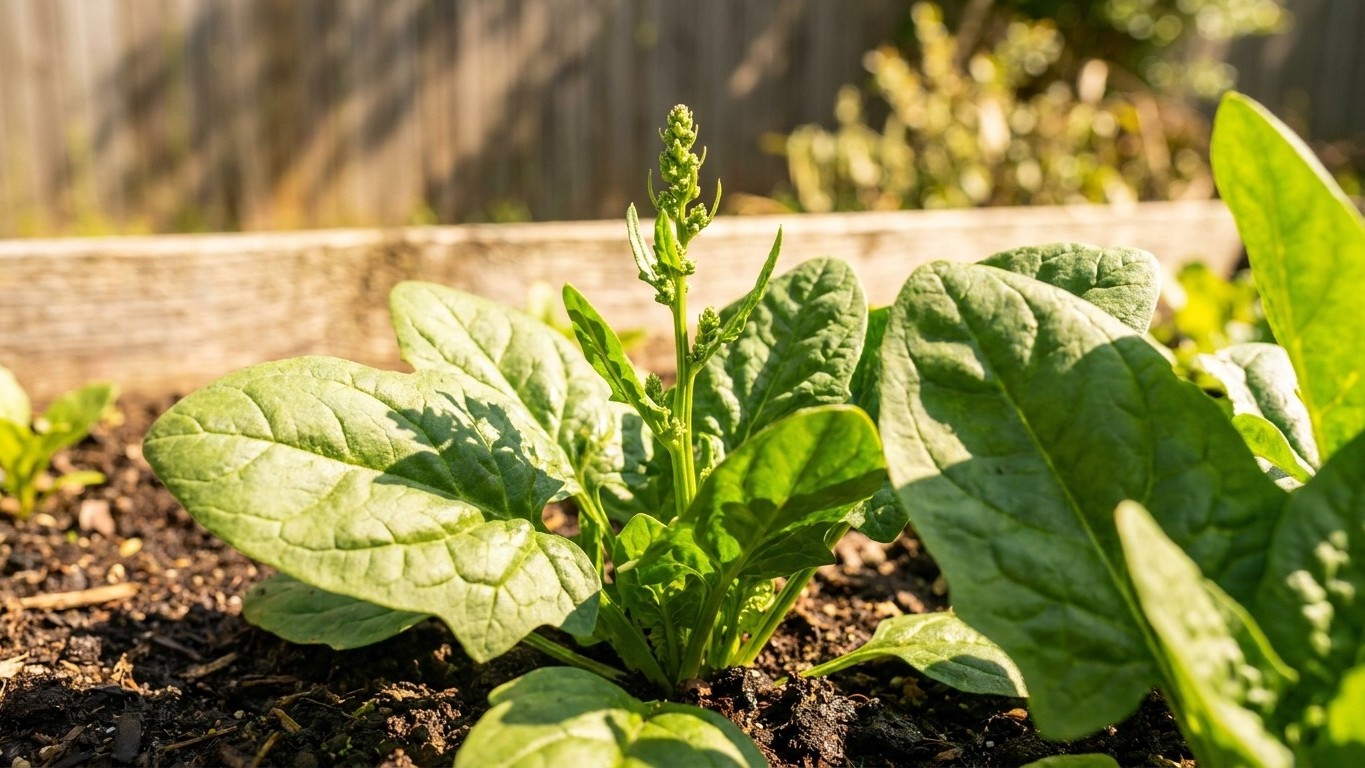

Cut spinach in Yellowknife-area gardens in two short bursts: a spring crop sown at the first workable ground and cut before the longest days arrive, and a July sowing cut before the first frost. Once cut, it holds two weeks at most, and only at 32°F. The reference point for every date below is Environment and Climate Change Canada’s Yellowknife A station. Gardens farther north or on higher ground run weeks behind it.
The short answer
On the longest day of the year, Yellowknife gets 19 h 30 of daylight. That figure is calculated from the station’s latitude and counts the sun’s geometric horizon only, so real daylight runs a few minutes longer. For spinach, a day that long is a problem. The plant flowers (bolts) in response to long days as well as warm temperatures, and day length alone is enough to trigger it. A cool northern summer doesn’t change that. Cool nights and mild afternoons slow the heat side of the equation, but the calendar keeps pushing the plant toward a flower stalk regardless.
So the limit here is day length first, and heat a distant second. Utah State University Extension puts spinach’s comfort zone at temperatures that stay under 75 F (about 24 °C), the same number past which growth declines and leaves turn bitter. At Yellowknife A, the number of days reaching 30 °C averages 0.45 a year, and days reaching 32 °C average 0.03. Those counts describe extreme days, not ordinary warm ones, so they don’t tell you how often the garden crosses 75 F. They do tell you that heat is rarely what ends a northern spinach crop. The sun’s schedule is.
In practice, that means cutting early and often during the stretch when the plants are young and the days are still lengthening. Take leaves once they’re big enough to be worth eating, and if a seed stalk starts rising from the center of a plant, cut the whole thing that day. A bolted plant won’t reverse course. The fall sowing gets cut in the weeks before frost, using a different calendar (more on that below).
Two dates anchor the season, and both need a caveat. The average last spring frost at Yellowknife A is May 25, and the average first fall frost is September 18. They’re means, not guarantees. In one year out of two, the spring frost lands later than May 25, and in one year out of two, the autumn frost arrives earlier than September 18. Treat each as the middle of a window. Between the two dates sits roughly 16 weeks of frost-free time on average, and the spinach crops use only slices of it.
Then there’s the other half of the question: how long the leaves last after you cut them. UC Davis Postharvest is blunt about it. Spinach is highly perishable and will not maintain good quality for more than 2 weeks, and that’s at the ideal 32°F with 95 to 98 percent relative humidity. Wilting, yellowing and decay become more likely after 10 to 14 days. At 41 to 50°F, the range a typical refrigerator holds, it declines faster, and yellow leaves show up in days. Treat two weeks as a ceiling, not a plan. The coldest spot in a home fridge is usually the back of the bottom shelf, not the door, which swings through the warmest air in the box. Details on the cold-chain numbers are in the UC Davis spinach fact sheet.
For the full growing picture, start with Growing Spinach in Northwest Territories. The bolting question has its own page: Will Spinach Bolt Early in Northwest Territories?
How long the spring window really is
The arithmetic is short, and the answer is shorter than most gardeners expect. Here is how it works out, step by step.
- Start with the last frost. The mean date is May 25 at Yellowknife A. Half of years it comes later, so this is the middle of a range, not a date you can trust.
- Back up two to three weeks. Spinach is sown that far ahead of the last frost, which puts the target sowing at about May 4 to May 11 on an average year. That assumes the ground is workable by then. No thaw date is published for this page, so use a spade rather than the calendar to decide. If the soil is still frozen or sodden, the window simply starts later.
- Mark the heat ceiling. Growth stops being good above 75 F, and bitterness arrives at the same threshold. With days at or above 30 °C averaging well under one a year at this station, heat is unlikely to cut the season short. Check a thermometer in a sunny bed or under row cover, though, because a covered bed can run far warmer than the air outside.
- Mark the day-length wall. The longest day brings 19 h 30 of daylight. Counting forward from a May 11 sowing to the solstice gives about six weeks, and from May 4 about seven. Those weeks run on days that are lengthening toward the peak the whole time.
- Read the result. Usable spring is roughly six to seven weeks of growth between sowing and the longest day, and the crop has to be eating-size inside that span. That is arithmetic, not a published bolting date. The source publishes no days-to-maturity for spinach, so there is no honest way to say exactly when the first cut falls.
What this means in the garden is simple: sow the moment the soil can be worked, and don’t wait for a warm spell. Spinach is a cool-weather plant, and in the north the early start is the only part of spring you control. Waiting for comfortable gardening weather means sowing into days that are already long, which hands the plant its flowering signal before it has grown much.
A late sowing in June looks reasonable on the calendar, since the frost risk is long gone. In practice it starts life at or near the peak of day length, which is the exact condition that triggers flowering. Better to save that bed for something else and aim the next spinach sowing at July.
On varieties, Utah State University Extension names four: Bloomsdale, Melody, Teton and Olympia. The source gives no data on any of them, so nothing here ranks or describes them. If a seed packet claims a variety resists bolting, take it as a seed-packet claim, not a measured result for this latitude. Pests are a separate matter that can shorten the window too, and What Eats Spinach in Northwest Territories, and When covers them.
The autumn crop, and when the soil lets you sow
A fall crop in the north runs into two obstacles at opposite ends of the season. One is a soil problem in midsummer. The other is the frost that ends everything in September.
Warm soil blocks the sowing
The obstacle at the front end isn’t cold. It’s warmth. Seed germination drops once soil climbs above 80 F (about 27 °C), and a July bed in near-constant daylight can get there more easily than you’d guess. Bare dark soil under 19-plus hours of sun soaks up a lot of energy, and raised beds and containers warm even faster than ground-level plots.
No soil temperature record is published for this page, so the only reliable check is a thermometer pushed a couple of inches into the bed at midday. If it reads above 80 F, wait, or cool the bed before sowing. Light shade, a thorough watering and a day or two of rest can pull the number down. Sowing into soil that’s too hot doesn’t fail loudly. It just gives you a patchy, thin stand and a wasted packet.
Frost ends the season, so count back
The source’s rule for a fall crop is to plant 50 to 75 days before the date you want to harvest. It isn’t a days-to-maturity figure for spinach (none is published), only a planting guide. Start with the mean first fall frost at Yellowknife A, September 18, and count back. Seventy-five days before it is July 5, and 50 days before it is July 30. That gives a sowing window of July 5 to July 30 if the goal is to finish cutting by the average frost date.
Because that date is only the midpoint, and the frost arrives earlier than September 18 in half of years, it makes sense to give yourself a margin. Aiming to finish a week sooner, around September 11, moves the window to June 28 through July 23. Garden edges, low spots and northern or upland districts run weeks behind or ahead of the airport station, so shift the dates to match your own first frost, not this one.
Within the window, the two obstacles pull in opposite directions. Early sowings meet warm soil and days that are still near their longest, which invites bolting. Late sowings run out of weeks before frost. For most beds the middle of the window is the compromise, which means mid-July in an average year. Check the soil with that thermometer first, then pick the date.
Common questions
Does a cool summer give me extra weeks of spring spinach?
No. Long days alone are enough to make spinach flower, and the longest day here brings 19 h 30 of daylight. Cool air slows the heat side of the problem, but it doesn’t turn off the day-length trigger. The usable window stays short, roughly six to seven weeks between a sowing in early to mid May and the solstice.
Is May 25 a safe date for the last frost?
It’s an average, not a safe date. At Yellowknife A the mean last spring frost is May 25, and in one year out of two the final frost lands later. Gardens outside the airport’s climate can run weeks behind. Spinach is sown ahead of the last frost anyway, so the date is more useful as the midpoint of a range than as a deadline.
How long does cut spinach keep in the fridge?
Two weeks is the ceiling, not a promise. UC Davis Postharvest says spinach won’t hold good quality beyond two weeks even at 32°F, and wilting, yellowing and decay become more likely after 10 to 14 days. At 41 to 50°F, it yellows within days. Store it at the back of the bottom shelf, away from the door, and use it early.
Which spinach variety should I plant?
Utah State University Extension names Bloomsdale, Melody, Teton and Olympia, but publishes no data on any of them, so no honest ranking exists here. Pick on what you can verify (seed freshness, sowing date, soil temperature) rather than on bolting claims you can’t confirm.