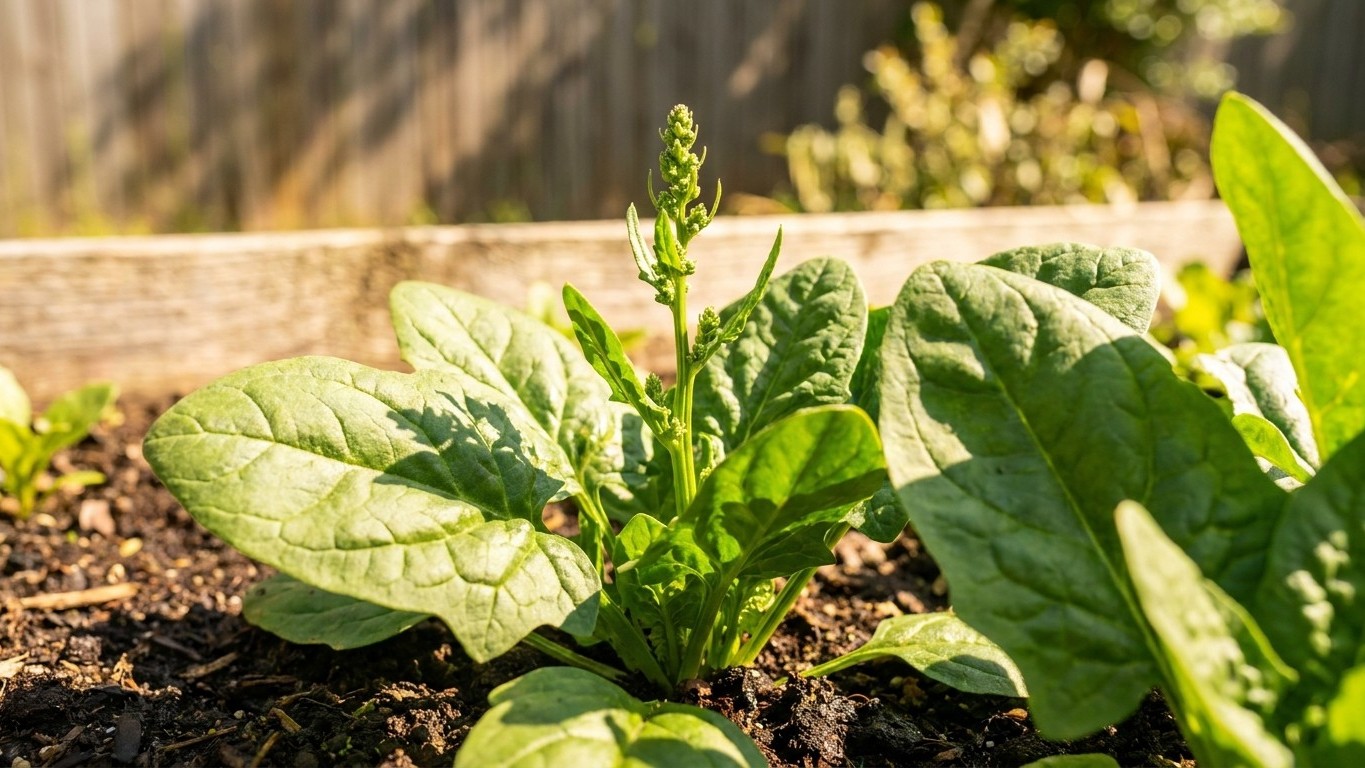

In the Northwest Territories, the thing that cuts a spinach crop short is mostly the calendar, not an insect. At Yellowknife A, the longest day runs 19 h 30, and long days alone push spinach to flower. Heat plays a smaller supporting role, and frost closes the season from the other end. Pest pressure is a separate question, and this page has no verified data on it. It sticks to what the sky and the thermometer do, and when.
The short answer
Yellowknife A gets 19 h 30 of daylight on the longest day of the year. That number is calculated from the station’s latitude with the standard sunset formula. It ignores the roughly seven minutes that atmospheric refraction adds, so the real day is slightly longer.
Spinach bolts, meaning it throws up a flower stalk and the leaves turn thin and bitter, during long days and warm temperatures. Utah State University Extension adds that it grows best where temperatures stay at or below 75 F (about 24 °C). Day length is the part that surprises northern gardeners. Long days alone can trigger flowering, so a cool summer does not buy extra weeks the way it would in a garden farther south. Cool air slows the clock a little, but the light keeps pushing the plant toward seed.
So is the limit here day length, heat, or both? Day length is the main one. Heat is a real but secondary factor. At Yellowknife A, an average of 0.45 days a year reach 30 °C, and 0.03 days a year reach 32 °C. Those figures count extreme days, not the whole season. They say nothing about how many days sit just above 24 °C, and that count is not published here. A sheltered, sun-soaked bed could still pass the 75 F line while the airport station stays comfortable.
Frost sets the outer edges. Environment and Climate Change Canada puts the average last spring frost at Yellowknife A on May 25 and the average first fall frost on September 18. These are midpoints, not safe dates. In one year out of two, the frost arrives later than the average, and in the other half it arrives earlier. Treat each date as the middle of a window of several weeks.
Two cautions on those dates. They come from one airport station, and communities farther north or on different terrain run on their own clocks, sometimes weeks apart. And Canadian normals cover an older 30-year span than the US figures used elsewhere on this site, so comparisons across the border are loose. For the full growing picture, start with Growing Spinach in Northwest Territories. For how flowering unfolds in a long-day climate, see Will Spinach Bolt Early in Northwest Territories?
How long the spring window really is
The usual advice is to sow spinach 2 to 3 weeks before the last frost, and growth stops being good above 75 F. In a place where the days stretch toward 19 h 30, the real question is how many weeks pass before the light itself ends the crop. Here is the arithmetic, step by step.
- Anchor on the average last frost. At Yellowknife A that is May 25. Because half of all years frost later, this is the middle of the range, not a promise.
- Count back 2 to 3 weeks. That puts the sowing window between about May 4 and May 11. On paper, that is. Whether the soil in your yard is thawed and workable by then is not something the station data can tell you, so check the bed itself before you plant.
- Count forward to the longest day. From May 4 to the solstice in late June is roughly seven weeks. From May 11 it is closer to six. The days are already long in May and keep lengthening the whole way, so the plant is under flowering pressure for most of that stretch.
- Treat the result as a ceiling. Six to seven weeks is the most the calendar could allow, not what you should expect. The source gives no day-length threshold at which spinach starts to bolt, and no days to maturity, so any tighter number would be invented.
What does that leave? A short spring crop, and the earliest sowing you can safely manage is the one that counts. Every week of delay moves the harvest closer to the solstice, when the light is strongest. That is the opposite of how a warm-climate gardener thinks about spring, where the worry is the heat arriving. Here the worry is the light, and a cool week does little to hold it back.
The 75 F figure matters in this window too, but as a quality line rather than a date. It is the ceiling for good growth and also where bitterness sets in. A sheltered bed against a south wall, or a covered one, can cross it on a sunny afternoon even when the airport thermometer reads cooler. If you grow in a protected spot, keep a thermometer in it.
Once the leaves are picked, the clock runs again. UC Davis says spinach is highly perishable and will not hold good quality for more than 2 weeks, even at the ideal 0 °C (32 °F). That is a ceiling, not a plan. Harvest what you will eat soon.
The autumn crop, and when the soil lets you sow
A second crop is possible, but two obstacles stand in the way, one at each end of the sowing window. The only timing rule available is the one from Utah State University Extension: plant 50 to 75 days before the date you want to harvest. That is a planting lead time, not a days-to-maturity figure. The source publishes no maturity number for spinach, and none is borrowed here.
Warm soil, not cold, blocks the early sowing
Seed germination drops when the soil is above 80 F (about 27 °C). In a hot region, that is the thing that holds back a late-summer sowing, and the window opens only once the soil cools. Northern gardens face a milder version. With 0.45 days a year reaching 30 °C at Yellowknife A, the air rarely gets near that level. But soil temperature is not published in the data behind this page, so I cannot tell you how long a dark, sunny bed stays above 80 F. A cheap soil thermometer pressed 2 inches down settles the question for your own bed in half a minute.
Bolting is the other problem with an early sowing. Seed planted in late June or early July goes in under days that are still very long, just past the longest day of the year. The plant is germinating into the same light that makes it flower, which is a poor start. For a closer look at the timing, see When to Sow Autumn Spinach in Northwest Territories.
The first frost sets the end date
Now count back. The average first fall frost at Yellowknife A is September 18. If you wanted to be harvesting on that exact day, 50 days earlier is July 30, and 75 days earlier is July 5. That gives a sowing window of about July 5 to July 30.
Don’t plan to the average, though. Half of all years bring frost earlier, so a realistic harvest date sits a week or so ahead of September 18. Aim for about September 8, and the same count lands between June 25 and July 20. The earlier end of that range runs straight into the long-day problem described above, and the later end leaves little slack if the frost comes early. The practical choice is probably the middle of the range, with the seed in the ground in early to mid July, though that is a judgment call and not a published rule.
The same station caveat applies. Yellowknife A is one airport. A garden in a colder pocket or farther north should count back from a frost date that arrives earlier, and the whole window slides with it. The source names four varieties (Bloomsdale, Melody, Teton and Olympia) but publishes no data on any of them, so there is no basis here for saying which one handles a short northern season best.
Common questions
Do insects and pests eat spinach in the Northwest Territories?
Pest data is not part of the verified material for this page, so no pest list or dates are given here. The documented limits on a northern spinach crop are the light, the warmth and the frost. If you see damage, check the leaves directly and ask your local gardening group or territorial agriculture office what is active in your area.
Is heat a problem for spinach in the Northwest Territories?
Less than day length. Yellowknife A averages 0.45 days a year at or above 30 °C and 0.03 days at or above 32 °C. Those count extremes only. A sheltered bed can still pass 75 F (about 24 °C), the point where growth falls off and bitterness begins, but how often that happens is not published here.
How long does harvested spinach keep?
Two weeks is the outer limit, and only at 0 °C (32 °F) with 95 to 98 percent humidity. At 41 to 50 °F, typical of a fridge door, it wilts and yellows within days. Put it at the back of the bottom shelf, not in the door, and use it early instead of counting on the full 14 days.
Which spinach variety should I grow?
The source lists Bloomsdale, Melody, Teton and Olympia. It publishes no data about any of them, including bolting resistance or days to harvest, so no ranking can be given here. Try one or two in a small bed and keep notes on when each one flowers.