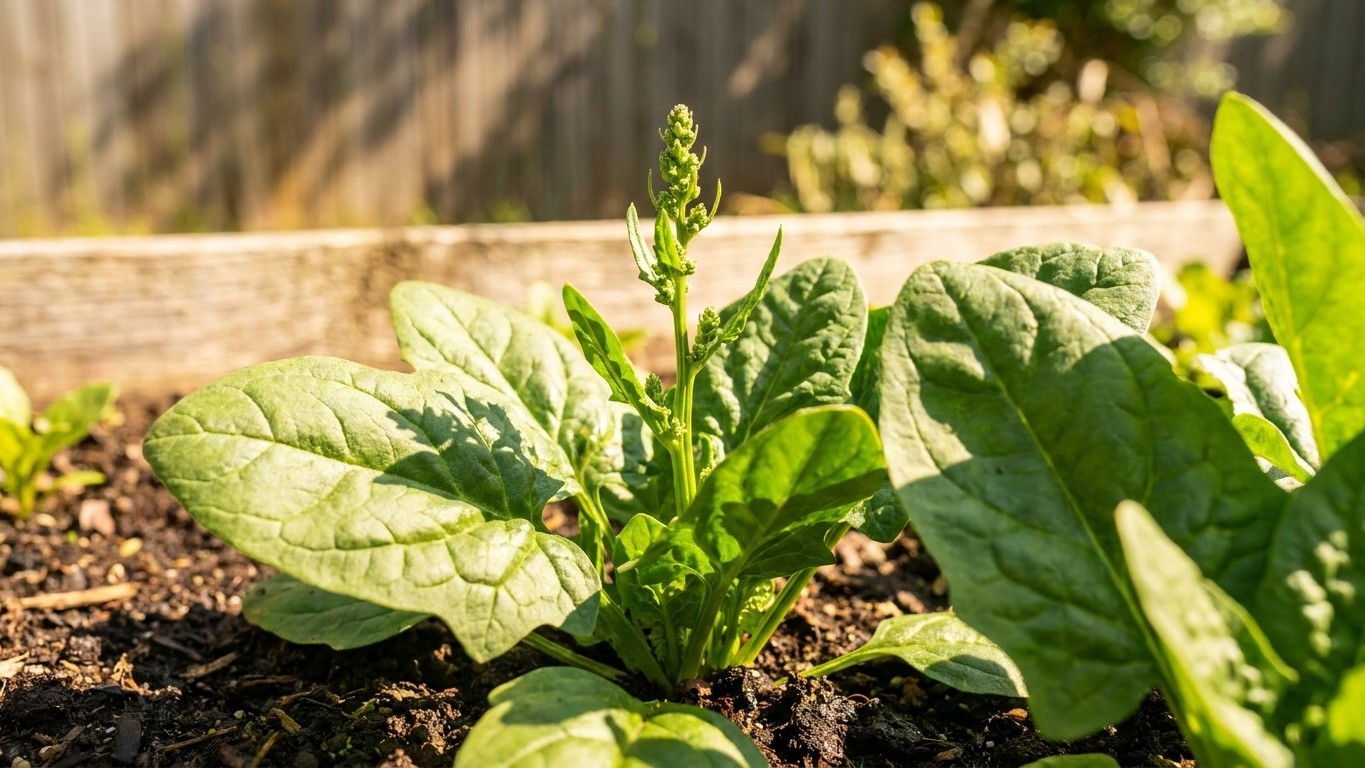

Cut spinach young, while the leaves are tender and before a stalk climbs from the center. In Nunavut the timing is tight because the longest day at Rankin Inlet A runs 19 h 41, and long days alone push spinach to flower. Sow in early June as soon as the ground allows, or again from the end of June through late July for a fall crop. Once cut, count the keeping time in days: two weeks is the ceiling, and only at 32°F (0 °C).
The short answer
Nineteen hours and 41 minutes. That is the daylight at Rankin Inlet A on the longest day of the year, calculated from the station’s latitude without counting the roughly seven extra minutes that atmospheric refraction adds. Spinach reads that number as a signal to flower. Utah State University Extension says plainly that spinach bolts during long days and warm temperatures, and that it grows best where temperatures do not exceed 75 F (about 24 °C). The word “and” matters there, because long days are enough on their own. A cool summer does not buy extra weeks.
People in the north often assume cool weather protects leafy greens. It does protect them from heat, but heat is not what ends the spinach season here. At the Rankin Inlet A station, the 30-year normals from Environment and Climate Change Canada show 0.03 days a year above 30 °C and 0.0 days at 32 °C. Heat of that order simply does not occur at that airport. This page has no published count of days above 24 °C, so it cannot say how often the air crosses the 75 F growth line. What it can say is that the binding limit in Nunavut is day length. Heat is a minor second factor at best.
What does that mean at the cutting board? Harvest early and often. Take leaves while they are young and the plant is still putting out a rosette. Once a central stalk starts to lengthen and the leaves turn narrow and pointed, the plant has switched to making seed, and flavor turns bitter. Cut the whole plant at that point and stop waiting. For the deeper mechanics, see Will Spinach Bolt Early in Nunavut?, and for the basics of the crop, Growing Spinach in Nunavut.
Then there is the second half of the question: how long the cut leaves last. UC Davis Postharvest Technology Center puts the optimum at 32°F (0 °C) with 95 to 98 percent relative humidity, and states that spinach is highly perishable and will not maintain good quality for more than 2 weeks (UC Davis Postharvest, spinach fact sheet). Read that as a ceiling, not a plan. Wilting, yellowing and decay become more likely after 10 to 14 days, and they come faster at 41 to 50°F (5 to 10 °C), which is about what a home fridge actually holds. Put the bag at the back of the bottom shelf, where the air is coldest and steadiest, not in the door.
One caution on geography. These dates and counts come from a single airport station on the Kivalliq coast. Nunavut spans several climates, and communities farther north or inland run weeks behind it, with even longer summer days. Treat every date below as a midpoint to adjust, not a promise.
How long the spring window really is
On paper the spring window is short, and on the calendar it is shorter than it looks. Work through it in order:
- Start with the frost date. The average last spring frost at Rankin Inlet A is June 19. It is a mean, which means that in one year out of two the last frost falls later. It is the middle of a window, not a safe date.
- Count back for sowing. Spinach is sown 2 to 3 weeks before the last frost. Counting back from June 19 gives roughly May 29 to June 5. Whether the ground is workable that early is a local question, and this page has no soil temperature data for it.
- Check the heat ceiling. Growth stops being good above 75 F. With 0.03 days a year above 30 °C at the station, heat does not close this window. In a southern state, heat would end the spring crop by early summer. Here it never gets the chance.
- Check the day length. The longest day, 19 h 41, arrives about two weeks after the average last frost. A seedling sown on June 5 sees its days lengthen for only about two weeks before they peak. Sown on May 29, it gets about three.
- Add it up. The usable spring window comes to roughly two to three weeks of lengthening days, starting from the earliest sowing date, and then the plants live under near-peak daylight whether or not the weather is cool.
So spring gives something like two to three weeks of useful runway. It is not a growing season in the southern sense. It is a short sprint that ends when the plants meet the longest days of the year, and the source does not publish a days-to-maturity figure for spinach, so I can’t tell you how large the plants will be by then. What helps is cutting small. Baby leaves, taken young and often, are the realistic harvest for a spring sowing in Nunavut, and a rosette that is allowed to size up may bolt before it gets there.
If a frost threatens the seedlings, a cover is cheap insurance, and the 50-50 odds on June 19 mean you will need it about half the time. Some northern gardeners also pull an opaque cover over beds in the evening to cut the hours of light the plants receive. That is a practical idea, not something with published data here, so try it on a small row first.
The autumn crop, and when the soil lets you sow
The fall crop is where the odds improve, because the days are shortening rather than lengthening. Two obstacles stand in the way, and they are not the ones most gardeners expect.
Obstacle one: soil too warm to germinate
Seed germination drops once the soil goes above 80 F (about 27 °C), according to Utah State University Extension. This is the standard trap for fall spinach in hot states, where the sowing window opens only when the soil cools. In Nunavut the picture is very different. With air temperatures that essentially never reach 30 °C at Rankin Inlet A, warm soil is rarely a problem in open ground. The exception is a dark bed under glass or plastic on a sunny day, where soil can run far hotter than the air. If you grow under cover in July, check the soil with a thermometer before you sow, not just the air.
Obstacle two: the frost that ends the season
The average first fall frost at Rankin Inlet A is September 13. Again that is a mean. In one year out of two the frost arrives earlier, so a harvest planned for September 13 is a coin flip. Utah State University Extension advises planting a fall crop 50 to 75 days before the date you want to harvest. Counting back from September 13 gives a sowing window from about June 30 to July 25.
For some margin, plan the harvest for a week or so before the average frost, which moves the whole window about a week earlier. The earlier end of the range, around the start of July, is also where the days are still close to their longest. The later end, late July, gives shorter days but less time to grow. The source publishes no day-length cutoff for spinach, so there is no number to aim for, only a direction. The trade-off is real, and sowing in the middle of the window is a reasonable compromise.
The source names four varieties, Bloomsdale, Melody, Teton and Olympia, and publishes no data about any of them. Nothing here can tell you which bolts last or matures fastest in the north. A small trial of two or three in the same bed will tell you more than any catalog. Pests also matter in the fall, and What Eats Spinach in Nunavut, and When covers what to expect.
Common questions
Is June 19 a safe date to plant after?
No. It is the average last frost at Rankin Inlet A, which means a later frost occurs in about half of years. The date is the middle of a range. Cover seedlings or hold some seed back for a second sowing. The same applies to the September 13 first fall frost, which is also a midpoint.
Which variety bolts last?
The published source lists Bloomsdale, Melody, Teton and Olympia and gives no data on any of them. Claims about bolt resistance for a named variety are not backed up here. Because long days alone trigger flowering, even a slow-bolting type will flower eventually under 19 h 41 of daylight.
Why not keep spinach in the fridge door?
The door is the warmest, least stable part of the fridge. UC Davis reports that spinach held at 41 to 50°F (5 to 10 °C) yellows and decays faster than at 32°F (0 °C), and quality is not maintained beyond 2 weeks even at the ideal temperature. Use the back of the bottom shelf and eat the leaves within days.
Can I still cut a spinach plant that has started to bolt?
You can, but expect the flavor to turn bitter. Once the central stalk is rising, take the whole plant instead of waiting for a better harvest. Seed left in the ground will not rescue the season, so use the bed for a quick fall sowing if the dates still fit. The 75 F figure is both the growth ceiling and the bitterness threshold, and it is a temperature, never a date on the calendar.