
Three things eat into a spinach season in Nunavut: day length, a short frost-free stretch, and, only in sheltered spots, heat. Day length is the one that doesn’t budge, and cool weather doesn’t offset it. Heat above 75 F is a minor, local problem. The two frost dates set the outer edges of the season, but both are averages, not promises. Here is how each one works, and what it leaves you.
The short answer
On the longest day of the year, Rankin Inlet gets 19 h 41 of daylight. That figure is calculated from the station’s latitude with the standard sunset formula, using the geometric horizon, so the real number runs about seven minutes longer once atmospheric refraction is counted. Either way, it is a very long day. Rankin Inlet A is the reference station for this page, and communities farther north see even more sun around the solstice, to the point where it doesn’t set at all.
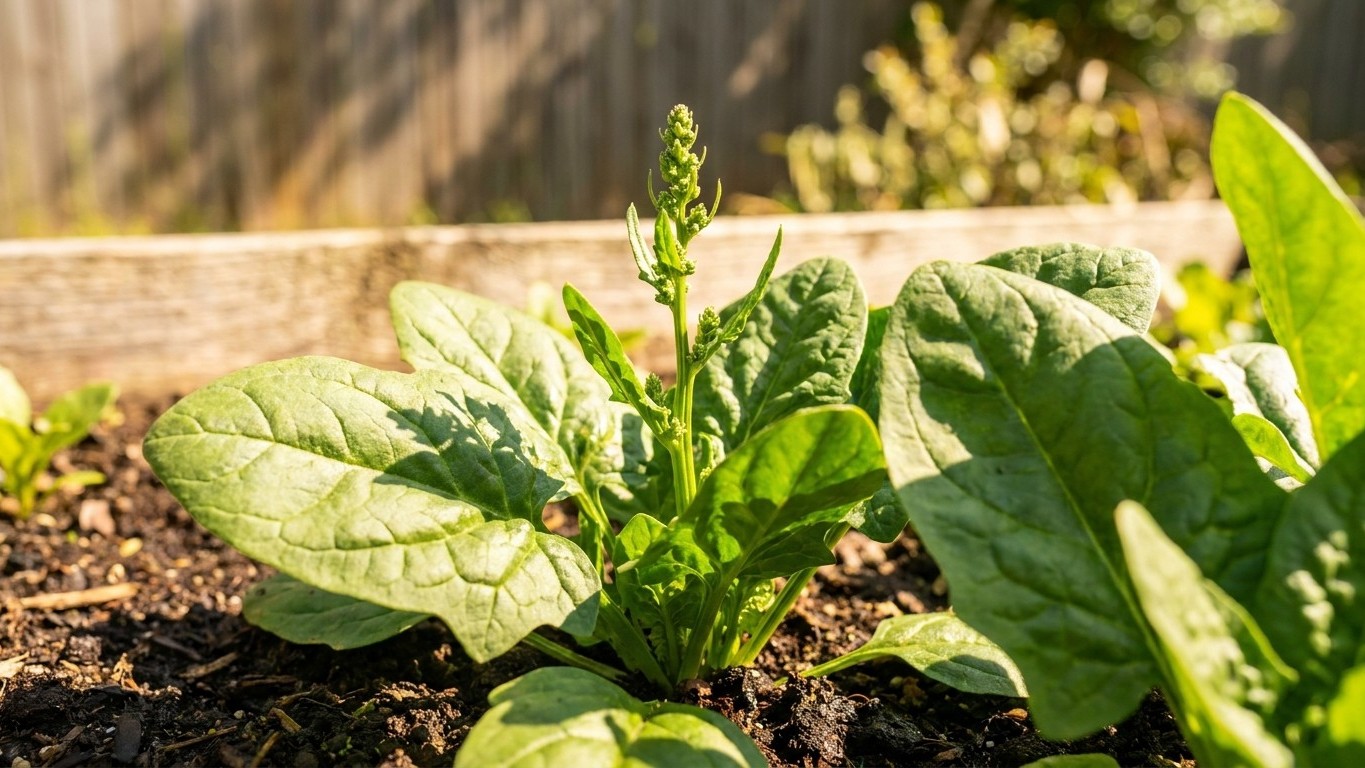
That matters because spinach flowers in response to long days as well as warm temperatures, according to Utah State University Extension. Long days alone are enough. The usual garden instinct says a cool summer protects leafy greens, and for lettuce-minded gardeners in warmer places it often does. Here it does not buy extra weeks. A bed at 55 F under a 19-hour sky is still getting the signal to bolt, and a bolted plant puts its energy into a flower stalk instead of tender leaves.
So which limit is it, day length or heat? Day length, first and clearly. Heat is the lesser, local factor. Utah State puts the best growing range for spinach at temperatures that do not exceed 75 F, and that same number is where bitterness begins. But the climate normals for Rankin Inlet A show 0.0 days a year reaching 32 °C, and that zero is measured: thirty years of complete daily records never reached it. The count above 30 °C is 0.03 days a year. Heat of that order simply does not occur at the station.
Those two thresholds sit well above 75 F, though, so they can’t tell you how often an ordinary July afternoon crosses the growth ceiling. That number is not published here. The places where it is most likely to happen are the ones you create: a south-facing wall, a dark raised bed, a closed cold frame, or a greenhouse on a calm, sunny day. In open ground the daylight is the problem. Under cover, you can add heat to it.
The frost dates frame everything else. The average last spring frost at Rankin Inlet A is June 19, and the average first fall frost is September 13. Both come from Environment and Climate Change Canada’s thirty-year normals, and both are means, so in one year out of two the frost lands later than the date shown. Treat each as the middle of a window. Other Nunavut communities, especially farther north, will run behind these dates, so a garden in another settlement should expect different numbers.
For the full growing picture beyond the calendar, see Growing Spinach in Nunavut. This page covers only what shortens the season.
How long the spring window really is
Spring sowing advice says to plant two to three weeks before the last frost. Put that against the Rankin Inlet A averages and the window turns out to be short, which you can see by working through it step by step.
- Start with June 19. That is the average last spring frost. Half of years it comes later, so it is a midpoint, not a safe date.
- Count back two to three weeks. Two weeks ahead of June 19 is June 5, and three weeks ahead is May 29. The sowing window is therefore about one week wide, from roughly May 29 to June 5. Whether the ground is thawed and workable that early is local and not measured in the climate data. A covered bed usually thaws sooner than open soil.
- Check the heat ceiling. Growth stops being good above 75 F, and that is also where leaves turn bitter. Open ground at this station rarely meets that problem, given the zero count at 32 °C and the 0.03 days at 30 °C. A cover or a sunny wall can change that quickly.
- Add the daylight. The solstice falls about June 21, only a couple of days after the average last frost. Someone sowing on May 29 has about three weeks until then, with days already long and still lengthening toward 19 h 41.
- Read the total. From the first possible sowing to the longest day, the usable spring runs about three weeks. After that the crop is growing in the longest days of the year, which is the setting that triggers flowering.
Three weeks is not a lot. And the sources used for this page publish no days-to-maturity figure for spinach, so there is no honest way to say whether a sowing made on May 29 finishes its leaves before the long days push it toward a flower stalk. Anyone who gives you a neat number is borrowing it from somewhere else.
What the dates do show is the shape of the problem. The spring sowing starts when the days are already long, not when they are short and lengthening slowly. That is why this window is so different from, say, a garden in the mid-latitudes, where early spring still has plenty of room before the daylight peaks. In Nunavut you start close to the peak.
The autumn crop, and when the soil lets you sow
Autumn is the other chance, and in many places it is the better one for spinach. The rule from the source is to plant 50 to 75 days before the date you want to harvest. Two obstacles shape how that works in Nunavut: the soil can be too warm to germinate seed, and the first frost ends the season.
The soil: warm is the problem, not cold
Seed germination drops off once soil goes above 80 F, according to Utah State University Extension. In a hot region, that is what holds back an autumn sowing; the window opens only when the soil cools. At Rankin Inlet A, ordinary air temperatures don’t come close to that kind of heat, since heat of 30 °C or more occurs 0.03 days a year. So open ground is unlikely to be too warm for germination.
The exceptions are the same ones that affect spring: dark soil in a closed frame, a greenhouse bed, or a spot against a sun-baked wall. If you sow in one of those in July, check the soil itself, not the air, before you plant. A cooler bed beside it may be the better choice.
The frost: counting back from the end
The average first fall frost at Rankin Inlet A is September 13, again a mean, so half of years it arrives earlier. Counting back from that date shows the range. Fifty days before September 13 is July 25, and 75 days before is June 30. If September 13 were a guaranteed harvest day, the sowing window would run from June 30 to July 25.
It isn’t guaranteed, so a realistic harvest date should come earlier. Aim for about September 1, which leaves roughly twelve days of margin before the average frost. Counting back 50 to 75 days from September 1 gives a sowing window of about June 18 to July 13. That window opens right around the solstice, which is the wrong end of the calendar for a crop that bolts in long days. The source publishes no day-length threshold for spinach, so the exact cost cannot be calculated. It does mean the earliest autumn sowings go in under the longest days, while the later ones go in as days begin to shorten.
The sources used here don’t say how much cold a spinach plant tolerates, and no second frost threshold is published for this station, so only the average first frost date counts. For the sowing calendar in detail, see When to Sow Autumn Spinach in Nunavut.
Common questions
Does a cool summer let spinach grow longer in Nunavut?
No. Long days alone trigger flowering, and Rankin Inlet gets 19 h 41 of daylight on the longest day. Cool air helps with bitterness and the 75 F growth ceiling, but it does not cancel the day-length signal.
Is heat ever a problem at Rankin Inlet?
In open ground, rarely. The station recorded 0.0 days a year reaching 32 °C and 0.03 days a year above 30 °C. Under glass, plastic, or against a dark wall, the 75 F ceiling is much easier to reach, and the climate normals don’t count those days.
Which variety should I grow?
The source names four: Bloomsdale, Melody, Teton, and Olympia. It gives no data about any of them, so there is nothing reliable to say about how each performs here. Treat any claim about a variety’s bolting resistance in Nunavut as unsupported until you see it published.
How long does cut spinach keep?
UC Davis Postharvest lists the best storage at 32°F with 95 to 98 percent humidity, and says spinach will not maintain good quality for more than 2 weeks. That is a ceiling, not a plan. At the 41 to 50°F typical of a home fridge it yellows in days. Use the back of the bottom shelf, not the door. The UC Davis spinach fact sheet has the full numbers, and When to Cut Spinach in Nunavut, and How Long It Really Keeps covers the harvest side.