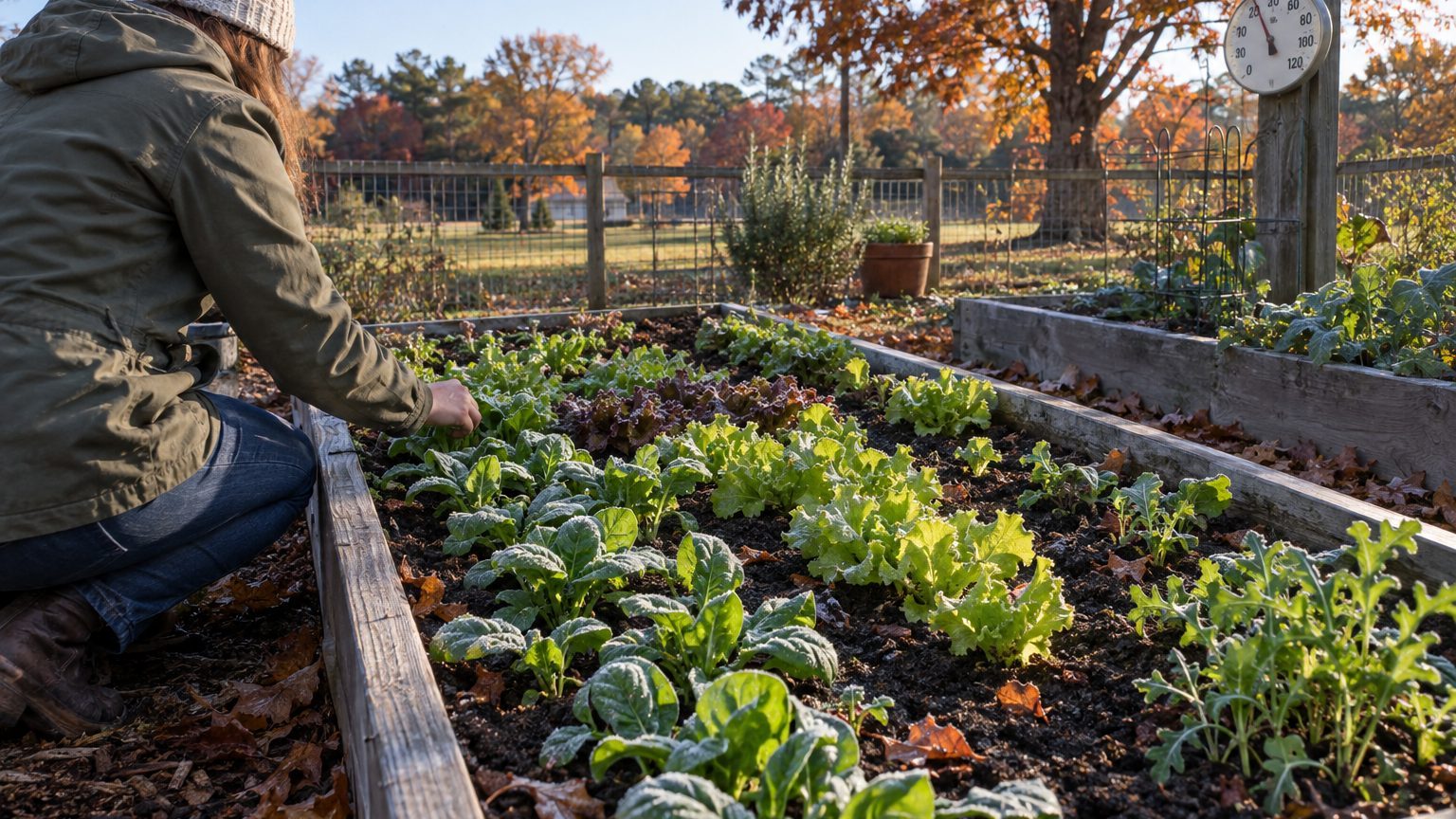

Sow Delaware winter salads in late summer to early fall, counting backward from the first fall frost. At the Wilmington reference station that frost arrives between October 26 and November 7. A second round can go in as the last spring frost passes, April 3 to April 14. Those dates describe one airport, not your yard, so use them as a starting line. For the wider picture, see Winter Salads for Delaware Gardens.
The short answer for Delaware
Think of the fall frost band as the door closing behind you. Seed has to be in the ground early enough to grow most of its leaves before that band opens, because growth slows hard once nights drop under freezing and days shorten. Spring works the other way: the last-frost band is when the bed starts to open back up for a second sowing of cold-tolerant greens.
| Event | Reference-city range (Wilmington) |
|---|---|
| Last spring frost | April 3 to April 14 |
| First fall frost | October 26 to November 7 |
These come from the NOAA NCEI 1991-2020 Climate Normals, station USW00013781. What they measure is a probability. Each range is the stretch of dates where the chance of a 32°F freeze sits between 30 and 70 percent. They are not the day the frost will fall, and a freeze can land before or after either window in any given year.
The station is an airport, which matters. Suburban and rural gardens usually see the last spring frost later and the first fall frost earlier than the airport does, often by one to two weeks. A gardener outside town should shift the fall edge of that window earlier and treat the spring dates as the earliest possible, not the typical.
The practical method is simple. Find the days to maturity on the seed packet, add a cushion for the slower growth of shortening days, and count back from your own version of the fall band. Fast baby greens tolerate a later sowing. Anything that needs to reach full size, like heading types or larger leaf crops, goes in first. Which types fit which slot is covered in The Best Winter Salads for Delaware.
This page does not have a dated Delaware winter-salad calendar from a state source, so the window above is built from frost probabilities alone. That is a sound framework, but it is not the same as a trialed schedule.
What will not work here
Start with the cold itself. The mean daily minimum of Delaware’s coldest month, at the Wilmington reference station, is 25.6°F. That is an average night, so real nights run colder. Tender lettuces left uncovered in an open bed will not carry through January and February. They stall, burn at the edges, or collapse. Hardy greens can hold in the open. Soft-leaved types need a cover, a cold frame, or a different plan.
Sowing too late is the second failure, and the frost dates explain it. A seed started on or after October 26, the opening of the fall band, gets a few weeks of weak growth before freezing nights arrive. What you end up with is seedlings, not salad. They may sit through winter and produce in spring, but that is a different crop on a different schedule, and a dry stretch or a hard freeze can erase it.
Sowing too early fails in a quieter way. Late summer in a humid state is warm in the soil and the air, and lettuce seed is fussy about heat. Germination turns patchy. The seedlings that do come up are crowded into damp, still air, which invites damping off and leaf disease. Close spacing that works in a drier climate backfires here. Give seedlings room, water in the morning so leaves dry quickly, and sow in the shade of taller plants if the bed is still hot in early September.
Spring sowing has its own limit. Overwintered plants and early spring sowings both bolt as days lengthen and the weather warms, and Delaware’s warming is not gradual enough to stretch the harvest much past late spring. A bed of lettuce hoping to run into summer will turn bitter and send up flower stalks.
The last thing that fails is trusting the airport. A gardener in a rural spot who sows to the exact October dates above is working with numbers that run a week or two optimistic on the fall side. In a low pocket where cold air settles, the gap can be wider. If you have already lost a crop to an early freeze, that is likely why, and the fix is a calendar shifted earlier, not tougher seed.
What changes across Delaware
There is no single Delaware answer. The USDA Plant Hardiness Zone Map (2023 edition, built on 1991-2020 normals) puts the state at 7a to 8a. That system rests on one variable, the average annual extreme minimum temperature, so it tells you about winter survival and says nothing about how long the growing season is or how hot summer gets. Zones 7a, 7b and 8a all fall inside the state’s range, and the spread is wide enough to change what you do in January.
North versus south
The reference city, Wilmington, sits in the northern end of the state. This page does not have station data for Kent or Sussex County, so it will not guess at their frost dates. What the zone range does tell you is that a gardener at the cooler end of the spread has less margin. Sow earlier, plan on covers from the start, and expect hardy types to be the safer choice. A gardener at the warmer end has more slack, with a longer fall runway and better odds of leaving a bed uncovered. Humid warmth also lingers longer there, though, so disease pressure in a crowded bed lasts later into the season.
Altitude and local ground
Delaware is low-lying, so elevation plays a smaller part than it does in neighboring hill country. Local ground matters more: open fields versus sheltered town lots, low spots where cold air settles, and the tempering effect of nearby water. A bed against a south-facing wall can behave like a different zone from one thirty feet away.
Do not take a zone from this page and assume it is yours. Use the USDA map, enter your ZIP code, and read the zone for your location. Then treat the 7a to 8a spread as a reminder that the state-level dates here are a middle, not a promise.
Where to check this for your own county
The best next stop is your state extension service, which for Delaware is the University of Delaware Cooperative Extension. It is the land-grant university’s outreach arm, and it has agents who know what grows in New Castle, Kent and Sussex Counties, not only in the state as a whole.
Look for two things. The first is a local planting calendar, ideally written for vegetables and with fall and winter sowings listed, not only spring ones. The second is a record of varieties trialed in your county, since a lettuce that performs well in one soil type and one coastal influence can fail ten miles away. Trial results beat catalog descriptions every time.
Extension offices also publish guidance on season extension, and many hold gardening hotlines or Master Gardener programs staffed by volunteers who grow in the same soil you do. If a question comes up about a frost date, a pest that arrived late in the season, or a cover that did not hold, that is the place to ask.
A county recommendation beats a state one. This page is the state one: it gives you a reference-city window, a hardiness range, and reasons things fail, but it cannot see your county’s soil, drainage or frost pockets. Where the two disagree, go with the county. Calendars from other states are tempting to borrow, but a Southern or Midwestern calendar rests on different frost dates and will mislead you here.
Checking this against your own garden
Your own observations outrank every date above. Three are worth watching, and none needs equipment.
- Soil warmth by feel. Press your hand flat on the bed in the late afternoon in late summer. If the soil still feels warm, it is too hot for lettuce seed to germinate well. If a bed stays warm longer than another, it also tells you which spot holds heat into fall and may stay productive later.
- The first flush of male flowers. On spinach, male plants send up flower stalks first in spring. When they appear, the bed has crossed from cool growing into bolting. Whichever bed shows them first is your warmest and earliest microclimate.
- The first true leaves. After the seed leaves, the first true leaves mark a seedling that has taken hold. Note how many days that takes in your bed, then compare it to the packet.
That last one is the most telling in October. If true leaves are slow to show, the season is already working against you, and the bed is telling you the cutoff, not the calendar. Write down what you see each year, because three seasons of your own notes will sharpen these dates better than any state average.
Common questions
Can I still sow winter salads in October in Delaware?
Early October falls before the fall frost band at the Wilmington reference station (October 26 to November 7), but rural gardens often freeze one to two weeks sooner. Quick, hardy greens may make it. Slower types likely will not.
Do winter salads need a cover in Delaware?
The mean daily minimum of the coldest month is 25.6°F at the reference station, and real nights run colder. Hardy greens can hold in an open bed. Tender lettuces generally need a cold frame or similar cover.
Do the Wilmington dates apply in Sussex County?
Not safely. They come from one northern airport station, and this page has no frost data for Sussex. Check with your county extension office for local dates.
What hardiness zone is Delaware?
The USDA Plant Hardiness Zone Map (2023) places the state in 7a to 8a. That is a range, not a single zone, so look up your own location on the map by ZIP code.