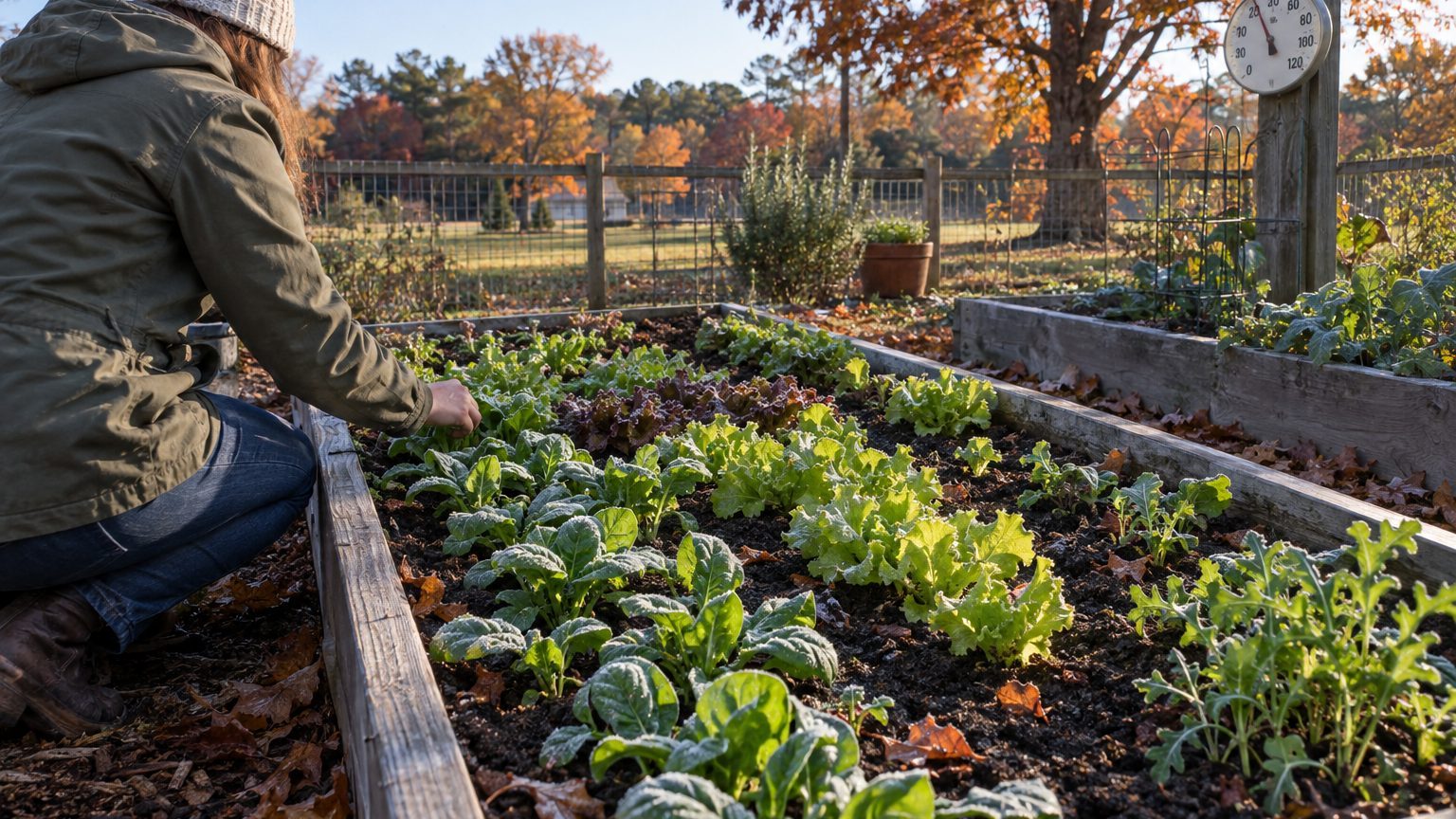

In Manitoba, winter salads go in the ground in late summer, not spring. The date you count back from is the average first fall frost, September 22 at the Winnipeg airport weather station. Sow early enough that seedlings are close to full size before growth stalls, then shelter them for the cold months. The crops themselves are covered in Winter Salads for Manitoba Gardens.
The short answer for Manitoba
What the two dates measure
Environment and Climate Change Canada puts the last spring frost at Winnipeg Richardson International A on average May 23, and the first fall frost on average September 22. Between those two averages sit about 122 days. That is the whole frost-free stretch a Manitoba gardener can count on in a typical year, and winter salads have to fit into the tail end of it.
Both dates are means, not safe lines. In one year out of two, the spring frost falls later than May 23. In one year out of two, the fall frost arrives later than September 22, which also means it arrives earlier in the other half. Treat each date as the midpoint of a window, never as a promise. The figures also come from the 1981-2010 Canadian normals, and a single Winnipeg station stands in for a province that is far larger than one climate.
Counting back from September 22
Hardy greens tolerate frost, so September 22 is not a cliff. It is a marker that growth is about to slow as days shorten and nights cool. The practical method is arithmetic: take the days to maturity on the seed packet and count back from that date, then add a couple of weeks of cushion. A variety listed at 45 days to maturity, for example, works out to August 8 on a straight count, and closer to late July once you leave room for slowing growth. That is an illustration of the method, not a recommendation for any one variety.
Because the frost date is a coin flip, sow in two or three batches a week or two apart. One of them will usually land in the right spot, whether autumn runs warm or arrives early. Which types fit that clock is the subject of The Best Winter Salads for Manitoba.
What will not work here
A sowing made in the last days of September fails. Seeds may germinate, but seedlings that small have nothing to harvest by the time light and warmth drop. The frost date arrives with the plants still the size of a thumbnail, and winter does the rest. Anyone who reads “sow in fall” and plants when the leaves turn has misread the calendar by about two months.
Slow crops fail too. With roughly 122 frost-free days between the two Winnipeg averages, a variety needing 70 days or more sown at the start of August has little margin before growth slows. Fast, small-leaved greens fit this season length. Slow, heading types often do not.
The open bed is the next casualty. The mean daily minimum of the coldest month in Winnipeg is -21.4 °C (-6.6 °F). That is the average January night, not a record low, which means colder nights are routine. Gardeners in milder states who leave greens standing in an unprotected bed and harvest through winter are working with a different climate. Here, leaves left bare will not stay usable. A cold frame, low tunnel or similar cover buys shelter, not mild weather, so plan for slow growth and pauses rather than a steady supply.
Heat at the wrong end of the calendar causes trouble as well. A late-July sowing goes into warm soil, and lettuce in particular can germinate poorly when the ground is hot. Shade the row, keep it evenly moist and consider sowing in the evening. The very conditions that make early sowing necessary also make it harder.
Finally, May 23 is no guide for the season ahead. Since spring frost falls after that date in half of all years, a gardener who treats it as the all-clear for tender transplants is gambling at even odds. Winter salads mostly avoid this problem, because their season is built in late summer, but it catches people who start seed trays on the same schedule as tomatoes.
What changes across Manitoba
Winnipeg is in plant hardiness zone 3b, in Canada’s system, according to Natural Resources Canada’s 1991-2020 normals. That is the zone of the reference city, not of the province. This is not a USDA zone and does not convert to one. The Canadian system uses seven climate variables where USDA uses one, and Natural Resources Canada says there are no simple conversions between them. Its own comparison shows Canadian zone 4a overlapping nine different USDA zones, from 3a to 7a.
So there is no single answer for Manitoba. The frost dates above come from one station, and the source is explicit that northern and upland districts run weeks behind it. This page does not carry a figure for how wide the zone spread is across the province, and it will not borrow one from elsewhere. What it can say is the direction: the farther north or higher you garden, the earlier you count back from your own first fall frost, and the shorter your margin for slow crops becomes.
The sensible shift is to move your sowing earlier by however many weeks your local frost runs ahead of Winnipeg’s, and to lean harder on fast greens and on cover. A gardener in a cold pocket may find the whole late-summer window has closed before a Winnipeg gardener has started.
To see where your own municipality falls, use Natural Resources Canada’s plant hardiness site and look it up on the map. Nobody can tell you your zone from a page like this one. Remember too that the hardiness zones use 1991-2020 data while the frost dates here use 1981-2010, so the two are not strictly measuring the same years.
Where to check this for your own county
The provincial source is Manitoba Agriculture. Look there for two things: a local planting calendar for your area, and any varieties trialled near you rather than in a distant research plot. Those two items turn a provincial average into something you can sow by.
When you find a calendar, check which crop it covers and which place it was built for. A calendar for a market-garden vegetable is not a calendar for a late-sown winter salad, and a date for the Red River Valley will not suit a garden farther north or on higher ground. If the local office or a nearby grower can tell you the typical first fall frost for your own spot, write it down. That number replaces September 22 in the arithmetic above.
A local recommendation beats a provincial one, and this page is the provincial one. It is built on a single weather station and a 30-year average. It does not have a Manitoba Agriculture winter salad calendar to cite, and it will not pretend that one exists. If your area has trial results or a local frost date, they outrank anything printed here.
Checking this against your own garden
Your own observations outrank every date on this page. Three are worth watching, and none needs an instrument.
- Soil warmth by feel. In late July and early August, push your hand a few inches into the bed in the morning and again in the afternoon. If the soil feels hot even early in the day, the bed will be hard on lettuce seed, and a shaded or cooler spot is a better microclimate for sowing.
- The first male flowers. If you grow squash, note the day the first male blooms open. They come ahead of the female flowers, so a late first flush in your garden tells you the season is running behind the calendar, a cue to count back from a possibly earlier frost.
- The first true leaves. The first pair after the seed leaves marks real growth. If late-summer sowings reach that stage in about a week in one bed and take far longer in another, the slower bed is cooler, shadier or more exposed, and the crops there need more cushion.
Write the dates down, even on a seed packet. After a season or two, your notes will give you a frost and growth calendar for your garden specifically, and that is more useful than any average.
Common questions
Is September 22 a safe date to count on?
No. It is the average first fall frost at the Winnipeg station, so in one year out of two the frost comes later and in the other it comes earlier. Use it as the midpoint of a window and sow in batches.
Can I sow winter salads in spring instead?
The page does not have a spring-sowing schedule for winter salads. The average last spring frost is May 23 at Winnipeg, and frost falls after that date in half of years. Winter salads are built around late-summer sowing, not spring.
Is hardiness zone 3b the same as a USDA zone?
No. It is Canadian zone 3b for Winnipeg, calculated from seven climate variables, and it does not convert to a USDA zone. Natural Resources Canada states there are no simple conversions between the two systems.
How cold does it actually get?
The mean daily minimum in the coldest month is -21.4 °C (-6.6 °F) at the Winnipeg reference station. That is an average night, not a record, so unprotected greens will not hold up in the open bed through winter.