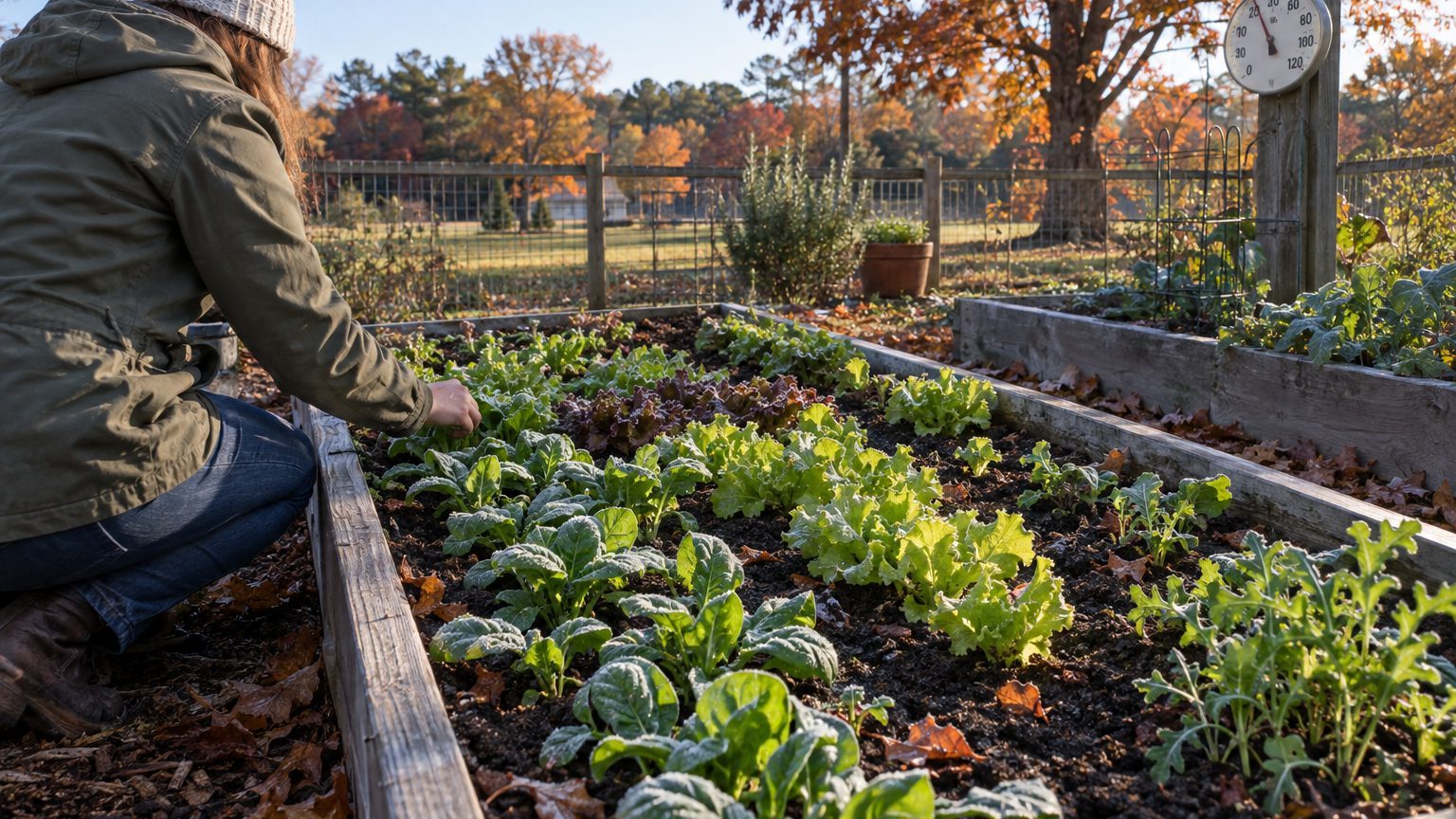

Hawaii has no frost-based sowing calendar, because no freeze occurs in inhabited areas. Winter salads go in as the cooler, wetter months arrive, and the exact timing depends on rainfall, elevation and which side of the island you garden on. For most lowland gardeners, that means starting seed in the fall and keeping sowings going through the cool season.
The short answer for Hawaii
Sow winter salads once the summer heat eases and the rains return, then keep sowing in small batches through the cool months. A frost date is a probability: the chance that a 32°F freeze arrives after a given day in spring or before it in fall. Here that probability does not exist. The NOAA 1991-2020 Climate Normals for the Honolulu-area station show zero days per year at or below 32°F, and every freeze percentile at 32°F and 36°F comes back flagged “not computable.”
Frost does occur, but only on the high volcanic summits of Mauna Kea, Mauna Loa and Haleakala. Nobody gardens there. A calendar that counts weeks back from a last frost, the way mainland seed packets do, has no anchor in the islands.
The number that matters is the mean daily minimum of the coldest month, which is 66.8°F at the Honolulu reference station (NOAA NCEI Climate Normals 1991-2020). Cold never threatens a lettuce plant at that figure. Winter salads in Hawaii are limited by heat at one end and by rain and exposure at the other, not by a killing night.
So the useful question is not “when is my last frost?” but “when does my garden stop being too warm, and how wet is it going to get?” Early October, where this article lands, is already a reasonable time to start thinking about it in many lowland spots. This page does not carry county-level sowing dates, and it will not invent them. What it can give you is the logic for setting your own start date.
Start with the cooler end of your local year, sow a short row, and sow another every couple of weeks. Staggering protects you from one bad week of heat or one stretch of heavy rain wiping out the whole planting. For what to sow once you have a window, see Winter Salads for Hawaii Gardens and The Best Winter Salads for Hawaii.
What will not work here
Anything built on cold fails. Mainland advice to sow “six weeks before the last frost” or “after the first frost sweetens the leaves” assumes a freeze that never arrives in a Hawaii garden. Same for row covers and cold frames: with a coldest-month mean minimum of 66.8°F, they trap heat you are already trying to shed.
Heat is the real opponent. Lettuce and many other salad greens respond to warmth by bolting, sending up a flower stalk and turning bitter. A packet marked “sow in spring” for a mainland climate may do better in a Hawaii winter than a packet marked “sow in summer.” Sowing too early in a warm lowland fall is the most common way to lose a crop. Lettuce seed can also sulk or refuse to germinate in very warm soil, so a hot September bed is a poor place to start seed.
Crops that depend on a real chill to finish are another weak spot. Chicories that color up and sweeten under cold nights, or spinach types bred for cool northern springs, can be disappointing at low elevation. Heat-tolerant greens and cut-and-come-again types are safer bets (details on the varieties page).
Rain breaks the plan on the wet side of the islands. Windward slopes can stay saturated for days. Tight spacing that works in a dry bed will hold moisture around the leaves and invite rot and slugs. Raised beds, wider spacing and a spot with morning sun and good airflow matter far more than a calendar date.
On the dry leeward side, the opposite mistake shows up. Watering once a week, which can work on the mainland in a cool spring, leaves shallow-rooted salad seedlings stressed in a dry, bright climate. Lettuce roots sit in the top few inches of soil. Seedlings need steady moisture, and a mulch layer helps a lot.
Finally, a single-date answer fails. “Plant on November 1” ignores that a garden at sea level on a dry coast and one on a rainy upland slope are running on different clocks.
What changes across Hawaii
Hawaii is not one garden. The USDA Plant Hardiness Zone Map (2023, based on 1991-2020 normals) lists the state as zones 9a to 13a. That is five full zones, a spread few states can match. There is no single answer for the territory.
Keep in mind what that zone system measures: the average annual extreme minimum temperature, and nothing else. It says nothing about rain or heat, which are the two things that actually decide a salad crop here. The reference city for this page is Honolulu, and other parts of the state differ. To see where your own address falls, use the USDA map and look up your location. Do not guess from the island you live on.
| Situation | What governs | What to shift |
|---|---|---|
| Low elevation, leeward (dry) | Heat and irrigation | Start later in the fall, shade cloth in warm spells, mulch, frequent light watering |
| Low elevation, windward (wet) | Rain and rot | Raised beds, wider spacing, watch for slugs |
| Higher elevation | Cooler air, more cloud and rain | The usable window opens earlier and runs longer |
Elevation is the biggest lever. Air cools as you climb, so an upland garden may hold salads comfortably through months when a coastal bed bolts. The trade-off is that higher slopes often catch more cloud and rain, so the drainage advice above applies there too.
Gardeners on the north and east sides of an island, which face the trade winds, should plan for wetter soil. Gardeners on the south and west sides should plan for drier, brighter conditions. Neither group can borrow the other’s sowing dates.
Where to check this for your own county
Your state extension service is the best next stop. In Hawaii, that is the University of Hawaii CTAHR Cooperative Extension, listed in the USDA NIFA land-grant extension directory. Extension agents work with growers on each island and know which valleys stay wet and which slopes run hot.
When you get there, look for two things. First, a local planting calendar for your island or county, ideally one that names the months for lettuce, greens and other cool-season crops. Second, any variety trial results from your area. A variety that was grown side by side with others on your island, in your sort of rainfall, is worth more than any general list.
This page is the state-level view, and a county recommendation beats a state one. A state page has to cover everything from a dry leeward shoreline to a cloudy upland farm, so it can describe the logic but not your dates. Where an extension office publishes a calendar for your county, follow it over anything here.
One caution: extension calendars elsewhere in the country are not substitutes. Some universities publish excellent calendars, but they are written for their own state’s frost dates and climate. This page has no Hawaii-specific calendar to cite, so it does not borrow one from the mainland.
Checking this against your own garden
Your own observations outrank every date on this page, and you do not need instruments. Three things are worth watching.
- Soil warmth by feel. Push your hand a couple of inches into the bed in the morning. If it feels distinctly warm, like bathwater, lettuce seed is likely to struggle. When it feels cool or neutral, you are close to your window. Beds in full afternoon sun will lag behind shaded ones.
- How long the soil stays wet after rain. If a bed is still soggy two days after a shower, you are on the wet side of the story. Plant in raised soil and space wider. If it dries to dust in a day, plan on mulch and more frequent watering.
- The first true leaves. After the seed leaves, the first true leaves show how the seedling is coping. Fast, sturdy growth means the spot suits you. Leggy, pale or stretched seedlings point to too much heat or too little light. A flower stalk on an early planting is your garden telling you it was too warm.
Write down the date you sowed and what you saw. After one season you will have a calendar that is more accurate for your yard than any state-level page.
Common questions
Is there a last frost date I can use in Hawaii?
No. NOAA’s 1991-2020 normals show no freeze in inhabited areas, and the freeze percentiles cannot be computed. Frost occurs only on the high summits of Mauna Kea, Mauna Loa and Haleakala.
Do I need to protect winter salads from cold?
Almost never. The mean daily minimum of the coldest month at the Honolulu reference station is 66.8°F. Heat, rain and wind are the larger worries, not cold nights.
Can I use a mainland seed-packet calendar?
Not directly. Those calendars count from frost dates that do not exist here. Use the seed packet for spacing and depth, and set your timing by local temperature and rainfall.
Which hardiness zone is Hawaii?
The USDA 2023 map lists zones 9a to 13a across the state, so there is no single answer. Look up your own location on the USDA map, because zone alone does not capture rainfall or heat.