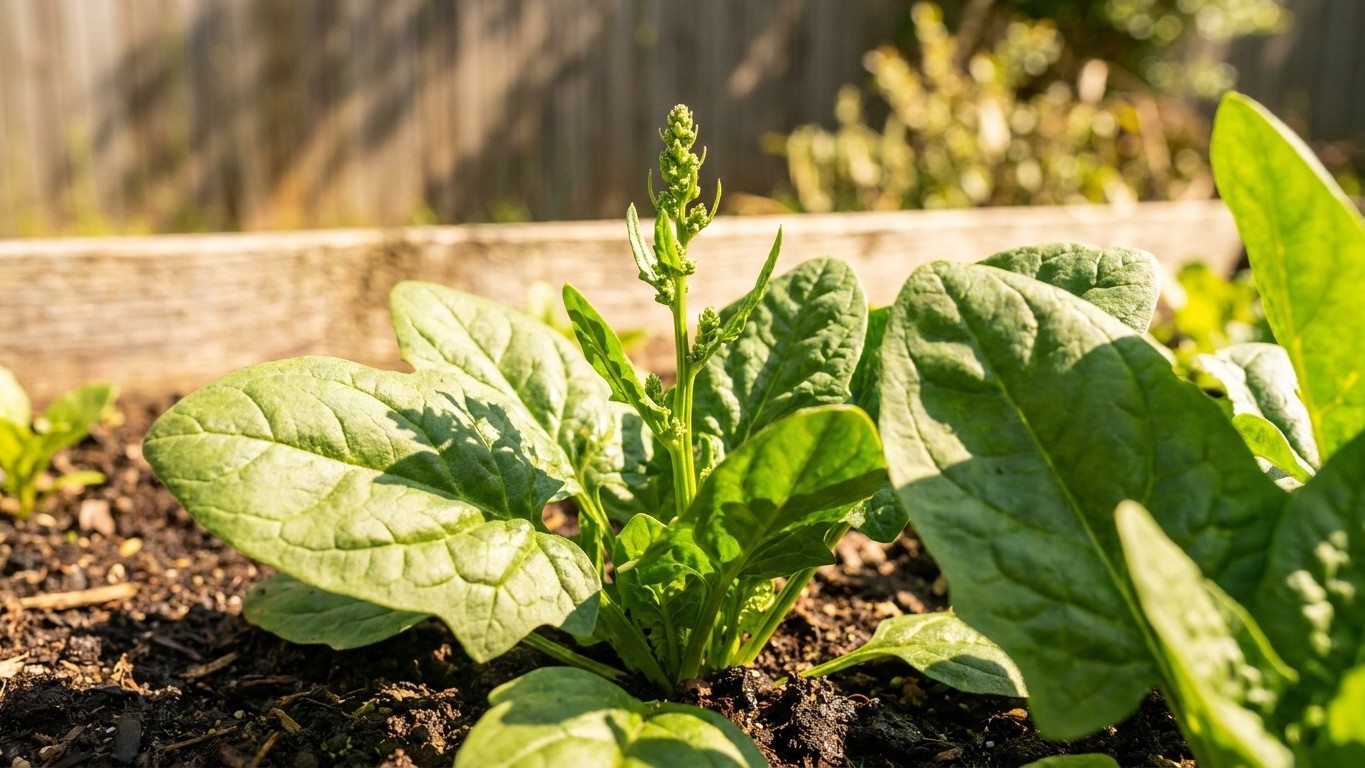

In South Carolina, spinach gets cut in two windows: spring, before highs settle above 75 F, and late fall, ahead of the first frost. Summer is closed. Once the leaves are cut, two weeks is the absolute ceiling for keeping them, and that holds only at 32 F. The Charleston-area dates below come from federal climate normals, and the Upstate runs tighter at both ends.
The short answer
The longest day of the year in Charleston carries 14 h 10 of daylight. That figure comes from the latitude of the station behind the climate normals, measured to the geometric horizon (refraction adds roughly seven more minutes of real light). For spinach, a day that long is a problem. Long days, along with warm temperatures, are what push spinach to flower, and a plant that flowers stops producing the tender leaves you wanted. This is the opposite of what happens with onions, where day length builds the crop. With spinach, it spends the crop.
Day length and heat close the door together
Because long days trigger flowering on their own, a cool summer does not buy extra weeks. Cool weather would help with heat, but it would not shorten a 14-hour day. South Carolina does not get the cool summer in the first place: the Charleston station averages 55.1 days a year at 90 F or higher. Utah State University Extension puts spinach’s comfortable range at temperatures that do not exceed 75 F, and 75 F is also where the leaves turn bitter. So in this state the limit is both. Day length sets a hard seasonal edge, and heat arrives early enough to eat most of what the calendar would otherwise allow. The practical rule is to cut while the weather is still cool and before the plant starts sending up a center stalk. For the signs that the stalk is starting, see Will Spinach Bolt Early in South Carolina?
For the full season picture, from seed packet to bed preparation, Growing Spinach in South Carolina covers the ground this page skips.
How long it keeps once it’s cut
Harvest is only half the clock. The UC Davis Postharvest Technology Center describes spinach as highly perishable and says it will not maintain good quality for more than 2 weeks, even at the optimum of 32 F and 95 to 98 percent relative humidity. Wilting, yellowing and decay become more likely past 10 to 14 days, and they come faster at 41 to 50 F, which is closer to what produce actually meets in ordinary distribution and in many kitchens (UC Davis Produce Facts Sheet: Spinach).
Read that as a ceiling, not a plan. A home refrigerator is not a 32 F room, and the door is its warmest, most variable spot. Put the leaves in a bag or container at the back of the bottom shelf, where the air is coldest and steadiest, and expect them to yellow in days if you park them in the door. Cutting in the cool part of the day and getting the leaves cold quickly gives them the best shot at the long end of that range.
How long the spring window really is
The spring window is shorter than most gardeners expect, and the way to see it is to work backward from the frost date. The steps run in order.
- Find the last spring frost. NOAA NCEI’s 1991-2020 Climate Normals, using the 30 to 70 percent probability band for a 32 F freeze at the Charleston station, put it between February 28 and March 17.
- Back up two to three weeks. Spinach goes in the ground that far ahead of the last frost. That puts sowing between about February 7 and March 3.
- Count the sowing window. From the first date to the last is roughly three and a half weeks. Seed sown at the early edge has the most cool weather ahead of it. Seed sown at the late edge has the least.
- Find where growth stops being good. Above 75 F, growth declines and bitterness sets in. That is a temperature, not a date, so watch your own forecast rather than a calendar square.
- Cut before the heat. Harvest whatever is ready while highs still sit below 75 F, and pull the bed when the center stalk starts to rise.
What the weeks add up to
Here is the honest arithmetic. Spring gives you about three and a half weeks to get seed in the ground, then however many weeks of highs below 75 F remain after the plants are up. The sources I hold do not tie that cutoff to a date for Charleston, and it moves with the year. What the numbers do show is that a coastal station with 55.1 days a year at 90 F or higher is not a place where cool weather lingers into late spring. Think of the usable harvest as weeks, not months. Sow at the early edge of the window, because the late edge leaves plants racing the thermometer and the lengthening days at once.
Upstate South Carolina runs several weeks tighter at both ends of the season than the Charleston airport station does, and peninsular Charleston is milder than the airport. Use the Charleston dates as a starting reference and adjust to your own frost experience. The same logic holds anywhere in the state: find your last frost, back up two to three weeks, and treat 75 F as the finish line.
Utah State University Extension names four varieties: Bloomsdale, Melody, Teton and Olympia. It publishes no data on any of them, so I can’t tell you which tolerates heat best or which holds longest in the fridge. The choice is yours to test.
The autumn crop, and when the soil lets you sow
Fall is the better of the two seasons for spinach in the Southeast, because days are shortening instead of lengthening and the temperature curve is heading down. Two obstacles stand in the way, and neither is the one most people expect.
The soil is too warm to germinate
The block on a fall planting is warm soil, not cold. Seed germination is reduced when soil is above 80 F. After a summer with 55.1 days at 90 F or higher, South Carolina soil can still sit above that line well into September, and a bed that was fine for tomatoes can be wrong for spinach seed. The sowing window opens when the soil falls, not on a calendar date, so a soil thermometer is a better guide than any planting chart.
Seed that does not come up is the visible failure, and the less visible one is a thin, patchy stand that never fills in. Shade the bed, water it during germination, and sow a little thicker if the soil is borderline. When seedlings do emerge, check them regularly. What Eats Spinach in South Carolina, and When covers who is likely to find them first.
The frost that ends the season
Utah State University Extension’s rule for a fall crop is to plant 50 to 75 days before the date you want to harvest. It does not publish a days-to-maturity for spinach, so I won’t supply one. Use the rule as given. The same NOAA NCEI normals put the first fall frost between November 20 and December 5 at the Charleston station. Treat that as the realistic end of the harvest plan, since the figures I hold carry no cold-tolerance threshold for spinach.
Count back from those dates:
- To harvest by November 20, sow between about September 6 (75 days) and October 1 (50 days).
- To harvest by December 5, sow between about September 21 (75 days) and October 16 (50 days).
Put the two together and the full range runs from early September to mid-October. Today is October 5, so the later half of that range is the live one. The earliest dates are also the ones most likely to collide with soil above 80 F. In the Upstate, where the first frost arrives sooner, the whole range moves earlier and narrows, so the later sowings are riskier there.
Common questions
Can I keep spinach going through a South Carolina summer?
Not in the open garden. Long days push spinach toward flowering whatever the temperature, and the heat adds to it, with growth no longer good above 75 F. The 14 h 10 longest day and the 55.1 days at 90 F or higher in Charleston leave nothing to work with. Plan for two cool seasons and leave the summer bed to something else.
How do I know when to cut a plant before it bolts?
Cut when the leaves are a size you would eat and before a center stalk starts to rise. Once warmth and long days are pushing the plant toward flowering, harvest what is there rather than waiting for it to grow bigger. Leaves also turn bitter above 75 F, so a warm spell is a signal to cut early.
How long does cut spinach last in the refrigerator?
UC Davis says spinach will not keep good quality for more than 2 weeks, and that figure is for 32 F with 95 to 98 percent humidity. Wilting, yellowing and decay become more likely beyond 10 to 14 days, and faster at 41 to 50 F. Count two weeks as the ceiling, not the promise, and store it at the back of the bottom shelf instead of in the door.
Do the Charleston dates apply to the rest of the state?
Only roughly. The frost windows above come from a Charleston station, and peninsular Charleston is milder than the airport itself. Upstate South Carolina runs several weeks tighter at both ends, with a later spring and an earlier fall frost. I do not hold station data for the Upstate, so use your own last and first frost dates and apply the same arithmetic: two to three weeks before the last frost in spring, and 50 to 75 days back from your harvest date in fall.