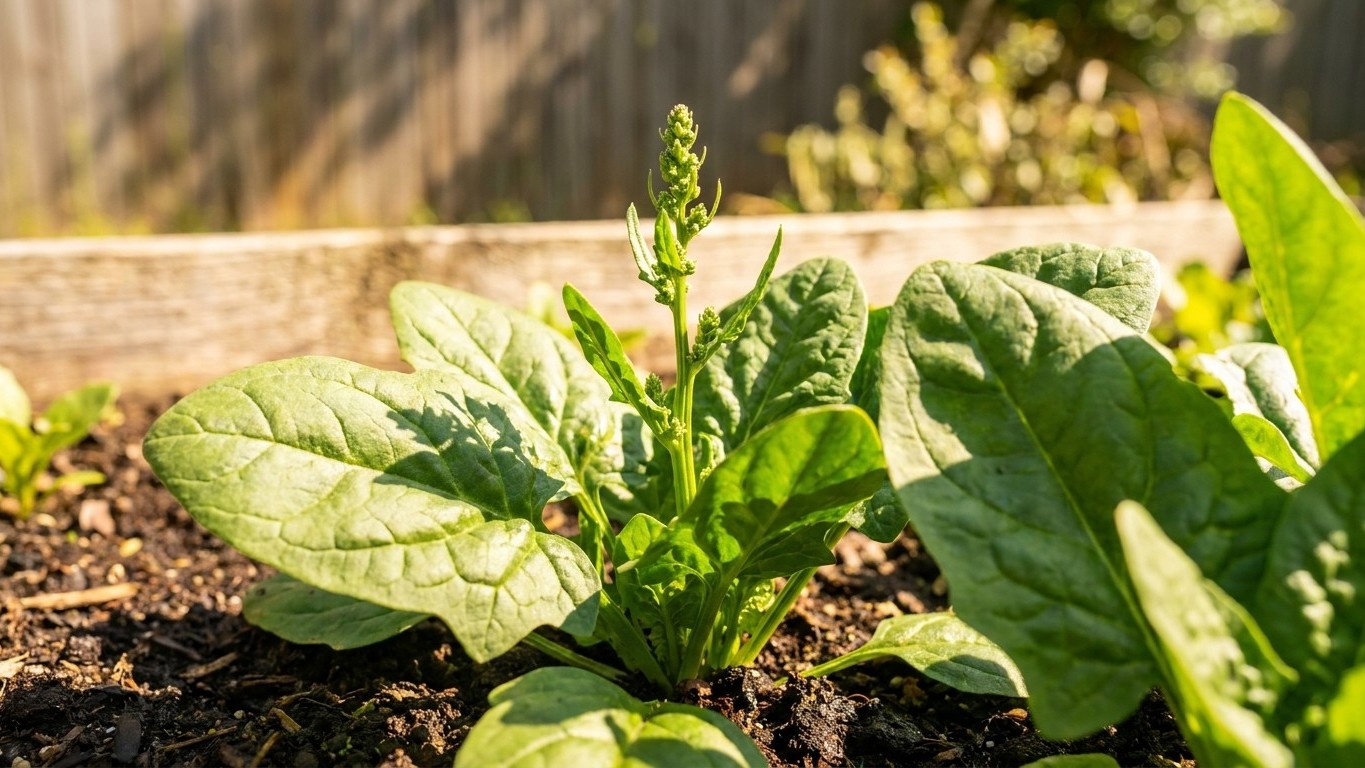

Cut spinach while temperatures stay under 75 F and before a seed stalk starts rising from the center. In Houston terms, that means a short spring run after a midwinter sowing and a fall run that ends near the first frost. Once harvested, spinach holds good quality for 10 to 14 days at best, and only at 32 F. Every date below comes from Houston, so treat it as a model for your own arithmetic, not a statewide calendar.
The short answer
On the longest day of the year, Houston gets 13 h 56 of daylight. That figure matters because spinach bolts during long days as well as warm temperatures, according to Utah State University Extension. Long days alone are enough to push a plant toward flowering. A cool summer would not buy extra weeks of leaf, even if Texas offered one.
The limit here is both day length and heat, and the two stack. Spinach grows best where temperatures do not exceed 75 F. Houston reaches 90 F or more on an average of 102.4 days a year, which is more than a quarter of the calendar. The heat side is the one you can partly dodge by choosing sowing dates. The day-length side you cannot dodge at all. The source behind these numbers does not say at what day length spinach starts to flower, so no one can honestly hand you an exact bolting date. For the early-bolting question specifically, Will Spinach Bolt Early in Texas? goes deeper.
Those Houston figures need a warning label. They come from the NOAA NCEI 1991-2020 Climate Normals for the station at Bush Intercontinental (IAH), and they describe the mild Gulf end of the state. Texas spans four USDA zones. The Panhandle freezes months earlier in fall and months later in spring. The Hill Country and North Texas each run on their own clocks. Even inside Houston, Hobby airport runs about two weeks milder than IAH. Use the method here with your own frost dates, not the Houston numbers.
For reference, the Houston figures are a last spring frost between February 4 and March 1, and a first fall frost between December 1 and December 19. Both are the 30-70% probability band, so they describe a range of likely dates, not a promise.
So when do you actually cut? When the leaves are big enough to be worth eating, the weather is still under 75 F, and the center of the plant has not started to send up a stalk. That is the whole decision. For the broader picture of sowing and care, see Growing Spinach in Texas.
What happens after the cut is where most people lose the crop. UC Davis puts it bluntly: “Spinach is highly perishable and will not maintain good quality for more than 2 weeks.” The optimum is 32 F with 95-98% relative humidity. Wilting, yellowing and decay increase after 10 to 14 days of storage, and faster at the 41 to 50 F typical of ordinary distribution. A home refrigerator door lives in that warmer range. The coldest spot is the back of the bottom shelf, so store spinach there, not in the door. Two weeks is a ceiling, not a plan. The full UC Davis spinach fact sheet lays out the numbers.
How long the spring window really is
Spring spinach in Houston is a race with a fixed finish line. The start moves around, but the finish is set by the weather. Here is how the arithmetic works.
- Start with the last frost. For Houston, that is February 4 to March 1. Find the equivalent range for your own county first.
- Back up two to three weeks. Sowing is recommended 2 to 3 weeks before the last frost. Counting back from the early edge (February 4) lands between January 14 and January 21. From the late edge (March 1), it lands between February 8 and February 15. So the Houston sowing window runs from about mid-January to mid-February, roughly four and a half weeks wide.
- Find the end, and notice it is not a date. Growth stops being good above 75 F, and that same number is where bitterness sets in. The data here carries no date for when Houston crosses 75 F, so the finish line is a thermometer reading, not a square on the calendar. When daytime highs settle above it, the harvest is over, whatever the seed packet says.
- Count what is left in weeks. The source publishes no days to maturity for spinach, so I will not invent one. What can be said is this: the usable spring is the stretch between your sowing date and the week highs settle above 75 F, and in Houston that is weeks, not months. A sowing in mid-January gets the most of it. A sowing in mid-February gets the least, because the finish line does not move to make room.
- Treat every week of delay as a week lost. A sowing that slips a week does not push the end back a week. It simply removes a week of harvest from the back end.
That fourth step is the one worth remembering. Spring spinach in Houston rewards the gardener who sows at the early edge of the window, and it punishes the one who waits for the first truly warm weekend. By the time a weekend feels like spring to a person, it is already past what spinach wants.
Farther north, the same logic works with different dates. A Panhandle gardener has a later last frost, so sowing starts later, but 75 F also arrives later in the season, and the day-length trigger is no friendlier at that latitude. The method (last frost, minus two to three weeks, then watch the thermometer) travels. The Houston dates do not.
The crowd of 90-degree days (102.4 a year in Houston) is why the spring window closes so firmly. By the time summer proper arrives, spinach has long since given up. Pests tend to show up in the same weeks, and What Eats Spinach in Texas, and When covers who to expect.
The autumn crop, and when the soil lets you sow
Fall is the gentler season for spinach in Texas, but it has two gatekeepers. One opens late and the other closes early, and your sowing date has to fit between them.
Warm soil stops the seed before the cold ever could
Seed germination is reduced when the soil is above 80 F. That is the first obstacle, and it surprises people who assume autumn sowing is blocked by cold. In Texas, the problem is the opposite. After a summer with 102.4 days at or above 90 F in Houston, soil can hold its heat well into the season. A calendar date alone will not tell you when the ground has cooled enough, so a soil thermometer pushed a couple of inches into the bed is the most useful tool you can own for fall spinach. Sow when the reading falls below 80 F. In a hot region, the window opens when the soil falls, not when the calendar says fall.
Days are also shortening by then, so the day-length trigger that works against spinach in spring stops pushing the plant toward flower. That is a reasonable expectation from the same source, not a guarantee, and warm spells can still cause trouble.
Frost closes the season, so count back from it
The second obstacle is the first fall frost. Houston’s falls between December 1 and December 19. The guidance for a fall crop is to plant 50 to 75 days before the date you want to harvest. Set a realistic harvest date and count back.
If you want to be cutting by December 1 (the early edge of the frost band), 50 days back is October 12 and 75 days back is September 17. If you are willing to run until December 19, 50 days back is October 30 and 75 days back is October 5. On paper, then, the Houston sowing window stretches from about September 17 to about October 30, depending on how long you want to keep harvesting and how much margin you want.
Those are paper dates, and the soil gets a vote. A September 17 sowing only works if the bed has actually dropped under 80 F. If it has not, wait and accept a later, shorter harvest. The 50-to-75 range is all the source offers. It publishes no days to maturity for spinach, and I will not fill that gap with a number borrowed from another crop.
The source names four varieties (Bloomsdale, Melody, Teton and Olympia) but gives no data about any of them. Which one matures fastest or resists heat is simply not published here, so check the seed packet for your own region instead of trusting a rumor.
Common questions
How do I know it is time to cut?
Cut when the leaves are large enough to eat and the weather is still below 75 F. If a stalk is rising from the center of the plant, it is bolting. At that point, harvest everything and pull it, because the leaves will turn bitter.
How long does cut spinach keep in the fridge?
At best, 10 to 14 days, and only at 32 F with 95-98% humidity. UC Davis says it will not keep good quality for more than 2 weeks. At 41 to 50 F, which is what a refrigerator door holds, it declines faster. Store it at the back of the bottom shelf.
Which variety should I grow in Texas?
The source lists Bloomsdale, Melody, Teton and Olympia, and publishes no data on any of them. I cannot rank them for Texas, and I will not pretend to.
Why are my leaves chewed or bitter?
Bitter leaves usually mean temperatures have climbed past 75 F, which is both the growth ceiling and the bitterness threshold. Chewed leaves point to pests, and What Eats Spinach in Texas, and When explains who is likely responsible and when they arrive.