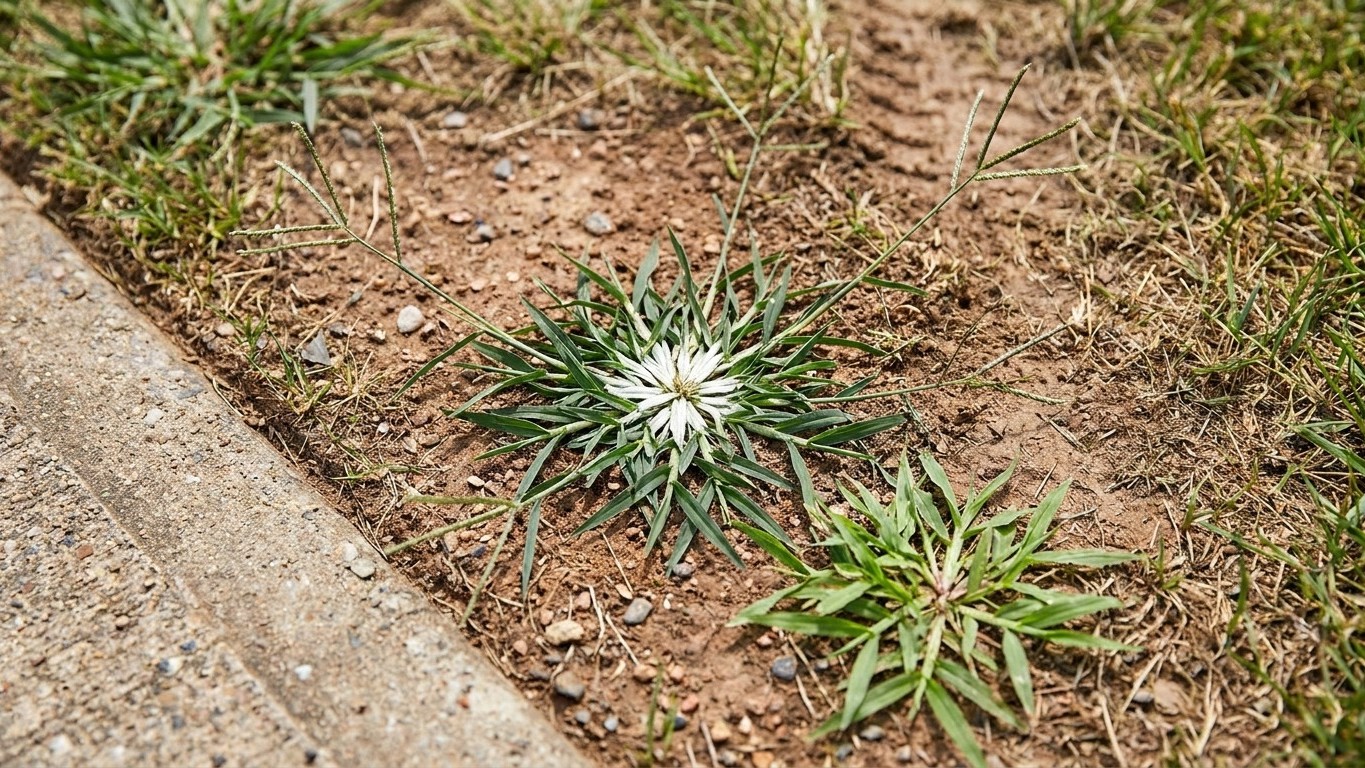

Most Illinois lawns do best cut between 2 and 3.5 inches, and the right number depends on the grass. Tall fescue wants 3 to 3.5 inches. Kentucky bluegrass and fine fescues sit at 2 to 3 inches. Perennial ryegrass and rough bluegrass run lower, at 1.5 to 2.5 inches. If you can’t tell what you have, 3 inches is a safe middle for three of the five species.
The mowing height for Illinois lawns
The list of grasses is short because winter does the editing. Illinois lawns are cool-season turf: tall fescue, fine fescues, Kentucky bluegrass, perennial ryegrass and rough bluegrass. A warm-season grass grows in midsummer heat and goes dormant and brown once frost arrives. Here frost comes in late October or early November, and the cold stretch that follows is long. A warm-season lawn would spend much of the year straw-colored and exposed to winter damage, so the cool-season species are the ones that hold.
The heights differ because the grasses grow differently. Tall fescue is coarse, deep-rooted and upright, and it tolerates being left tall. Perennial ryegrass and rough bluegrass are finer and lower-growing, and they thin out when left long.
| Grass | Mowing height |
|---|---|
| Tall Fescue | 3 to 3.5 inches |
| Kentucky Bluegrass | 2 to 3 inches |
| Fine Fescues | 2 to 3 inches |
| Perennial Ryegrass | 1.5 to 2.5 inches |
| Rough Bluegrass | 1.5 to 2.5 inches |
These figures sit within the ranges published by land-grant extension programs, including University of Illinois Extension.
If your lawn is a mix
Many lawns are blends, and the species can shift over the years as one crowds out another. When a lawn holds more than one grass, set the deck for the species that is least forgiving. A lawn with ryegrass in it should not go above 2.5 inches, even if the fescue beside it would be happier taller. A height inside both ranges, such as 2.5 inches for a bluegrass and ryegrass mix, covers both. For the general routine behind all of this, see Mowing a Lawn.
Check the height with a ruler against the deck setting once. Mower dial numbers are often off by half an inch or more, and a deck marked 3 may be cutting at 2.5. Set the mower on a flat driveway, measure from the pavement to the blade, and adjust the lever until the real number matches your target.
Raising the deck when the heat comes
July is when cool-season grass struggles. Growth slows in the heat, roots sit in warm soil, and a lawn cut short has less leaf to shade its own crown. The standard move is to raise the deck to the top of your species range for the hottest weeks: 3.5 inches for tall fescue, 3 for Kentucky bluegrass and fine fescues, 2.5 for ryegrass and rough bluegrass. Taller blades shade the soil, which slows evaporation and keeps the root zone cooler.
Normals for the reference station (NOAA NCEI, 1991-2020) show about 12.1 inches of rain across June, July and August, out of 37.9 inches for the year. June averages 4.1 inches, July 3.71 (the driest of the three) and August 4.25. That is a wet summer by many standards, and it is what the region can usually expect, not a forecast. It is also a single airport station. A slope, a city heat island or a local storm track can change what lands on your lot, and a rain gauge in your own yard is what settles it.
Soil decides what those inches do. On sandy soil, rain moves through within the day, so a wet summer can still leave a lawn dry and needing water every second day. On clay, the same inch can stay in the surface for a week.
That is the case for mowing tall in the heat. Extra height buys some protection on dry stretches. It does not replace watering on sandy ground, and it does not rescue turf sitting in saturated clay with weak roots. If the grass goes brown and stops growing in a dry spell, hold off on cutting until it greens up and grows again, then resume at the raised height. For comparison with other cool-season states that face similar summers, see How High to Mow a Lawn in Michigan and How High to Mow a Lawn in Oregon.
The one-third rule, and why it is not arbitrary
Never remove more than one third of the blade height in a single mowing. Gardeners repeat it so often it sounds like folklore. It is arithmetic with a biological reason behind it.
The leaf blades are the lawn’s solar panels. They make the sugars that feed the roots. Strip off more than a third at once and the plant loses a big share of its energy supply while still having to regrow the missing leaf. Roots respond by slowing their growth for a while, and the lawn becomes thinner and more open to weeds and heat stress. A single severe cut can set the lawn back more than weeks of ordinary mowing.
The rule works backward from your target height. If you keep Kentucky bluegrass at 3 inches, the grass should be mowed before it reaches 4.5 inches, because cutting 4.5 down to 3 removes exactly one third. For tall fescue at 3.5 inches, the limit is 5.25 inches. For ryegrass at 2 inches, mow at 3 inches. A lawn kept shorter has less room to grow between cuts, which means more frequent mowing.
That is also why the schedule should follow growth, not the calendar. In a wet, cool spell, grass can gain several inches in a week. In a dry July it may barely move. If you were away and the lawn has gotten ahead of you, do not drop to your normal height in one pass. Cut it back by a third, wait a few days, and cut again. It takes longer but it saves the lawn.
The first and last cut of the year
The lawn does not follow the calendar, but frost dates offer a rough frame. At the airport reference station in the NOAA NCEI 1991-2020 normals, the last spring freeze at 32°F typically falls between April 11 and April 22, and the first fall freeze between October 24 and November 3. Those are the 30 to 70 percent probability band for one station, not a statewide guarantee. Suburban and rural lots often see the last spring frost later and the first fall frost earlier, commonly by one to two weeks. Your county Extension office can tell you and University of Illinois Extension is the place to start.
First mow of spring
Start when the grass is growing and tall enough that you will take off no more than a third. Do not mow because the date says so, and do not mow soggy ground, which leaves ruts and tears the turf. For the first cut, set the deck at the upper end of your species range. Spring growth is fast, roots are still waking up, and the lawn will not appreciate being scalped to tidy it after winter. You can lower the deck a little by midspring if your species allows it.
Last mow of fall
Keep mowing as long as the grass grows, which in Illinois often means into late October or even November in a mild year. When growth picks back up in fall, the deck can drop toward the middle of the range, and for the final cuts toward the lower-middle, such as 2.5 inches for bluegrass or 3 for tall fescue. Long grass that goes under snow can mat down and invite snow mold, and leaves left on top make the same problem worse. Do not go to the other extreme and scalp the lawn to its minimum. A short lawn going into winter has less leaf left for the last weeks of energy storage.
Mulching fallen leaves with the mower counts as mowing, and it helps. Run over them while they are dry and let the pieces drop into the turf.
Common questions
What is the best all-purpose mowing height in Illinois?
Three inches. It sits within the ranges for tall fescue, Kentucky bluegrass and fine fescues. If your lawn includes perennial ryegrass or rough bluegrass, drop to 2.5 inches, the top of their range.
Should I bag the clippings?
Usually not. If you follow the one-third rule, short clippings break down on the lawn and return nutrients. Bag or rake when the grass was so overgrown that clippings are lying in clumps.
How often should I mow in summer?
When the grass has grown about one third above your target height. In a wet spell that might be weekly or more often, and in a dry July it might be every ten days or longer. Watch the grass instead of the weekend.
Can I use the same height all season?
You can, but small adjustments pay off. Raise the deck in the heat of July and August, then bring it back down in fall. Because Illinois rainfall is a station average (July 3.71 inches at the reference station, for example), a rain gauge in your yard will tell you whether your lawn is getting what the normals suggest.