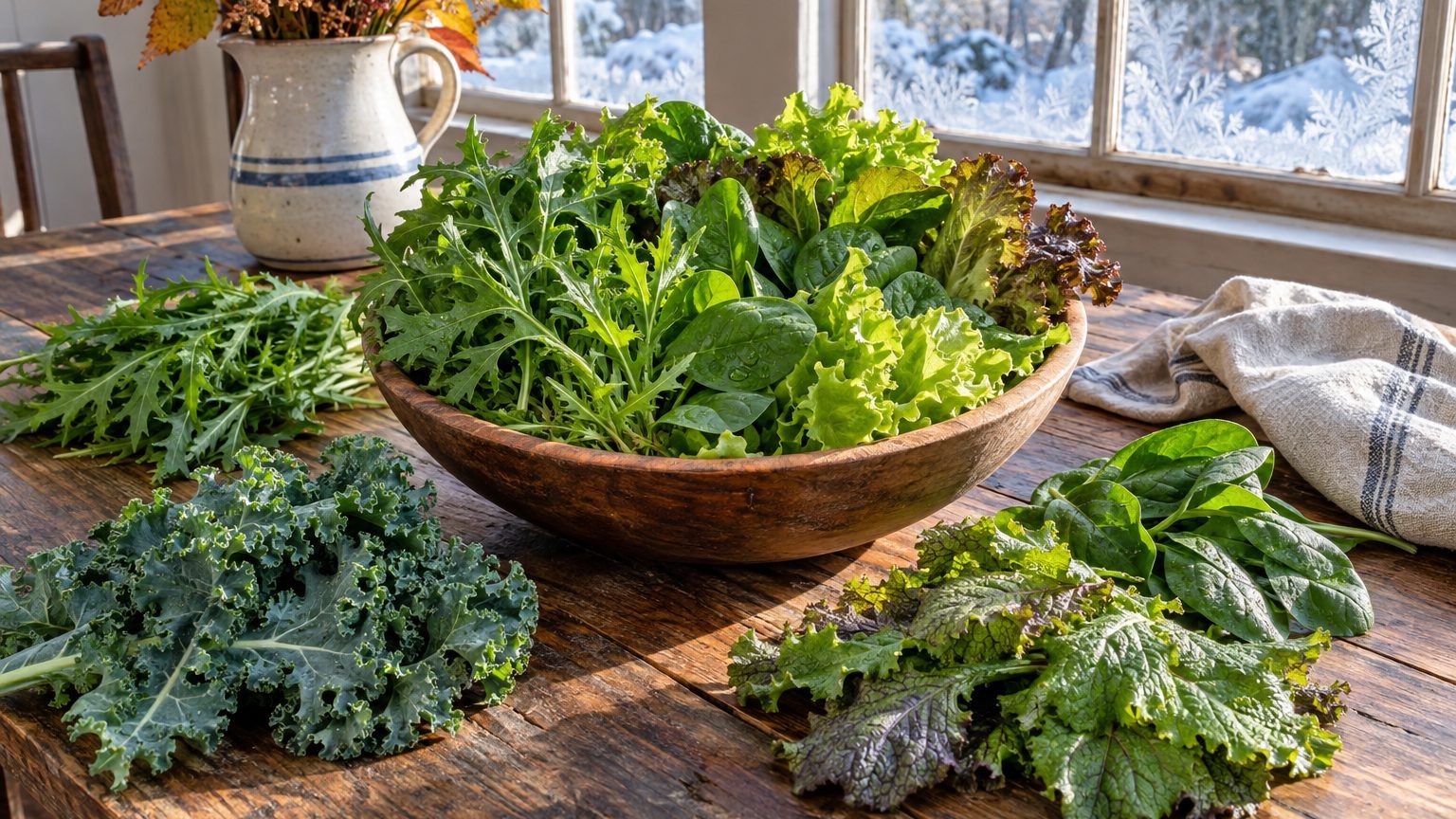

Cold-hardy leaf crops are the best winter salads for West Virginia: spinach, mâche, claytonia, kale, collards, mustard greens and arugula. Tender heading lettuce belongs under cover. The state’s winters are cold but rarely brutal in the valleys, and the gap between the hardy and the fragile types decides what survives. Everything below is built on Charleston numbers, so treat it as a starting point.
The short answer for West Virginia
Choose by type, not by cultivar: hardy leaf greens outdoors, tender lettuces in a cold frame or tunnel. That is the decision the climate numbers support for the reference station at Charleston, and it matches the broader approach in Winter Salads for West Virginia Gardens.
Start with the cold. NOAA’s 1991-2020 Climate Normals put the mean daily minimum of the coldest month at 26.1°F. That is about six degrees under freezing, and it is an average, so plenty of nights run colder. Spinach, kale, collards and mâche shrug off that kind of cold. A butterhead lettuce left in an open bed does not.
The frost dates set the clock. The last spring freeze falls between April 9 and April 23, and the first fall freeze between October 18 and November 1. Those are not calendar guarantees. They mark the band where the chance of a 32°F freeze sits between 30 and 70 percent. Roughly half the years, you will still see frost on those dates in spring, and roughly half the years it will already have arrived by those dates in fall. For the sowing window that follows from these dates, see When to Sow Winter Salads in West Virginia.
| Type | Examples | Winter plan in West Virginia |
|---|---|---|
| Very hardy, low-growing | Spinach, mâche, claytonia | Outdoors, with a light row cover on the harshest nights |
| Hardy, upright | Kale, collards, mustard greens | Outdoors; leaves sweeten after cold snaps |
| Quick and peppery | Arugula, small mustards | Outdoors early, covered once hard freezes arrive |
| Tender heading types | Butterhead and romaine lettuce | Cold frame or tunnel only |
This page has no summer heat figure for the state, so it will not rank varieties by heat tolerance. What it can say is that the cold side is manageable almost everywhere, and the work is in timing.
What will not work here
Tender lettuce in an open bed is the first failure. A coldest-month mean minimum of 26.1°F means freezing is routine, not rare. Heading lettuce can take a light frost in fall, but repeated nights below the average will melt the outer leaves. Gardeners who expect a January salad bowl from unprotected romaine usually end up composting it.
Sowing after the first fall freeze fails just as reliably. With that freeze arriving between October 18 and November 1, seeds started in November have almost nothing to work with. Days are short and growth slows to a crawl, so a winter salad crop has to be mostly grown before the cold sets in and then simply held. The plants stand through winter. They do not grow much in it. Sow too late and you get a bed of seedlings that never reach harvest size.
Borrowing the Charleston dates is a third mistake, and it is the one most specific to this state. Charleston sits in a river valley, and the source data warns that higher elevations across West Virginia freeze noticeably earlier in fall. A gardener on a ridge who follows valley dates can lose a sowing outright. For anyone above the valley floors, the practical fix is to start fall crops earlier than the Charleston band suggests and to put covers on sooner.
Slow, heading crops need caution too. Radicchio and tight-hearted types want a long stretch of steady growth before the cold arrives. In a fall that turns early, they stall short of size. Loose-leaf and non-heading types forgive a short season far better.
Finally, damp weather punishes crowding. This page does not carry a humidity figure, so it cannot say how wet any given fall will be. But wherever autumn stays humid and leaves stay wet, tight spacing invites leaf disease. Thin seedlings early. Give kale and collards room, and let spinach rows breathe, because airflow does more for winter greens than any fertilizer.
What changes across West Virginia
There is no single answer for the state. The USDA Plant Hardiness Zone Map (2023 edition, built on 1991-2020 normals) places West Virginia anywhere from zone 5a to 7a. That is five half-zone steps, from the coldest highlands to the mildest low valleys. The map uses one variable only: the average annual extreme minimum temperature. It says nothing about frost dates, summer heat or rainfall.
If you are in the north or at altitude
Expect colder extremes and an earlier fall freeze than the Charleston numbers show. Lean harder on the hardiest group: spinach, mâche, claytonia, kale and collards. Move your sowings earlier than the valley window suggests, and plan to cover beds sooner and more heavily. Skip tender lettuce outdoors entirely, and treat a cold frame as the baseline instead of an upgrade. Tall crops like kale handle snow load better than gardeners expect, but low rows of spinach do better under a cover that keeps the leaves off wet ground.
If you are in a low valley or the milder south and west
The Charleston figures fit best here. Outdoor harvests of hardy greens through most of winter are realistic, and a simple cover extends the season for arugula and small mustards. Even so, the 26.1°F figure is a mean for the coldest month, not a floor. Keep a cover within reach for the nights that run well below it.
Do not use this page to decide which zone you are in. Look up your own location on the USDA map, then use the zone as one input among several. A zone tells you whether a plant survives the coldest stretch. It does not tell you when to sow.
Where to check this for your own county
Your state extension service is the next stop. West Virginia University Extension is the land-grant program for the state, and its county offices know local conditions in a way no statewide page can. Two things are worth looking for there: a local vegetable planting calendar, and any varieties trialled in or near your county.
The calendar matters because dates shift with elevation and exposure. A county office can tell you what is typical where you live, not just in a river valley. The trial results matter because they come from real beds in real West Virginia weather, and they separate the varieties that merely survive from the ones that produce a harvest worth eating.
If the website does not spell out winter salad crops, call or email your county office and ask directly. Extension staff field gardening questions all the time. Ask what they would sow in your area in late summer, and which greens they have seen hold through January.
One point deserves plain statement. A county recommendation beats a state one, every time. This page is the state one. It rests on a single reference station and a statewide hardiness range, so it can steer you toward the right types and warn you off the wrong ones. It cannot tell you the date that works in your garden.
This page also does not have a West Virginia winter-salad calendar of its own from an extension source. Where the local office publishes one, use it and trust it over anything here.
Checking this against your own garden
Your own beds outrank every date on this page. A few observations, free and instrument-free, will tell you more about your microclimate than a statewide table can.
- Soil warmth by feel. Push a bare hand a few inches into the bed on a calm morning. In fall, soil that still feels mild means seeds will sprout quickly. In spring, soil that stays cold long after neighbors’ beds have warmed marks a slow, shaded or low-lying spot, and you should sow cool-season crops accordingly.
- The first male flowers on summer squash. Squash plants open male blooms before female ones. Note the date in your garden each year. If they arrive early, your site warms ahead of the average. Late arrivals point to a cooler pocket, and that same offset usually carries into fall freezes.
- The first true leaves. A seedling shows its seed leaves first, then the real ones. If fall sowings have true leaves before the first frost, they are sized to stand through winter. If they are still at the seed-leaf stage when frost arrives, your site is slower than the calendar assumes, and you should sow earlier next year.
Write the dates down. After two seasons, your notes will be a better guide than any statewide band, and they will show whether your garden behaves like the valley or the ridge.
Common questions
Can I grow winter salad outdoors in West Virginia without protection?
Hardy types can, in most places: spinach, mâche, claytonia, kale and collards. Tender lettuce cannot. With the coldest-month mean minimum at 26.1°F at the Charleston reference, light cover is still wise for the coldest nights.
Which winter salad should a first-timer try first?
Spinach or kale. Both tolerate cold and forgive imperfect timing, and neither needs a structure. Add mâche or claytonia once you want a salad crop that will keep going deep into winter.
Can I use the Charleston frost dates anywhere in the state?
Only as a rough guide. They come from a river-valley station, and higher elevations freeze noticeably earlier in fall. Shift your fall sowings earlier if you garden above the valley floors.
What does the zone range of 5a to 7a mean for my sowing dates?
Very little on its own. The USDA zone reflects only the average annual extreme minimum temperature, so it tells you about winter survival, not when to sow. Use the USDA map to find your zone, then check your county extension office for local timing.