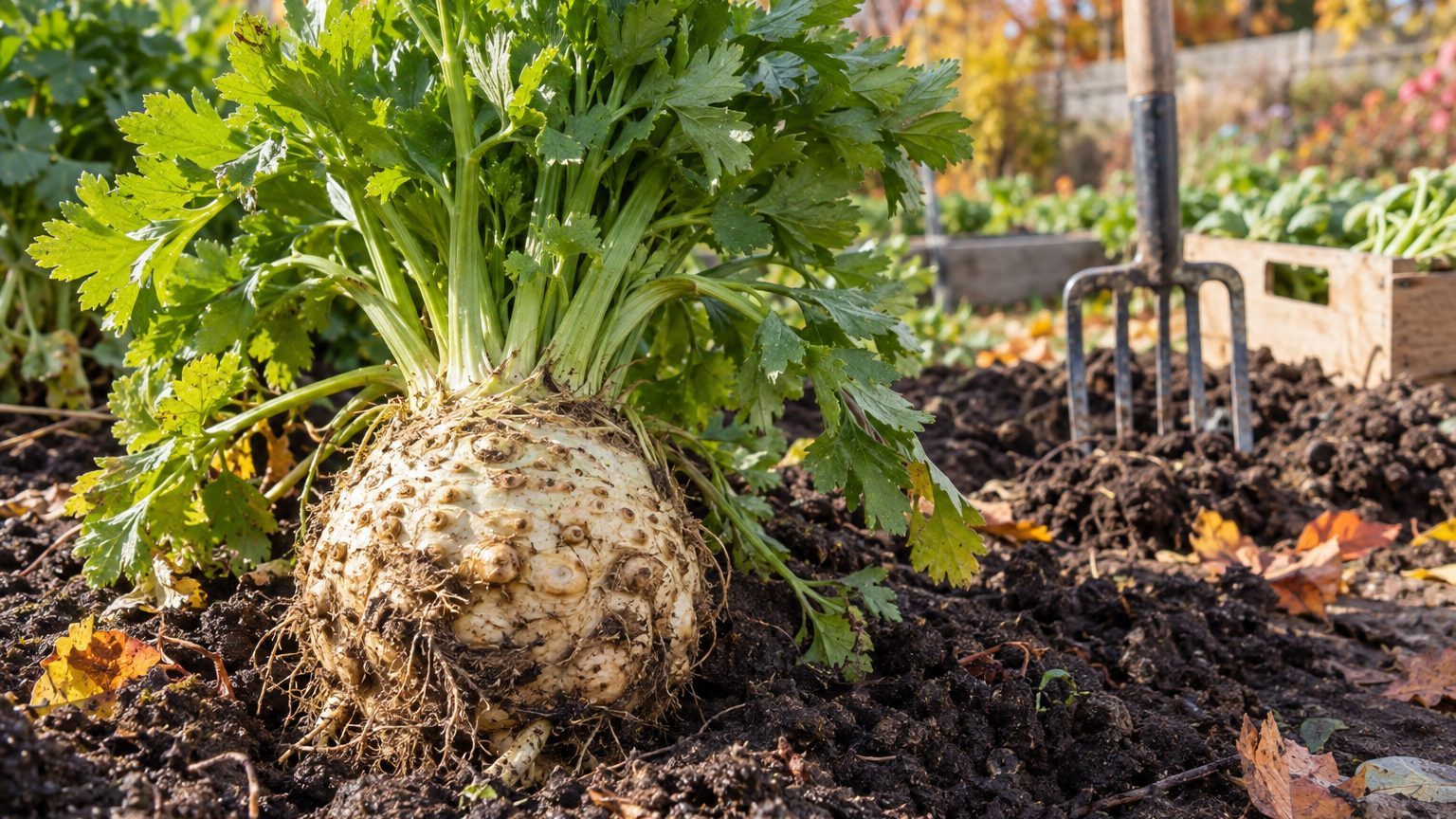

Celeriac needs roughly 100 to 120 days in the ground after transplanting, plus another 8 to 10 weeks of indoor seed starting, and it wants evenly moist soil the entire time. That’s about six months from seed to harvest. Skip either half of that formula (the long runway or the steady water) and you get a golf-ball-sized knob with a woody or hollow center. Get both right and you get a 1- to 2-pound, knobby root that stores into winter.
Celeriac (Apium graveolens var. rapaceum) is the same species as celery, bred for its swollen stem base instead of its stalks. That family history explains almost everything about how it behaves: shallow roots, a taste for rich soil, a dislike of drought, and a nervous reaction to cold snaps in spring. It sits comfortably in the group covered in the Celeriac, Kohlrabi, Horseradish and Jerusalem Artichokes guide, though it’s the slowest and fussiest of the four.
The calendar: start early, plant after the cold has passed
A tomato is typically ready 60 to 85 days after transplanting. Celeriac asks for nearly twice that. The seed is the first hurdle: it’s dust-fine, needs light to germinate, and can take two to three weeks to sprout even at a steady 65 to 70°F. Surface-sow it or cover it with the barest dusting of seed-starting mix, then keep the tray evenly damp. A heat mat helps, and so does patience.
Count back 8 to 10 weeks from your average last frost date and sow then. In much of the Upper Midwest and Northeast, that means late February to mid-March. Gardeners in the Pacific Northwest often have a slightly wider window thanks to mild springs, while growers in Zones 8 to 10 along the Gulf and in the Deep South usually flip the schedule and start seed in late summer for a cool-season crop, since celeriac stalls when daytime temperatures push past the mid-80s.
Seedlings stay small for weeks. Once they have their first true leaves, move them into individual cells or 3-inch pots, and give them bright light from a grow light set a few inches above the foliage. Before they go outside, harden them off over 7 to 10 days.
Timing the move outdoors matters more than most people expect. Young celery-family plants that sit through a week or more of nights below roughly 50°F can interpret that as winter and bolt later, sending up a flower stalk in their first year. A bolted celeriac turns pithy and tough. So wait until the last frost has passed and nights are reliably above that mark, even if the plants look cramped and eager on the windowsill. A cold frame or row cover can bridge a questionable week.
Spacing and planting depth
Set plants 8 to 12 inches apart in rows 18 to 24 inches apart. Tighter spacing gives you more plants but smaller roots, which suits cooks who want tennis-ball-sized roots rather than softballs. Plant at the same depth the seedling grew in its pot. Burying the crown (the spot where the leaves meet the root) invites rot and produces a taller, narrower, less useful root. As the base swells over summer, it should rise partly above the soil line, and that’s normal.
Water: the part that makes or breaks the root
The roots of celeriac stay in the top 6 to 8 inches of soil. That is a shallow reach for a plant that ends up with a fist-sized swelling, and it means the crop feels every dry spell right away. The target is steady moisture, around 1 to 1.5 inches per week from rain and irrigation combined, and more than that in sandy soil or during heat waves. Think of a wrung-out sponge: damp all the way down, never soggy, never dusty.
The real danger lies in swings. A dry July followed by a soaking August thunderstorm can crack the surface of the root, leave the center spongy or hollow, and produce rough skin that’s tedious to peel. Even watering, rather than heavy but infrequent soaking, gives the root a smooth, uniform expansion. The details of how to schedule that, including drip setups and how to read the soil by hand, are laid out in Watering Root Crops for a Smooth Swelling. A simple check works in the meantime: push a finger 2 inches into the soil near the plant. If it’s dry at that depth, water.
Mulch does half the work for you. A 2- to 3-inch layer of straw, shredded leaves or untreated grass clippings (kept a couple of inches back from the crown) cools the soil, slows evaporation and smooths out the moisture swings. Drip tubing or a soaker hose under the mulch wets the root zone without splashing soil onto the leaves, which also cuts down on leaf spot diseases that thrive on wet foliage.
Small celeriac that never seems to swell, despite a long season and decent watering, usually has a different cause, such as crowded plants, compacted soil or bolting after a cold spell. The troubleshooting steps for that are in Celeriac That Never Swells.
Soil and feeding for a hungry crop
Celeriac is a heavy feeder. It does best in loose, fertile, well-drained soil with a pH between about 6.0 and 7.0, and it responds well to organic matter worked in before planting. Two to three inches of finished compost, forked into the top 8 inches, improves both nutrition and water-holding capacity. Heavy clay benefits from the same compost for drainage, and sandy soil benefits because the compost holds moisture that sand lets slip away.
A soil test is worth the few dollars. Most state Cooperative Extension offices (the land-grant university programs found in every state) run low-cost testing and will tell you your pH and nutrient levels. Celery-family crops are known to be sensitive to low boron, and a test helps you avoid guessing, since adding boron when you don’t need it can harm plants.
Once plants are established, side-dress with a balanced organic fertilizer or additional compost about every 3 to 4 weeks through midsummer. Stop feeding by late summer so the plant’s energy goes into the root rather than a flush of leaves. Weeding needs care: roots that close to the surface are easily damaged by a hoe, so hand-pull close to the plants and let mulch suppress the rest.
Some growers trim off the thin side roots that sprout from the sides of the swelling in late summer, pulling soil away from the shoulder first, because it makes the root cleaner and easier to peel. It’s optional. Plenty of gardeners skip it and simply scrub the roots at harvest.
Pests, harvest and storage
The main insect headaches are carrot rust fly maggots, which tunnel into roots, and celery leaf miners and aphids, which target foliage. Floating row cover laid right after transplanting blocks most of them, and slugs can be handled with the usual traps or hand-picking at dusk. Leaf spot (Septoria) shows up as small brown specks on foliage in wet, humid weather. Rotating celery-family crops (carrots, parsnips, parsley, celery) so they don’t return to the same bed for three years keeps disease from building.
Harvest begins when roots reach about 3 to 4 inches across, and many gardeners wait for 4 to 5 inches. Bigger isn’t always better. Oversized roots are more likely to be hollow in the middle, and a medium root that’s solid is nicer in the kitchen than a giant one with a void inside. Test one by gently brushing soil from the shoulder and measuring it before you commit to pulling the row.
Celeriac tolerates light frost, and a touch of cold sweetens the flavor slightly, but a hard freeze in the low 20s°F can damage the exposed shoulder. If you’re reading this in early October with plants still in the ground, this is the stretch to watch the forecast. Pile extra mulch or straw over the roots to push the harvest later, and lift everything before the ground freezes solid. In the coldest parts of the country (northern Minnesota, Maine, the Dakotas), that usually means finishing by late October or early November.
For storage, the aim is cold and humid: 32 to 40°F with high humidity, around 90 to 95 percent. Cut the tops to about an inch, trim off the roots with a knife, and don’t wash the roots, since leftover soil protects them. Layer them in barely damp sand, sawdust or peat-free potting mix in a crate in an unheated cellar or garage that stays above freezing. Stored this way, they commonly keep for three to five months. A smaller harvest fits in a refrigerator crisper drawer inside a perforated bag, where they last for several weeks.
Don’t toss the tops while trimming. The leaves taste like a stronger, more peppery version of celery leaf and work well chopped into stocks, soups or egg dishes, though they’re too coarse for salads once mature.