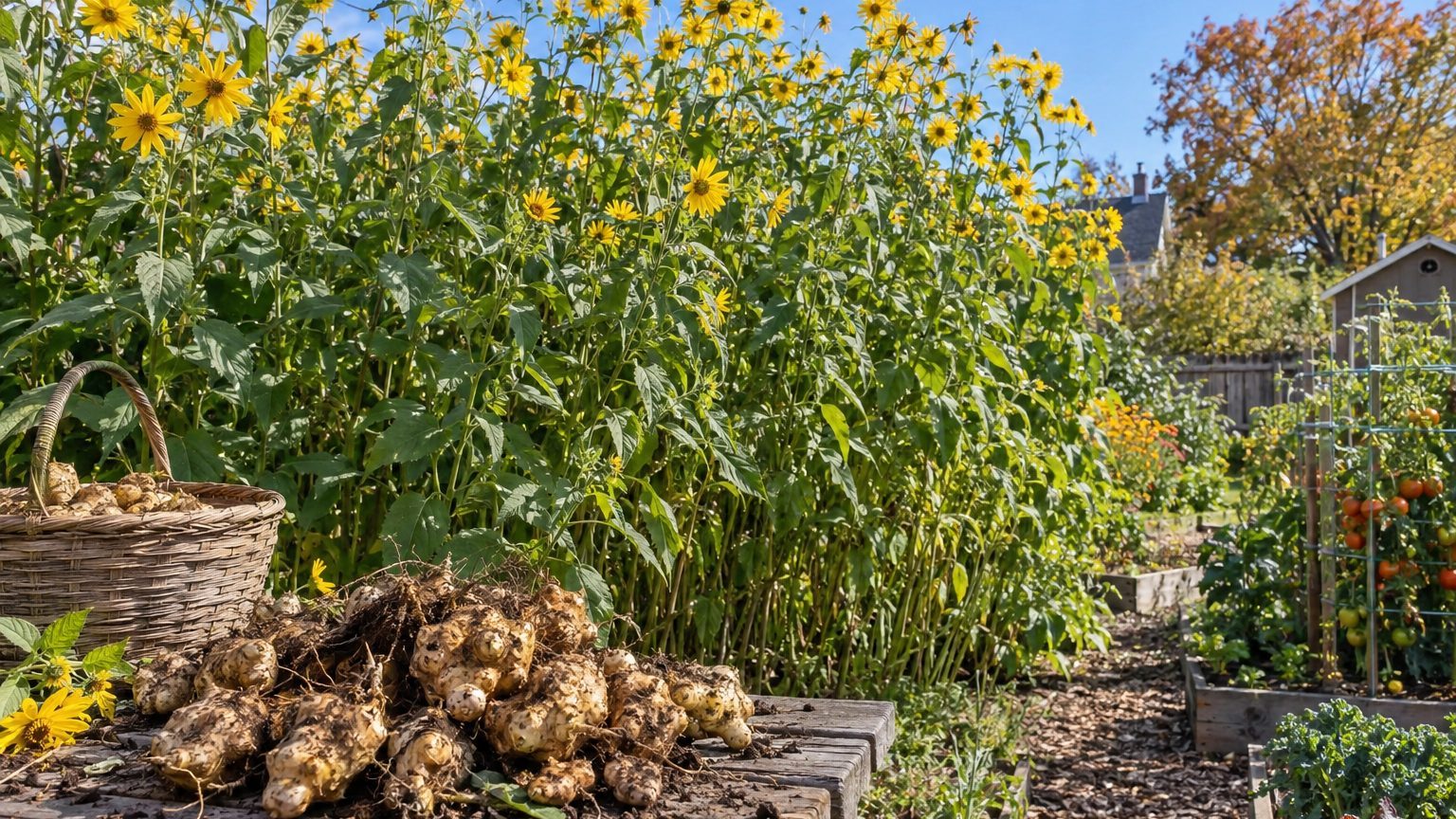

Plant Jerusalem artichokes (also sold as sunchokes) once, in a spot you are happy to give up for good. The tubers go 4 to 6 inches deep in early spring, about 12 to 18 inches apart, in full sun. They produce a 6 to 10 foot wall of yellow-flowered stalks by late summer. Then they come back every year, usually in a wider patch, because any tuber left in the ground can sprout. That persistence is the whole appeal and the whole risk. Handled well, you get a nearly maintenance-free crop of nutty, crisp tubers. Handled carelessly, you get a thicket that migrates into the tomatoes.
Of the four crops in our guide to Celeriac, Kohlrabi, Horseradish and Jerusalem Artichokes, this is the one where site selection matters more than technique. Celeriac fails if you skimp on water. Jerusalem artichokes fail you by succeeding too well.
Why this root behaves differently from other vegetables
Jerusalem artichoke (Helianthus tuberosus) is a perennial sunflower native to eastern and central North America. Indigenous peoples cultivated it long before European settlers arrived. It is not a once-a-year crop like a carrot. Each plant sends out underground rhizomes, and the tubers form along them. By fall, one plant can be surrounded by a cluster of knobby tubers, with others a foot or more away from the original stem.
Those tubers are the problem. They are thin-skinned and brittle, so a shovel or fork snaps them easily. Even small broken pieces with a bud can resprout the following spring. Unlike a potato, which you can mostly clear out with a careful dig, a Jerusalem artichoke bed is never fully harvested. Something always stays behind.
Where you live changes how seriously to take this. Inside its native range, across much of the East and Midwest, it blends in with other tall wildflowers. Farther west, and in other countries, it can behave more like an escaped weed along ditches, creek banks, and field edges. Before planting, check your state’s noxious weed list or ask your county extension office. It takes five minutes and could save you a headache.
Hardiness is rarely an issue. The plant is generally grown from USDA zones 3 through 9, and the tubers overwinter in frozen ground without protection. Cold is not going to kill it.
Choosing a spot you can live with for years
Start with light. Jerusalem artichokes want at least 6 hours of direct sun, and 8 is better. In shade the stalks stretch and flop, and tuber production drops off. Soil matters less than with almost any other root crop. They tolerate clay, sand, and mediocre fertility, which is one reason people end up with too many. What they do not tolerate is wet feet. In soil that stays waterlogged, tubers rot over winter, so skip the low spot where puddles linger after a storm.
Then think about shade you will cast. A mature patch can hit 10 feet, sometimes more in rich soil. Put it on the north side of the garden and it works as a living screen. Put it on the south side and it will block sun from everything behind it. The same height makes it useful along a back fence, beside a compost area, or as a summer privacy hedge for a patio.
Good locations tend to share a few traits:
- A fence, wall, or paved edge on at least one side to stop spread
- A mowed lawn border on another side, so stray sprouts get cut every week
- Distance from the vegetable beds, ideally 10 feet or more
- A property line setback, so tubers do not wander into a neighbor’s yard
That mowed-edge trick works better than you might expect. Shoots that pop up in lawn get cut repeatedly and, after a season or two, run out of stored energy. A tilled or mulched bed edge has no such check, which is why plants escape there.
Containment: what works and what doesn’t
Gardeners love to suggest buried barriers, and they help, but only partly. Rhizomes mostly run in the top foot of soil, so a buried edging of rigid plastic or metal sunk 12 to 18 inches deep can stop most lateral travel. Thin landscape edging will not do it, and neither will a barrier that sticks up only a couple of inches. Any gap, whether at a joint or a corner, is an exit.
Containers are the safest approach. A large pot, half whiskey barrel, or heavy fabric grow bag holds a plant or two, and the tubers have nowhere to go. Use at least a 15 to 20 gallon container for good yields, and keep it on a hard surface, not directly on soil, since roots poking through drainage holes can root into the ground below. The tradeoff is that pots dry out faster and yields are lower than in the ground. Also, you must dig every tuber at the end of the season, or whatever remains will sprout next year in the same pot (which, in fairness, is a perfectly fine outcome if you want it to).
A raised bed with a solid base is another route, though a standard raised bed open to the soil below is not a barrier at all. Tubers will grow straight down and out through the bottom.
Planting and growing the first season
Buy seed tubers from a garden center or mail-order supplier in early spring, or use firm, unblemished tubers from the grocery store produce section. Look for ones with visible knobby eyes and no soft spots. Varieties differ mainly in skin color and shape. Some, like Fuseau, are bred to be longer and smoother, which makes cleaning much easier than with the lumpy, deeply knuckled types.
Plant as soon as the soil can be worked, usually March through April in much of the country, a little later in northern states and mountain areas. Fall planting also works in milder regions, since the tubers sit dormant until spring. Set whole tubers, or pieces about the size of a hen’s egg with at least one eye each, 4 to 6 inches deep and 12 to 18 inches apart. If you want rows, space them roughly 3 feet apart so you can get a fork between them at harvest.
After that, there is not much to do. Water during the first few weeks while shoots establish, and again in long dry spells, since stress reduces tuber size. Fertilizer is rarely needed, and too much nitrogen gives you tall green stalks and fewer tubers. A layer of mulch holds moisture and slows weeds, though a mature stand will shade out most competition anyway.
Staking is usually not necessary, but tall plants in exposed spots can lean after a heavy storm. A couple of posts and a run of twine around the patch keeps things upright. Some gardeners cut the tops back by about a third in midsummer to keep height down. That can cost you a little yield, so use it only if wind or neighbors demand it.
Pest pressure is generally low compared with most vegetables, but not zero. Voles, gophers, and slugs go after the tubers, and a few fungal problems show up in humid weather. For specifics, see What Attacks These Four Crops.
Harvesting, eating, and getting rid of it if you must
Patience pays here. Tubers are not ready until the stalks start to yellow and die back, typically after the first hard frost in October or November, about 4 to 5 months after planting. Many growers wait for a frost on purpose, because cold nudges the plant to convert some of its starch-like carbohydrate, inulin, into sweeter sugars. Tubers dug in midsummer taste bland and watery by comparison.
Cut the stalks to a few inches above ground, then loosen the soil with a garden fork a foot or so out from where the stems stood. Lift gently and shake off the dirt. You can keep digging all winter wherever the ground does not freeze solid; a thick layer of straw or leaves over the bed helps keep soil workable in colder states. Dig only what you plan to eat in a week or two.
That is because storage is the weak point. Out of the ground, the thin skins lose moisture fast, and tubers turn rubbery in about a week at room temperature. Unwashed tubers in a perforated bag in the refrigerator crisper keep for a couple of weeks. Damp sand in a cool cellar can stretch that a bit. Roasting, simmering in soup, or slicing raw into salads all work. Scrub rather than peel, since the skin is edible and peeling a knobby tuber wastes half of it.
A caution about the kitchen end: inulin is the reason these tubers have a reputation for causing gas and bloating in many people. Start with a small portion and read Why Jerusalem Artichokes Disagree With People before serving a big batch to guests.
If you change your mind
Removal takes more than one season. Dig out every tuber you can find, then cut or mow every new shoot the moment it appears, ideally when it is under a foot tall. Repeat through the whole growing season and again the following year. Each cut forces the plant to spend stored energy on regrowth without letting leaves replenish it. Smothering with thick cardboard and mulch helps less than people hope, because tubers send shoots through surprisingly tough material. Do not till the patch, since a rototiller chops tubers into hundreds of new plants.
A last bit of trivia to keep in your back pocket: the name has nothing to do with Jerusalem or with artichokes. A common explanation is that “Jerusalem” is a corruption of girasole, Italian for sunflower, and the artichoke comparison came from the flavor, which does resemble artichoke hearts when the tubers are cooked.