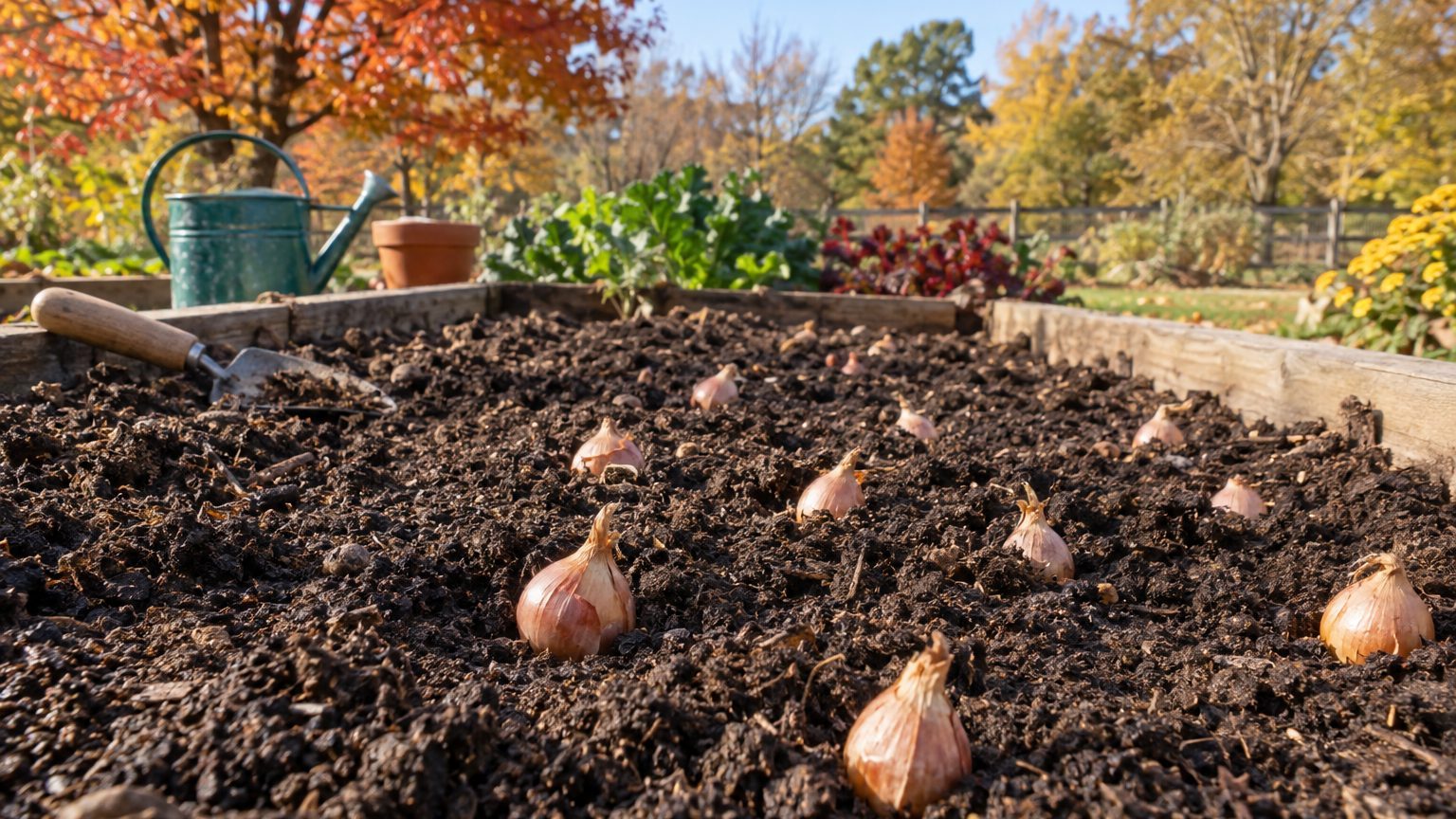

Plant shallots in Alberta in spring as soon as the soil can be worked, or in fall a few weeks before the ground freezes. Frost dates anchor both options. At the Calgary airport station, the last spring frost falls on average May 21 and the first fall frost on average September 16. Those are midpoints, not guarantees, so read them as the middle of a window.
The short answer for Alberta
Those two dates come from Environment and Climate Change Canada’s 1981-2010 normals for the Calgary International Airport station. Each is a mean. In one year out of two, the last spring frost lands later than May 21, and in one year out of two the first fall frost arrives later than September 16 (which also means it arrives earlier in the other half). So May 21 is not a safe date. It is the point where you have a coin-flip chance of being done with frost.
That distinction matters less for shallots than for tomatoes. Shallot bulbs and their first green shoots take a light frost without complaint, which is why spring planting does not have to wait for May 21. The practical window looks like this:
- Spring planting: as soon as the soil is workable and no longer waterlogged. In many years that comes before the mean last frost date, and the bulbs simply sit in cool soil and root.
- Fall planting: after the worst of the summer heat, early enough for roots to form but late enough that the tops do not race ahead before freeze-up.
- Frost-free stretch: a bit under four months separates the two mean dates, and that is the working season a shallot has to size up in.
This page does not carry a soil-thaw date or a ground-freeze date for Alberta, and those are the two dates a fall or early-spring planting actually hinges on. Frost dates are the closest figures available here, so they work as a sanity check rather than a schedule.
Why fall planting is worth considering
The coldest month at the Calgary reference station has a mean daily minimum of -13.2 °C (8.2 °F). That is an average of the nightly lows, not a record, and cold snaps dip well below it. Fall-planted shallots survive that kind of winter when they sit under a mulch layer or reliable snow cover, and they reward you with an earlier, larger crop. The risk is bare ground in a cold, snowless spell. If you want a hedge, split your bulbs: put roughly half in the ground in fall and hold the rest for spring.
For a broader look at the crop itself, see Growing Shallots in Alberta.
What will not work here
Waiting until May 21 to start, for one. Treating the mean frost date as the green light wastes the best weeks of cool, moist soil, when shallots root hardest. Bulbs planted in late May or June get a short run at leaf growth before the days shorten, and they tend to finish small.
Slow-maturing types are the second failure. With a bit under four months between the mean last and first frosts, anything that needs a long, hot, steady season struggles. Shallots grown from true seed and sown directly outdoors in spring are the clearest example: they need a long run to size up, and a short northern season does not give it to them. Seed-grown shallots can work, but only if you start them indoors early and accept smaller bulbs. Sets and bulbs are the reliable route. The variety question is covered in The Best Shallots to Grow in Alberta.
Fall planting also fails in two opposite ways. Plant too early, in warm September soil, and the bulbs push out a thick stand of leaves that the first hard freeze burns back, which drains the bulb. Plant too late and the roots never anchor, so winter thaw and refreeze can heave the bulbs out of the ground. Alberta’s chinook winds, common in the south, can warm the ground quickly in midwinter and then drop it back to hard freeze within a day or two. That cycle is harder on a bare bulb than steady cold is. A few inches of straw or shredded leaves evens it out.
The winter minimum rules out a different shortcut. A mean daily low of -13.2 °C in the coldest month, with colder nights on top of it, means that bulbs left shallow and unmulched are gambling. Pushing a bulb just under the surface, the way you might in a mild coastal state, does not hold up. And a note on the comparison: that is far colder than the January lows across much of the central and southern United States, where fall-planted alliums need little protection.
Finally, there is the assumption that one set of dates fits the province. The numbers on this page come from a single airport station. A planting date lifted from Calgary and applied in a cold northern pocket or on a higher bench will leave bulbs in the ground too late, or too early, by weeks.
What changes across Alberta
Natural Resources Canada places the reference city at zone 4a, in the Canadian plant hardiness system. That is not a USDA zone. The Canadian system draws on seven climate variables, the USDA system on one, and NRCan states there are no simple conversions between them. Canadian 4a overlaps nine USDA zones, from 3a to 7a, so comparing it to a US zone number misleads more than it helps. The figure is based on 1991-2020 normals for the reference city, not for the whole province. (The frost dates, by contrast, use 1981-2010 normals, so the two sets of figures do not cover the same years.)
Alberta stretches from the prairie south of Lethbridge to the foothills, the Rockies and the Peace River country in the north. There is no single answer for the province, and the spread of zones across it is not in the figures this page holds. The place to see it is the Natural Resources Canada plant hardiness site, where you can look up your own municipality rather than rely on this page to tell you.
If you garden north of Calgary, in the foothills, or at altitude, the shift runs in one direction. Frost arrives earlier in fall and leaves later in spring, so every date on this page slides later in spring and earlier in fall. Weeks, not days, is the scale the station figures themselves warn about. In practice that pushes you toward fall planting under a heavier mulch, toward varieties that mature early, and toward leaving seed-grown shallots to the indoor-start crowd. Southern gardens with milder pockets can lean on the dates as written, still treating them as midpoints.
Where to check this for your own county
The next step is Alberta Agriculture and Irrigation, the provincial agriculture department and the closest thing Alberta has to a state extension service. It is the right place to look for two things: a local planting calendar for your area, and any list of vegetable and allium varieties that have been trialled near you. A variety that performs in the Peace River region may behave differently in the foothills, and a trial plot nearby tells you more than any general recommendation does.
When you search, look for planting windows tied to your district rather than the whole province, and for notes on fall planting and mulching of garlic and other bulb alliums. Garlic guidance is often the closest match for shallots, since the two are planted and overwintered in nearly the same way. This page does not confirm that the provincial site lists shallots by name, so expect to adapt allium advice.
A county or district recommendation beats a state or provincial one, and this page is the provincial one. It is built on a single airport station and a single hardiness zone, which leaves out the frost pockets, wind-exposed ridges and sheltered south slopes that decide how a given garden behaves. Treat the numbers here as a starting frame, and let a local source overrule them wherever the two disagree.
Checking this against your own garden
Your own beds outrank every date above. Three observations will tell you more about your microclimate than a station 100 miles away.
Soil warmth by feel. In spring, squeeze a handful from a few inches down. If it crumbles instead of smearing into a wet ball, it is workable. If it feels like it is pulling the heat from your hand, it is still cold. A bed that passes this test two weeks ahead of the next one is your early spot.
Where the snow leaves first. The patches that clear early, and drain instead of pooling, are your best candidates for early shallots. Beds that stay white or soggy late, or sit in a low pocket where cold air settles, run behind and will want a later start or better drainage.
First growth on chives and other early perennials. Chives are alliums, so their first green shoots are a fair signal that the soil has warmed enough for shallots. If yours show well before your neighbors’ do, your garden runs warmer than the district average. If they come late, shift your planting later to match.
Common questions
Can I plant shallots in fall in Alberta?
Yes, and many gardeners prefer it. Plant after summer heat fades and early enough for roots to form, then mulch heavily. The risk is a snowless cold spell, so keep some bulbs back for spring.
Is May 21 a safe date to plant?
No. It is the average last spring frost at the Calgary airport station, which means frost falls later than that in one year out of two. Shallots tolerate light frost, so you can plant earlier, but the date is a midpoint, not a guarantee.
Does the Calgary frost date apply across Alberta?
No. The figures come from one station, and northern or upland districts run weeks behind it. Use them as a rough anchor and check your district for local dates.
How cold is too cold for shallots here?
The coldest month at the Calgary reference station has a mean daily minimum of -13.2 °C (8.2 °F), and nights go colder than that average. Mulch or reliable snow cover is what carries fall-planted bulbs through, more than the exact temperature.