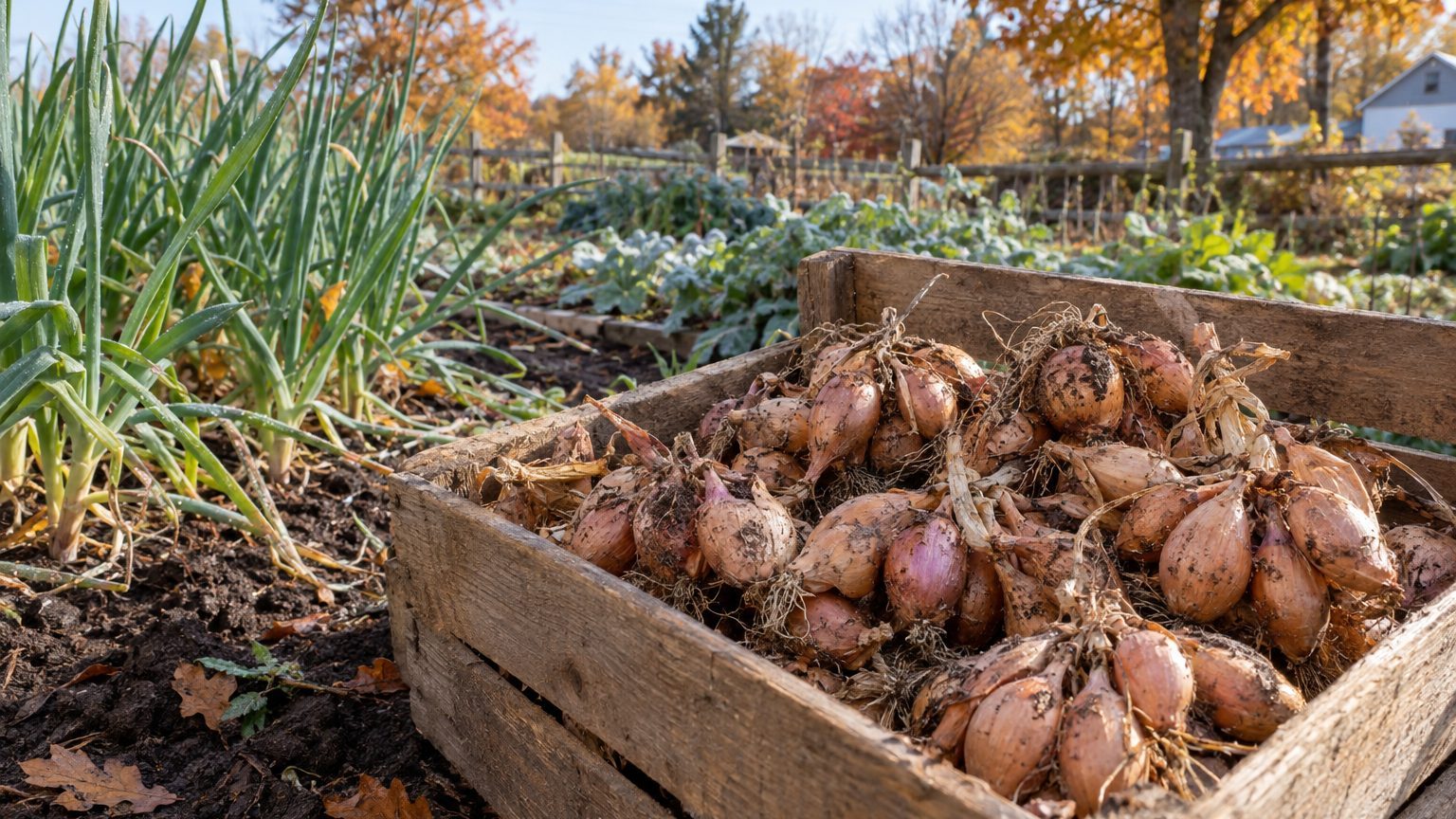

For most British Columbia gardeners, the best shallot is a multiplier type grown from a small bulb, not from seed. Plant it in fall on the mild coast and in early spring almost everywhere else. Seed-grown types are a gamble outside the southwest corner. This page anchors that advice to Vancouver’s frost record and flags where the rest of the province departs from it. For the wider picture, start with Growing Shallots in British Columbia.
The short answer for British Columbia
Choose bulb-planted multiplier shallots first, and treat seed-grown shallots as a second project. That is the decision by type, and it comes straight from the length and mildness of the season at the one station this page has data for: Vancouver International Airport.
Environment and Climate Change Canada’s 1981-2010 normals put the average last spring frost there on March 18 and the average first fall frost on November 10. Both are mean dates, not guarantees. In one year out of two, frost arrives later than March 18 in spring and later than November 10 in fall, so each date is the middle of a window. By simple arithmetic, about 237 days separate the two means. That is a long run for an onion relative, and it explains why the coast can handle almost any approach.
Winter is the other half of the picture. The mean daily minimum of the coldest month at the Vancouver reference station is 0.8 °C (33.5 °F). Bulbs sitting in the ground are not being tested by deep cold there. They are being tested by wet soil.
Why bulb types lead
A multiplier shallot starts with a head start: a bulb that already holds stored energy. Plant one clove-sized bulb and it divides into a cluster. It does not depend on a long, warm stretch to build a plant from a seed the size of a pencil dot. A seed-grown shallot needs weeks indoors under lights or on a bright sill, then transplanting, then a summer long enough to bulb up and cure. Some coastal gardeners manage that happily, and it can pay off in cost per plant. It just adds steps that a bulb skips.
How the main approaches compare
| Approach | Best fit in BC | Main risk |
|---|---|---|
| Multiplier bulbs, planted in fall | Mild coast and Lower Mainland-type climates | Waterlogged soil through winter |
| Multiplier bulbs, planted in spring | Interior, north, higher elevations | Later harvest, so less margin before fall weather |
| Seed-grown, started indoors | Coast, and sheltered interior sites with care | Extra work, and a thin margin if the summer runs cool |
| Seed-grown, sown directly outdoors | Only the mildest sites | Season too short for slower types |
Timing details by month live on When to Plant Shallots in British Columbia. This page does not carry a province-wide list of trialled cultivar names, and it will not make one up.
What will not work here
Start with the date everyone wants. March 18 is not a safe planting date for anything frost-tender, and it is certainly not a promise. Half of all years bring frost after it. Shallot bulbs shrug off a light freeze, but transplants hardened off too fast and tender seedlings do not. Treat the date as the center of a risky stretch, not a green light.
Slow seed-grown types are the next casualty once you leave the coast. The 237-day gap between mean frosts belongs to a station beside the Pacific. Northern and upland districts run weeks behind it, and a gap that long can shrink fast. A shallot grown from seed has to germinate, size up, mature and cure before fall weather arrives. Sown directly outdoors in a cool district, it can stall at pencil thickness. That is a poor trade for a crop that a planted bulb would have finished.
On the coast, the failure runs the other way. Fall planting works because the coldest month is mild at 0.8 °C, but the same mildness comes with a wet season, and bulbs left in heavy, poorly drained clay can rot before they root. Raised beds, a few inches of compost worked in, or a sloped bed all help. A flat bed over compacted subsoil does not.
Close spacing is the quiet mistake in damp climates. Multipliers fan out into clusters, and clusters planted a couple of inches apart trap moisture around the necks and invite mildew and neck rot. Give each bulb 6 inches or so, and thin if clumps get crowded. The same logic applies to heavy mulch on the coast: a thin layer protects, a thick wet one smothers.
Fall planting without protection is a gamble in colder districts. This page does not have winter minimums for the interior or the north, so it cannot name a number. What it can say is that the 0.8 °C figure is a coastal one, and that reader beyond the coast should assume winters get meaningfully harsher and plan on mulch, or on spring planting.
Last, don’t borrow a calendar from the United States. Canadian normals here cover 1981-2010, while US figures on this site cover 1991-2020, and the hardiness systems do not line up. Copying a Washington State planting date onto a Kootenay garden is a coin flip at best.
What changes across British Columbia
British Columbia is not one garden. It is a coastline, several mountain ranges, dry interior valleys, plateaus and a long northern stretch. The reference figure for this page is Canadian hardiness zone 9a, the zone of the reference city, Vancouver, from Natural Resources Canada’s 1991-2020 data. It is not the zone of the province. Across BC the spread is wide, with the coast at the mild end and the north and high country far colder, so no single answer fits everyone.
Be careful with the label, too. That 9a is in the Canadian system, which is built on seven climate variables, and it does not convert to a USDA zone. Natural Resources Canada says plainly that there are no simple conversions: Canadian zone 4a, for example, overlaps nine different USDA zones, from 3a to 7a. So a Canadian zone should never be pasted onto a US chart.
To find your own, use the Natural Resources Canada plant hardiness map, where you can look up your municipality. Don’t guess from a neighbor or from where you grew up.
What should a reader in the north or at altitude shift? Several things, roughly in order of importance:
- Lean on spring-planted bulbs, set out as soon as the soil can be worked.
- Push seed-grown shallots to a minority of the bed, started earlier indoors, or skip them.
- Treat Vancouver’s frost dates as an optimistic floor and add weeks.
- If you do plant in fall, mulch after the ground starts to chill, not before.
A gardener in a mild pocket of the south interior may land closer to the coast than to the north. Elevation, valley cold-air drainage and a south-facing slope can each move the answer by weeks.
Where to check this for your own county
The best next stop is the Government of British Columbia’s agriculture and seafood pages, the provincial agriculture source. British Columbia does not run a county extension network the way many US states do, and its local government is organized by regional district, so you may need to think in those terms rather than “county.”
When you get there, look for two things. First, a local planting calendar for onions, garlic or shallots in your region: last and first frost windows measured near you, not at an airport on the coast. Second, any list of varieties trialled in your area, because a cultivar that sized up well in a trial plot in your climate beats a catalog description every time.
If the provincial pages do not carry shallot-specific material, look for any onion or allium guidance and adapt it, keeping in mind the difference between bulb types and seed types described above. Local gardening groups and seed suppliers that grow in your region often know which types survived their winters, and a conversation there can fill the gaps in a publication.
A county or regional recommendation beats a state or provincial one, always. Local frost dates, soil and rainfall differ too much inside this province. This page is the provincial view, built around one reference station. It is a starting frame, and your region’s own guidance should override anything here that disagrees with it.
Checking this against your own garden
Your own observations outrank every date on this page. Three are worth tracking, and none needs equipment you’d have to buy.
First, soil warmth by feel. In early spring, push a trowel in and grab a handful. If it’s cold enough to make your fingers ache and it clumps into a wet ball, wait. If it crumbles and feels cool, not icy, the bed is ready for bulbs. Beds that reach that point weeks apart tell you which corners are warm pockets and which stay cold and wet.
Second, the first green shoots on fall-planted bulbs, or the first true leaves on seedlings (the straight blades that follow the initial loop). The date they appear tells you how fast your microclimate wakes up. If neighbors’ shoots are up and yours aren’t, your bed is colder or wetter than the district average.
Third, the last frost you actually see. Watch for white on the lawn or a frosted windshield, and write down the date. Low spots, where cold air pools, can see frost days after a hilltop. Keep that note for two or three seasons and you’ll have a better frost date than any normal.
Common questions
Should I grow shallots from bulbs or from seed in British Columbia?
Bulbs, for most gardeners. They need less season and less labor. Seed is a reasonable experiment on the mild coast, and a poor bet where summers are short.
Can I plant shallots in fall in British Columbia?
On the coast, yes. The coldest month at the Vancouver reference station has a mean daily minimum of 0.8 °C. Farther inland or north, winters are colder than this page has numbers for, so spring planting or heavy mulch is the safer plan.
Is Vancouver’s frost date my frost date?
Probably not. March 18 and November 10 are mean dates for one airport station from 1981-2010. Frost falls later than each date in half of all years, and northern and upland districts run weeks behind.
Which named varieties do best in British Columbia?
This page does not have trial results for named cultivars, so it won’t recommend any. Look for varieties trialled in your own region through provincial agriculture resources or local growers.
One last nuance: the hardiness zone cited here, 9a, is the figure for Vancouver. A gardener in the cold north could be several zones lower in that same Canadian system.