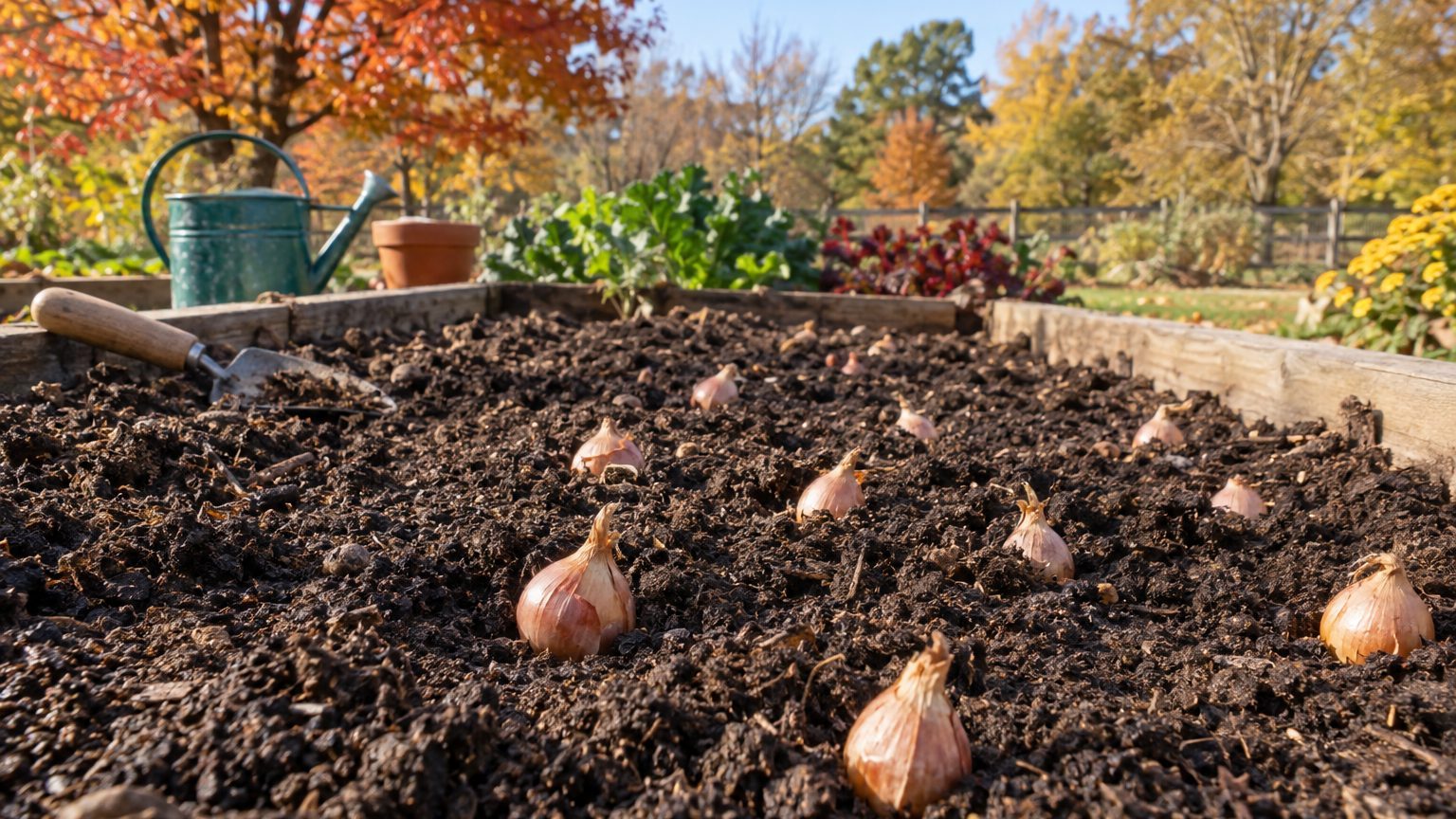

Shallots go in the ground twice a year in Colorado, and fall planting usually wins. Cloves set out near the first hard freeze root before winter and start growing early the next spring. Bulbs from that planting tend to size up before midsummer heat. Spring planting works too, but it leaves bulbs less time to fatten. Every date below comes from Denver’s frost record, so treat it as a starting point for the Front Range plains, not a rule for the whole state.
The short answer for Colorado
In Denver, plant fall shallots around the first fall frost, which NOAA’s 1991-2020 Climate Normals put at September 30 to October 12. Plant spring shallots as soon as the soil can be worked, well ahead of the last spring frost of May 1 to May 11. Those ranges are not deadlines. They are the band where the chance of a 32°F freeze falls between 30 and 70 percent, measured at the Denver reference station (USW00003017).
That distinction matters. A “last frost of May 1 to May 11” does not mean the garden is safe on May 12. It means that around those dates, the odds of another freeze have dropped to somewhere between a coin flip and a bit better than one in three. Colorado gardeners know a late storm in mid-May can still happen. Shallots shrug that off better than tomatoes or beans do. Their green tops tolerate a freeze, which is why spring cloves can go in weeks before the frost range instead of after it.
The fall logic runs the other way. You want roots, not tops. Plant too early and the cloves send up a tall green shoot that winter has to deal with. Plant at or just after the first fall frost range and the soil is still workable and cooling, which encourages roots without much leaf. Here is how the two windows line up against the Denver frost data:
| Planting window | Anchor in the Denver data | What you are aiming for |
|---|---|---|
| Fall | First fall frost: September 30 to October 12 | Roots before the ground freezes, little top growth |
| Spring | Before the last spring frost: May 1 to May 11 | Early planting once soil is workable, so bulbs size up before summer heat |
One more number shapes the fall choice. The mean daily minimum of Denver’s coldest month is 18.4°F. That is an average night, not the worst one, so colder nights will come. A layer of straw or shredded leaves over fall-planted shallots is cheap insurance against the freeze-thaw swings that heave small cloves out of the soil.
This page does not have a Colorado-specific shallot planting date from an extension source, so the windows above come from the frost record and how shallots behave in general. For the bigger picture, see Growing Shallots in Colorado.
What will not work here
Using Denver’s dates in a mountain town will not work. The facts attached to those frost numbers say it plainly: Denver sits at 5,280 feet on the plains, and mountain towns run far shorter seasons and can frost in July. A gardener at 8,000 feet who waits for “May 11” may be waiting for soil that is still cold, and one who plants in late September may find the ground freezing before roots form.
Planting in the heat of summer also fails. Shallots are a cool-season crop, and cloves set out in July or August stall or bolt. The Denver frost record shows a season of roughly five months between the last spring and first fall freeze. That is enough for a bulb started in early spring or the previous fall, and not enough for one that starts late and slow.
That is also why the slowest shallots are a poor match. Varieties grown from true seed, which need a full season to produce a usable bulb, are a gamble where spring comes late and the first fall freeze can arrive by September 30. Sets or cloves skip months of early growth. If you want to compare types, The Best Shallots to Grow in Colorado goes through what suits the state’s seasons.
Planting too early in fall is the next trap. Warm September days tempt people to plant in the first week of the month, and the cloves respond by growing leaf. A tall green top going into a Colorado winter is exposed to wind and dry cold. Hold off until the first fall frost range is near.
Planting too late fails differently. Cloves pushed into frozen or nearly frozen ground in late November have no time to root, and the freeze-thaw cycle can lift them out. An 18.4°F average minimum in the coldest month is a reminder that winter here is not mild, even on the plains.
Skipping the mulch is a quieter mistake. Colorado’s winters can be dry as well as cold, and bare soil over fall-planted shallots loses both warmth and moisture. A few inches of straw does more than most gardeners expect. Pull it back in spring as shoots push through.
What changes across Colorado
Colorado does not have one answer. The USDA Plant Hardiness Zone Map (2023, built on 1991-2020 normals) runs from zone 3b to zone 7b across the state. That spread covers high mountain valleys with winters severe enough to challenge almost any perennial, and warmer low-elevation spots where winters are far gentler. The USDA zone system rests on one variable, the average annual extreme minimum temperature, so it says nothing directly about frost-free days or summer heat. It tells you about winter cold, not season length.
If you garden in the north or at altitude
Shift everything later in spring and earlier in fall. Where frosts come in July and arrive again in late summer, the fall window can close in September, and the spring window may not open until after Denver gardeners have finished planting. Shorter seasons favor fall planting with heavy mulch if winter cold is survivable under snow, or early spring planting with the fastest-maturing types. Snow cover is a form of mulch, and in many mountain towns it does more than anything you can add.
If you garden on the plains or the western slope
The Denver numbers are the best guide for the Front Range plains, and they are a loose guide for the western slope, which differs again. Valleys on that side can warm up sooner in spring or cool off faster at night, depending on the spot. Treat Denver’s May 1 to May 11 and September 30 to October 12 ranges as a reference, not a prediction for your yard.
To find your own zone, use the USDA Plant Hardiness Zone Map and look up your ZIP code instead of guessing from a neighbor’s garden. Even within one town, a south-facing slope and a low spot where cold air pools can behave like different zones.
Where to check this for your own county
Your state extension service is the next stop. Colorado State University Extension is the land-grant extension program for Colorado, and its county offices know local conditions in a way a statewide page cannot.
When you get there, look for two things. First, a local planting calendar for your county, ideally one that lists onions or alliums with dates for your elevation. Second, the varieties trialled in your county, meaning plants that have been grown and evaluated in conditions close to yours rather than simply sold in catalogs. If the extension office has no shallot-specific sheet, an onion or garlic calendar is a reasonable proxy, since all three are alliums with similar cold tolerance. Mark it as a proxy in your notes, though.
A county recommendation beats a state one. This page is the state one. It is built on a single Denver reference station and a statewide hardiness range, and it cannot see your elevation, your slope, or the town-to-town differences that matter in a state this varied. If extension staff in your county give a date that contradicts anything here, follow them.
This page also does not have a Colorado extension planting calendar for shallots to cite, so it stays with the frost data and general shallot habits rather than inventing a county-level schedule.
Checking this against your own garden
Your own observation outranks every date on this page. Three things are worth watching, and none needs equipment you are unlikely to own.
First, soil warmth by feel. In spring, push a trowel in and scoop up a handful. If it crumbles instead of clumping into a cold, wet ball, and your hand does not ache after holding it, the bed is ready. Compare two spots, such as a sunny south wall and an open bed, and you will learn how much your microclimate runs ahead of or behind the neighborhood.
Second, watch the first flush of male flowers on trees and shrubs near you. When catkins open and the first bulbs flower around the yard, the ground has usually turned a corner. If those events come two weeks later in your yard than in a friend’s across town, plan your planting the same way.
Third, look for the first true leaves on early weeds and on volunteers like chives or overwintered onions. Green leaf pushing through tells you the root zone is active. In fall, the opposite signal matters: when those same plants stop growing and the soil cools, you are near the right window for cloves. Jot the dates in a notebook for two or three years, and you will have a calendar better than any statewide table.
Common questions
Can I plant shallots in Colorado in spring instead of fall?
Yes. Plant as soon as the soil can be worked, ahead of the May 1 to May 11 last-frost range at Denver. The tradeoff is less time for the bulbs to size up before summer heat.
Do I have to wait until after the last frost to plant?
No. The tops tolerate a freeze, so early spring planting is normal. The frost range is a probability of a 32°F freeze, not a deadline.
Are Denver’s frost dates right for my town?
Only if you garden on the Front Range plains at a similar elevation. Mountain towns have far shorter seasons and can frost in July, and the western slope differs again.
What hardiness zone is Colorado?
The USDA Plant Hardiness Zone Map (2023) spans 3b to 7b across the state, so there is no single zone. Look up your own location on the USDA map instead of relying on a state-wide figure.