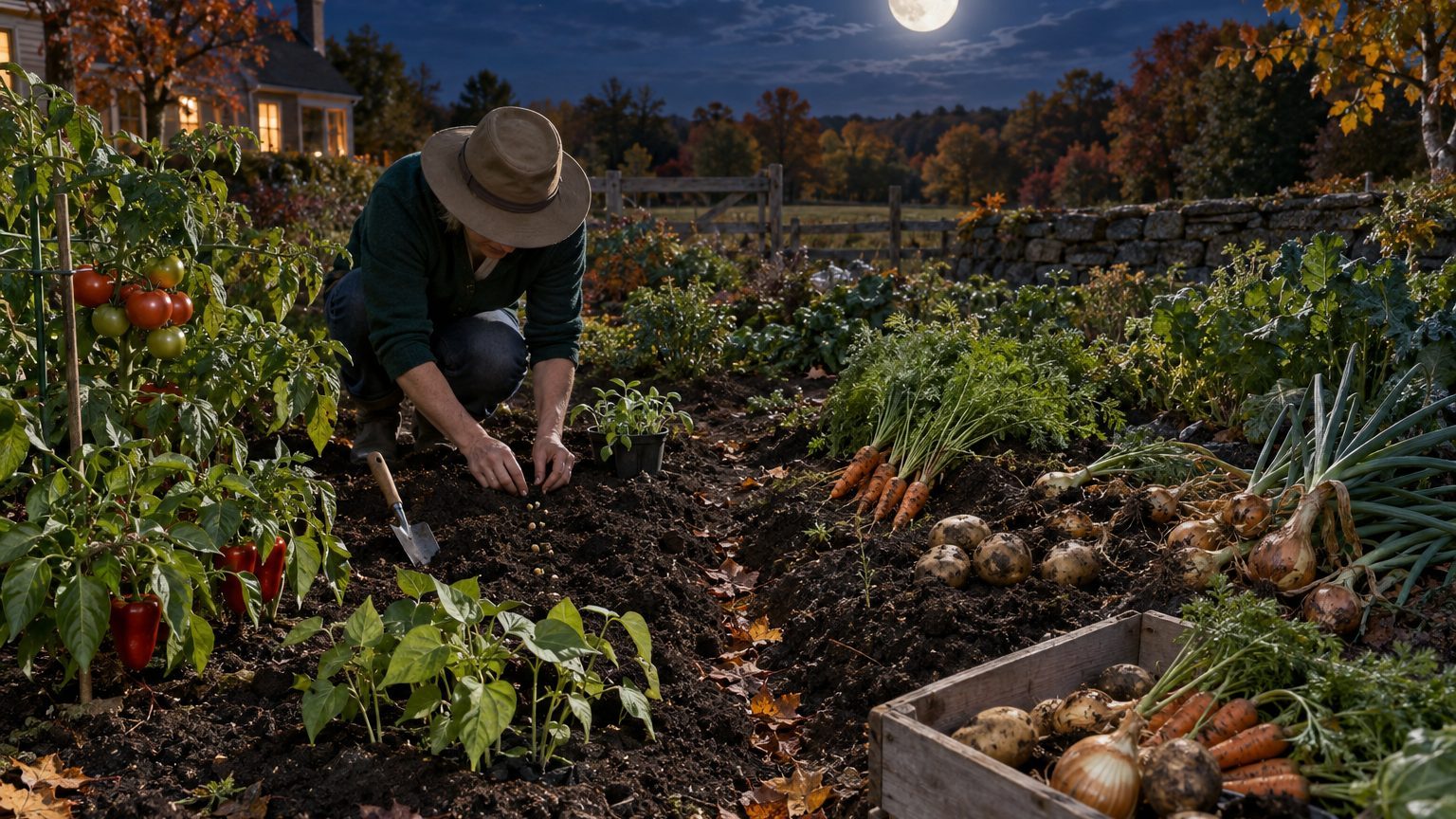

According to almanac tradition, the full moon is the line between two kinds of planting. Above-ground crops that bear seed inside the fruit belong to the waxing Moon, and root crops, bulbs and perennials belong to the days after the full moon. None of this is proven, and it never replaces your local frost dates. In October 2026, the full moon arrives on October 26 at 12:11 a.m. ET.
What the tradition says about full moon

The almanac rule starts from the Moon’s 29.53-day phase cycle and cuts it into four quarters. The full moon is the boundary between the second and the third. Everything before it, from first quarter to full, is the time for tomatoes, peppers, beans, squash and corn. Everything after it, from full moon to last quarter, is the time for potatoes, carrots, garlic, onions and beets, plus bulbs and perennials in general.
Notice what that means for the full moon itself. It is a single moment, not a stretch of days. In October 2026 that moment is 12:11 a.m. ET on October 26, just past midnight. So gardeners who plant by the Moon treat the full moon as a hinge, and the root-crop quarter opens right behind it.
Almanac tradition does not prove anything here. No effect of the Moon’s phase on germination or yield has been established, and the table below is a convention that gardeners have passed along, not a result. For anything practical, such as when a crop can go in the ground where you live, your state’s planting guide is the place to look.
| Quarter | Span | Tradition assigns |
|---|---|---|
| First | New moon to first quarter | Leafy crops that bear above ground (lettuce, spinach, cabbage, broccoli, celery) |
| Second | First quarter to full moon | Above-ground crops that bear seed inside the fruit (tomatoes, peppers, beans, squash, corn) |
| Third | Full moon to last quarter | Root crops, bulbs, perennials (potatoes, carrots, garlic, onions, beets) |
| Fourth | Last quarter to new moon | Rest: weeding, pruning, turning the soil, composting |
The full moon sits right where the second row ends and the third begins. That is why the tradition has two different answers for “planting on a full moon,” depending on whether you count the hours before it or the days after.
The next full moon dates
Two full moons are coming up, and both carry names from Old Farmer’s Almanac usage.
- Hunter’s Moon: October 26, 12:11 a.m. ET, with the Moon in Taurus.
- Beaver Moon: November 24, 9:53 a.m. ET, with the Moon in Gemini.
The gap between them is close to the 29.53-day average of the phase cycle. The Moon needs only 27.32 days to complete one orbit against the stars, but the Earth moves along its own orbit in the meantime, so the Moon takes about two extra days to catch up to the same phase.
For the waxing and waning spans, the October cycle runs like this. The Moon waxes from the New Moon of October 10 at 11:50 a.m. ET to the Full Moon of October 26 at 12:11 a.m. ET. It then wanes from that full moon to the New Moon of November 9 at 2:02 a.m. ET. Inside that waning stretch, the third quarter (the root-crop quarter in the Tradition) ends at the Last Quarter on November 1 at 3:28 p.m. ET. The fourth quarter, the rest quarter, takes over from there.
The next cycle starts the same way. The Moon waxes from the New Moon of November 9 at 2:02 a.m. ET to the Full Moon of November 24 at 9:53 a.m. ET, with First Quarter falling on November 17 at 6:47 a.m. ET along the way.
Which crops this phase is for, in the tradition
The third quarter, the one that opens at the full moon, is the root quarter. According to almanac tradition, it covers three groups: root crops, bulbs and perennials. Named in the almanac convention are potatoes, carrots, garlic, onions and beets. Gardeners who plant by the Moon keep leafy crops for the first quarter and fruiting crops for the second, so the full moon marks the point where they put those aside.
The sign of the Moon adds a second filter. This convention labels Cancer fruitful, Taurus semi-fruitful, and Gemini barren, and it asks for a fruitful or semi-fruitful sign inside the right quarter. That narrows the third quarter into short traditional windows. Biodynamic calendars following Maria Thun sort the days differently, by triplicity: Taurus is a root day, Gemini a flower day, and Cancer a leaf day. The two systems do not always agree, and sources differ even within the sign convention.
| Traditional window (root crops, bulbs, perennials) | Moon sign | Convention label | Sign change times (ET) |
|---|---|---|---|
| October 26-27 | Taurus | Semi-fruitful | Enters Taurus October 25, 7:34 p.m. Enters Gemini October 27, 9:01 p.m. |
| October 30-31 | Cancer | Fruitful | Enters Cancer October 29, 10:05 p.m. Enters Leo November 1, 12:18 a.m. |
| November 26-27 | Cancer | Fruitful | Enters Cancer November 26, 5:51 a.m. Enters Leo November 28, 6:20 a.m. |
One detail stands out. The November full moon, on November 24, falls with the Moon in Gemini, which this convention labels barren. So the day of the Beaver Moon itself is not a traditional root-crop day. The tradition’s next window opens two days later, with the Moon in Cancer. The October full moon, by contrast, lands in Taurus, so its root window starts almost at once.
When the Moon passes last quarter, the tradition changes its tune. From the Last Quarter of November 1 at 3:28 p.m. ET to the New Moon of November 9 at 2:02 a.m. ET, the quarter is a rest phase. The jobs it assigns are weeding, pruning, turning the soil and composting.
How much weight to give it
Very little, if you are asking whether the Moon changes what a seed does. The Moon’s tidal pull at the Earth’s surface, calculated from the constants in the NASA Moon Fact Sheet (a mean distance of 384,400 km, a 27.32-day orbit), comes to about 1.1 millionths of a meter per second squared. That is roughly one ten-millionth of gravity (1.1 x 10^-7 g) at its strongest. This figure is calculated, not measured on a seed. It is far too small to move anything as light as a seed or a root, and no effect of the phase or sign on germination or yield has been established.
What decides the season is the calendar of the place. Frost dates and soil temperature determine whether a crop can go in the ground at all. The Moon, if you choose to follow it, only picks among days that your local calendar already allows. Check your state’s planting guide first, then look at the lunar windows if the custom interests you. For the wider picture of what the evidence says, see our guide to planting by the moon.
Questions
Does the tradition say to plant on the full moon itself?
Not exactly. The full moon is the moment where the second quarter ends and the third begins. The almanac rule for root crops, bulbs and perennials covers the days after it, and the sign narrows those days into windows. For October 2026, the first root window is October 26-27, with the Moon in Taurus.
Why is the November full moon not in a traditional window?
Because the Moon is in Gemini on November 24, and this convention labels Gemini barren. The quarter rule alone would put the day in the root quarter, but the sign rule rules it out. The next traditional window for root crops, bulbs and perennials is November 26-27, with the Moon in Cancer.
Do the names Hunter’s Moon and Beaver Moon change anything?
No. Those names come from Old Farmer’s Almanac usage and label the full moons of October and November. The planting rule in the tradition comes from the quarter and the sign, not from the name of the moon.