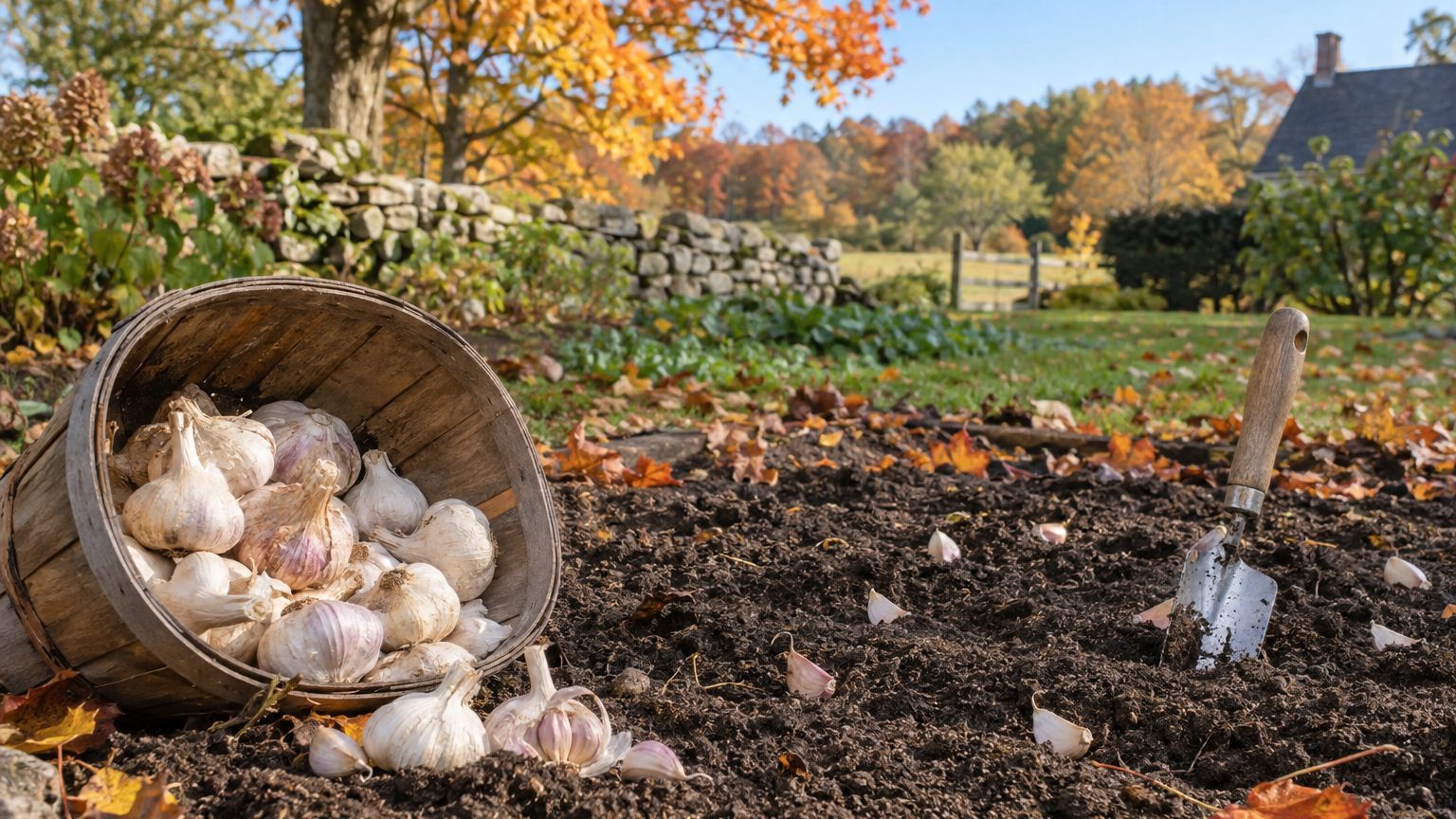

Garlic, according to almanac tradition, goes in during the third quarter of the Moon, the stretch from full moon to last quarter. No effect of the Moon on garlic has been shown, so treat the rule as an old custom for choosing among days that are already right for planting. Check your state’s garlic planting window first, then pick a tradition day from the table below that falls inside it.
What the tradition says about planting garlic

Gardeners who practice planting by the moon split the month into four quarters and give each quarter its own kind of crop. Garlic is a bulb, so the almanac files it under root crops, bulbs and perennials. Those go in during the third quarter, which runs from the full moon to the last quarter. The Moon is waning through that whole stretch, which is why you will also see the rule written as planting in a waning moon. The fourth quarter that follows is a rest period in the almanacs, kept for weeding, pruning, turning the soil and composting.
Where the evidence stands
No effect of the Moon’s phase or sign on germination or yield has been established. The practice is tradition, and this page presents it that way. The physics gives you no help either. NASA’s Moon Fact Sheet puts the phase cycle at 29.53 days, so each quarter lasts roughly a week. Calculated from the same fact sheet, the Moon’s tidal pull at the Earth’s surface is about one ten-millionth of gravity at its strongest. That is far too small to move a seed or a root.
Some gardeners follow the calendar anyway, simply as a way to pick a planting day.
The three crop types at a glance
| Crop type | Examples | Quarter, according to almanac tradition |
|---|---|---|
| Leafy crops that bear above ground | Lettuce, spinach, cabbage, broccoli, celery | First quarter, new moon to first quarter |
| Above-ground crops that bear seed inside the fruit | Tomatoes, peppers, beans, squash, corn | Second quarter, first quarter to full moon |
| Root crops, bulbs and perennials (garlic) | Potatoes, carrots, garlic, onions, beets | Third quarter, full moon to last quarter |
Traditional garlic planting days, 2026 and 2027
The table lists the days when the third quarter overlaps a fruitful or semi-fruitful Moon sign. Cancer is a fruitful sign in the almanac convention, and Taurus is semi-fruitful. Every day below is read at noon Eastern time (ET).
| Month | Traditional days, with the Moon sign |
|---|---|
| October 2026 | October 26-27 (Moon in Taurus), October 30-31 (Moon in Cancer) |
| November 2026 | November 26-27 (Moon in Cancer) |
| September 2027 | September 19-20 (Moon in Taurus) |
| October 2027 | October 16-17 (Moon in Taurus), October 20-22 (Moon in Cancer) |
| November 2027 | November 14 (Moon in Taurus), November 17-18 (Moon in Cancer) |
Which rows are yours
These months are the ones when gardeners in much of the country plant garlic. Your state may start earlier or later, so only the rows that fall inside your own state’s window count. The month-by-month detail for 2026 sits on the October 2026 moon calendar and the November 2026 moon calendar, where you can see each day beside its phase.
Treat the edges as soft
The Moon changes sign during the day, and the table reads it at noon ET. That makes the first and last day of every run a soft edge, because the table does not show the sign at other hours of the day. Readers outside Eastern time need to convert noon ET to their own clock.
Runs are short because two cycles have to line up. The Moon takes 29.53 days to go through its phases but only 27.32 days to circle the stars and pass through all twelve signs. NASA lists both figures. Because the two periods drift apart, a sign this convention labels fruitful or semi-fruitful rarely sits inside the third quarter for more than a couple of days, and some months offer only one run.
Check your state first: when to plant garlic where you live
The order of decisions matters more than any row in the table. Start with your state’s planting calendar for garlic, because that calendar sets the local planting window. The Moon never overrides that calendar. If you follow the custom, it only narrows your choice among days that calendar already allows.
Our page on when to plant garlic where you live sets out the timing logic for the crop. For a particular state, open the state guides and find your own. As one example of what a state page looks like, the Ohio planting calendar for garlic shows the window for that state, and it is the window, not any lunar day, that sets the limits there.
A sensible sequence
Once you know your state’s window, compare the dates in the table with it. Some years a tradition day sits comfortably in the middle of the window. Other years it falls on the very edge, or outside it altogether. When it falls outside, the window wins.
If you live where the window is long, you may find several tradition days inside it and can pick the one that suits your weekend. If the window is short, there may be none. If none falls inside the window, the tradition gives no reason to delay planting for a lunar date.
For local timing, use the state guides linked above.
How to compare two garlic planting dates
If you want to compare dates on your own plot, treat the result as a personal observation, not as evidence that the Moon caused it. Plant garlic two ways in the same season and keep the records.
- Choose one cultivar and one lot of seed garlic, to keep the two plantings as similar as practical apart from the planting day.
- Split the cloves into two equal halves and plant one half on a tradition day from the table, inside your state’s window.
- Plant the other half on an ordinary day within the same week, in the same bed with the same spacing and depth.
- Label both blocks with a stake and the date. Record the date on a weather-resistant label.
- Note when each block emerges in spring, then compare bulb size and weight at harvest.
What one season can and cannot tell you
One season will not settle anything. Differences between the two blocks would not, by themselves, establish an effect of the lunar calendar.
Notes from several seasons may be personally useful, but they cannot establish that the Moon caused any difference. Write down the drainage and sun of each block as well, so that a difference in the bed does not get credited to the calendar.
Questions about planting garlic by the moon
Does the tradition say to plant garlic in a waxing or a waning moon?
According to almanac tradition, garlic goes in during the waning moon, specifically the third quarter, between the full moon and the last quarter. The waxing moon belongs to the first two quarters, which the almanacs give to leafy crops and to crops that bear seed inside the fruit. The last stretch of the waning moon, the fourth quarter, is for rest and chores rather than planting.
What if the right day falls on a frost?
Then the frost wins. The tradition offers no rule that outranks the weather, and your state’s planting window comes before any lunar day. If a tradition day does not fit your state’s planting window, choose another day that does. If another tradition day is close, you may choose it to keep following the custom. An ordinary day inside your window is equally acceptable.
Do I need to follow the Moon sign as well?
Many almanacs do add the sign, and the days in the table above already include it. They use the common convention of fruitful signs (Cancer, Scorpio, Pisces) and semi-fruitful signs (Taurus, Libra, Capricorn), with the barren signs set aside. Sources differ on Virgo, Sagittarius and Aquarius. You can read more about the signs in our guide to moon sign gardening.
Biodynamic gardeners who follow Maria Thun use a different scheme, with four day types rather than the three sign categories used above. In that system the root days are Taurus, Virgo and Capricorn, and Cancer is a leaf day. A Thun follower would count October 26-27, 2026 for garlic but not October 30-31.