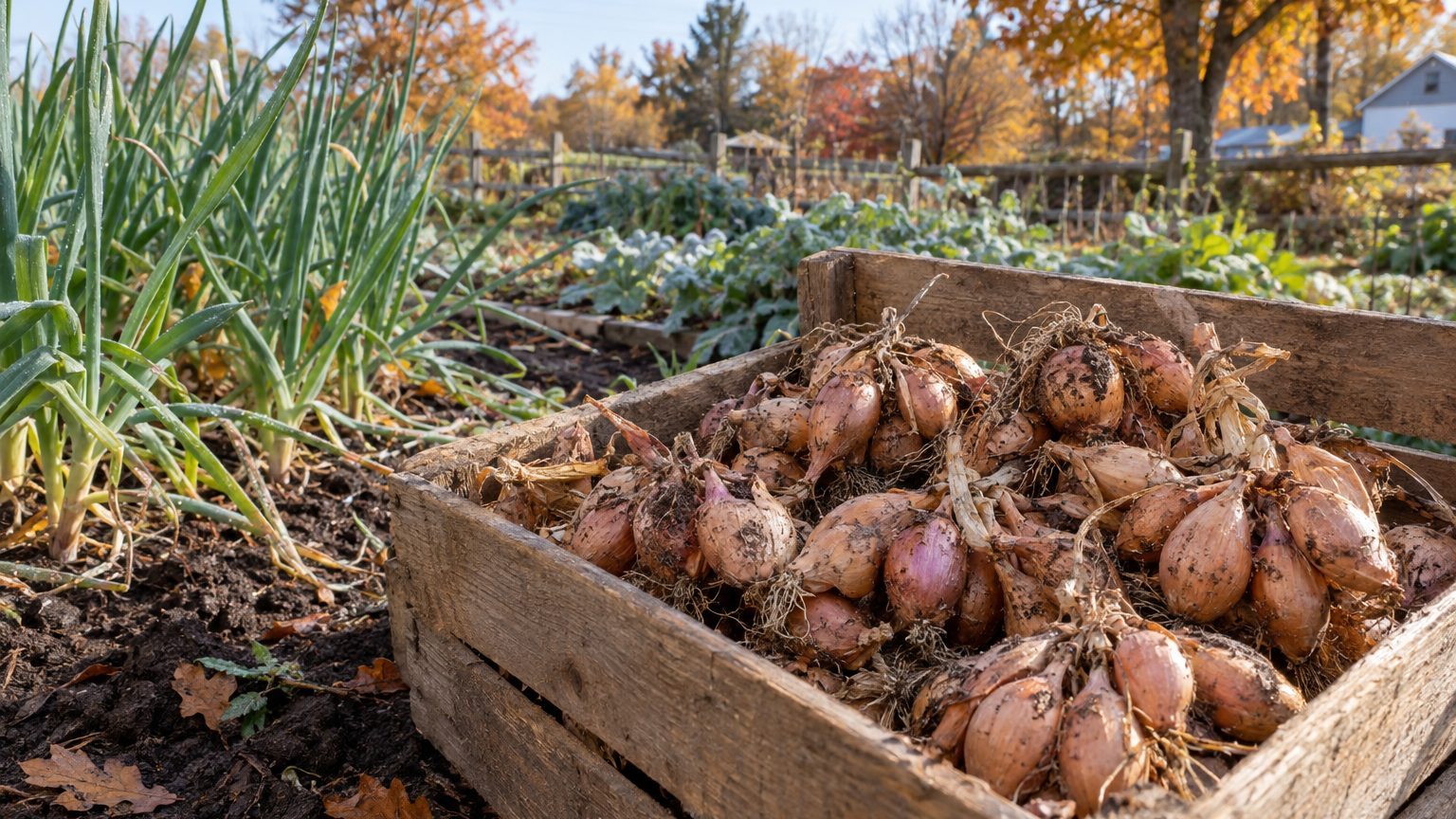

For most Iowa gardens, the best shallots are multiplier types grown from sets: planted in fall for the biggest bulbs, or in early spring as the fallback. Seed-grown shallots also work, but they demand more from a growing season of about six months between freezes. This page sorts the choice by type rather than brand, because it has no Iowa trial data to rank named varieties. The full routine is in Growing Shallots in Iowa.
The short answer for Iowa
The numbers behind the type decision are simple. At the Des Moines airport reference station, NOAA’s 1991-2020 Climate Normals put the last spring frost between April 12 and April 24, and the first fall frost between October 14 and October 25. Those dates come from the 30 to 70 percent band of 32°F freeze probabilities. They are odds of a freeze, not promises. The coldest month averages a daily minimum of 13.8°F, which is cold but well within what a mulched shallot bulb handles.
That window favors a clear order of preference. Fall-planted sets of multiplier shallots come first because they root before winter and start growing the moment soil thaws, which gives them a head start on early summer heat. Spring-planted sets come second and suit anyone who missed fall. Seed-grown shallots come third, and they are a good choice for gardeners who want to skip buying sets each year or who like a bigger crop of uniform, single bulbs.
| Type | When it goes in | Fit for Iowa | Main risk |
|---|---|---|---|
| Multiplier sets, fall-planted | Fall, before the ground freezes | Best overall | Heaving or winter damage without mulch |
| Multiplier sets, spring-planted | As soon as soil is workable | Reliable fallback | Smaller bulbs if planting slips late |
| Seed-grown shallots | Started indoors, set out in spring | Workable, with a tight schedule | Not enough time if started late |
Within each type, pick a variety sold for your region and check it against the storage and size you want. Specific cultivar names are where this page stops. It does not hold Iowa State trial results, and ranking brands without them would be guesswork. For dates to match each type, use When to Plant Shallots in Iowa.
What will not work here
Late-started seed shallots fail first. They need a long run of leafy growth before bulbs form, and Iowa’s frost-free stretch is only about six months at the optimistic airport end. The caution attached to those dates matters here: Iowa State Extension county figures (1950-2021) run about 4 days later in spring and 10 days earlier in fall. That shaves roughly two weeks off the season. A gardener who sows seed indoors in late March and sets seedlings out in May has little room for error.
Fall planting has its own failure mode, and it runs two ways. Sets planted too early push up tall green tops that winter then punishes. Sets planted too late never root, and with a coldest-month minimum of 13.8°F, freeze-thaw cycles can push shallow, unanchored bulbs up out of the soil. Bare ground over winter is the other common loss. A few inches of straw or shredded leaves settles the problem, and it is much cheaper than replanting.
Spring sets planted late disappoint in a quieter way. Shallots start forming bulbs in response to lengthening days and warming weather, and a set that goes in during mid May has far fewer weeks of leaf growth to feed that bulb. The result is a crop of small shallots that look fine on the counter but are fiddly to peel. Plant as soon as the soil can be worked, even if a late frost is still possible. Shallot tops tolerate light frost.
Humid summers are the last trap. Iowa summers often run muggy, and crowded shallots hold moisture around their necks and leaves, which invites rot and fungal disease at exactly the wrong moment, when the tops are starting to fall over. Spacing the sets 6 to 8 inches apart, planting in raised or well-drained rows, and curing the harvested bulbs somewhere airy and dry all help. A garage with an open door beats a damp porch.
Finally, expect fall-planted shallots to be ready earlier than you planned. Harvest comes in summer, and gardeners who count on September pulling are working from the wrong calendar.
What changes across Iowa
Iowa is not one garden. The USDA Plant Hardiness Zone Map (2023, built on 1991-2020 normals) places the state in 4b through 6a, which spans 4b, 5a, 5b and 6a. That means there is no single answer for the whole state. The map is built on one variable, the average annual extreme minimum temperature, so it says how cold winter gets and nothing about summer heat or frost dates.
For a dated recommendation, this page uses Des Moines as its reference city, the same station behind the frost dates above. Other parts of the state differ, sometimes by weeks. A reader in the northern tier, where the zone falls toward the cold end of that range, should shift in three ways. Plant fall sets a little earlier so roots establish before the ground locks up. Mulch more thickly than a Des Moines gardener would. And if a fall planting feels like too much of a gamble, go to spring sets without guilt. A reader in the south can lean the other way, planting a bit later in fall and counting on a longer spring run.
Local terrain moves things too. A low spot where cold air pools can behave like a colder zone, and a south-facing slope near a building can act like a warmer one. The map cannot see that detail.
Look up your own location on the USDA Plant Hardiness Zone Map rather than guessing from the state range. Enter your ZIP code, read the zone, and then adjust the planting dates in the direction described above.
Where to check this for your own county
Iowa State University Extension is the place to go next. Look for two things. First, the local planting calendar for your county or region, which will account for frost patterns this page cannot. Second, any vegetable variety trials run in or near your county, especially for onions, garlic and other alliums. Shallots are close relatives, so allium guidance transfers well even where shallot-specific results are thin.
Your county office staff and Master Gardener volunteers also know which sites in the area hold frost late, which soils stay wet in spring, and what has failed for neighbors. That kind of knowledge never makes it into a statewide page.
A county recommendation beats a state one, plainly. This page is the state one: it relies on a single airport reference station and a zone range that covers four half-zone steps. Where Extension gives a date for your county, use it over anything printed here. The frost-date caution applies in the same direction. County figures lean later in spring and earlier in fall than the airport numbers, so if the two disagree, trust the county.
Checking this against your own garden
Your own yard outranks every date above. Three observations will tell you more about your microclimate than any chart.
- Soil warmth by feel. In early spring, dig a handful from planting depth. If it crumbles and does not feel icy against your palm, it is ready for sets. If it smears or clumps wet, wait. Beds that reach this point a week before the neighbor’s are your warm spots.
- First green shoots. Note the week fall-planted shallots push up in spring. Compare beds. Shoots appearing earlier on a slope or against a wall mark the part of your garden that runs warmest.
- First frost in low spots. Look at when white frost first coats the grass in the lowest corner versus higher ground. A gap of a week or more tells you where cold air settles and where tender seedlings are at risk.
Write the dates down, even on a calendar by the back door. After two seasons you will have a personal planting schedule more accurate than any state page.
Common questions
Can I grow shallots from seed in Iowa?
Yes, with a tight schedule. Seed must be started indoors and moved out early enough to bulb before the first fall frost, which falls between October 14 and October 25 at the airport reference station and sooner by Extension county figures. Sets are the easier route.
Will shallots survive an Iowa winter?
Mulched fall-planted sets generally do. The coldest month averages a daily minimum of 13.8°F at Des Moines. In the colder parts of the state, mulch more heavily and consider spring planting instead.
Is fall or spring planting better?
Fall usually gives bigger bulbs because roots form before winter. Spring is the safer bet if you missed fall or live in a colder part of the zone range. Dates are on the planting calendar page.
Can I plant shallots from the grocery store?
It sometimes works, but store bulbs may have been treated to block sprouting, and you will not know the variety or its disease history. Sets from a seed supplier are the better bet. Local Extension offices can tell you which sources have done well in your county.