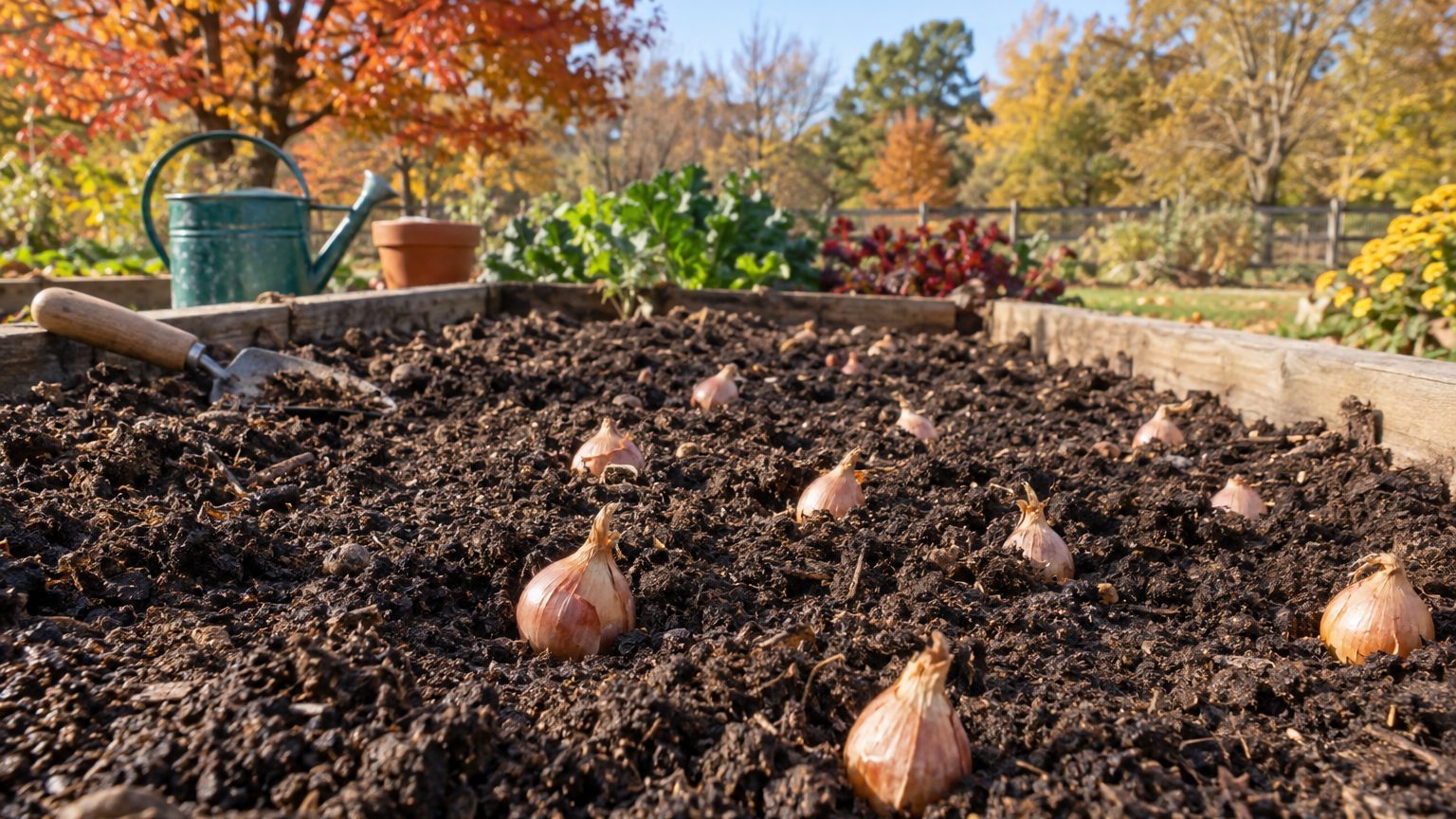

In New Brunswick, shallots go in the ground in one of two windows. In spring, plant the moment the soil can be worked. In fall, plant in the weeks around the first frost, before the ground locks up. The frost dates behind that advice come from Moncton: May 23 and October 2, both averages. Neither is a deadline to trust to the day.
The short answer for New Brunswick
Plant spring shallots as soon as the soil can be worked, which in most years comes ahead of May 23. Plant fall shallots from around the first fall frost until shortly before the ground freezes. Environment and Climate Change Canada’s 1981-2010 normals for the Moncton station put the last spring frost on average on May 23 and the first fall frost on average on October 2.
Those are mean dates, which means each is the midpoint of a spread of years. In one spring out of two, frost is still arriving after May 23. In one fall out of two, the first frost comes later than October 2, and in the other half it comes earlier. Each date is the 50/50 line for when a frost happens. It is not a safe date.
That is why the May 23 figure should not hold shallots back the way it holds tomatoes. Shallots are hardy. Frost can nip the green tops of a young planting, but the bulb underneath carries on. The real reason to plant early is day length. Bulbs form as days lengthen toward the June solstice, so a shallot that has spent six weeks building leaves before then has far more to feed the bulb than one planted in June.
The season itself gives some room. Counting from May 23 to October 2 gives about 132 days between the two mean frosts. A shallot grown from sets, which is how most home gardeners plant them, takes roughly three to four months from planting to harvest. That fits inside the gap with weeks to spare, provided planting is not delayed. (Curing the bulbs afterward also needs dry days before fall frost.)
In practice the two windows look like this:
- Spring: as soon as a spade turns the soil without hitting frost, usually before May 23. Frost after planting is expected and survivable.
- Fall: from around October 2 onward, early enough that bulbs root but late enough that they do not send up tops.
One gap should be stated plainly. This page does not have a ground-freeze date for the province, so the fall window has no hard end date. Watch the ground itself. The wider picture of the crop is in Growing Shallots in New Brunswick.
What will not work here
Waiting for May 23 will not work. A gardener who treats it as the starting gun gives away the cool, damp weeks when shallots root best. Planted in late June, a shallot has barely made leaf before the days start shortening, and the bulbs come out small. In a 132-day gap between frosts, every week lost in spring comes straight off the growing time.
Planting too early in fall does not work either. The winter here is serious. The mean daily minimum of the coldest month is -13.9 °C (6.9 °F), measured at Moncton for 1981-2010. That is an average of the nightly lows, so individual nights run colder. A shallot that has put up a hand of green growth in October has leaf exposed to those nights. The goal in fall is roots without tops, and a mulch layer over the bed helps protect them. Plant too soon after a warm September and the tops come up anyway.
The slowest shallots are the third casualty. A variety that needs a long run, or one grown from true seed rather than sets, has to be started indoors in late winter to use the season at all. Set against 132 days between frosts, it is a gamble that sets simply do not take. Anyone choosing between types should read The Best Shallots to Grow in New Brunswick before ordering.
The fourth failure is borrowing someone else’s calendar. A planting chart written for a US state uses 1991-2020 frost data and, usually, USDA zones. The Moncton figures here are 1981-2010 Canadian normals. Mixing the two puts different decades and different zone systems side by side as though they matched. A chart from Maine, Ontario or Nova Scotia describes their gardens, not yours.
Last, trusting Moncton too far. It is one station, and a province is not one climate. Northern and upland districts run weeks behind it. A gardener there who plants on Moncton’s schedule is guessing with the wrong reference point.
What changes across New Brunswick
The hardiness zone on file is 5a, in the Canadian system, from Natural Resources Canada’s 1991-2020 normals for the reference city. That number describes one city. It does not describe the province, and this page does not carry the zone range across New Brunswick. So there is no single answer for the whole province, and the spread has to be read off the map. NRCan’s Canada’s Plant Hardiness Site lets you look up a municipality directly. Check your own spot there rather than assuming it matches Moncton.
The Canadian system also does not convert to USDA zones. It is built on seven climate variables, while the USDA system uses one, so a 5a here should never be read as a US zone number.
What can be said is the direction of the shift. A reader in the north of the province, or at altitude, should expect everything on this page to slide later in spring and earlier in fall. Take a hypothetical district that runs two weeks behind Moncton. The spring frost midpoint would move from May 23 to around June 6, and the soil would be workable later by about the same margin. The fall end moves the other way, since the ground closes sooner and the October 2 frost may arrive earlier. The gardening window narrows from both sides.
For those districts, the sensible adjustments are modest. Plant in spring as soon as the ground is workable, however late that turns out to be. Aim fall planting toward the early side of the window. Mulch a little heavier. Pick shallots that finish early, since the slow ones were already marginal at Moncton and will fall short further north. That also reverses the usual worry about waiting too long: in cold districts, the risk is a short season, not a freeze on the bulb.
Where to check this for your own county
The next step is local. Start with Agriculture and Agri-Food Canada, which is the federal department and is the address that could be verified for this page. The provincial department’s own site refused automated checks when this page was prepared, so the federal one is linked in its place. From there, follow the links to provincial and regional resources for New Brunswick.
Two things are worth looking for. The first is a local planting calendar, ideally one that names shallots or onion-family crops and separates fall from spring planting. The second is a list of varieties trialled in your county or region, since a variety that did well in a research plot near your garden is better evidence than any general recommendation. If those are missing, ask a local office or garden group what has actually worked.
A county recommendation beats a provincial one, and the same goes for a district-level number versus a province-wide one. This page is the provincial one. It rests on a single station, Moncton, and a 1981-2010 averaging period. It sets the frame, and a local calendar fills in the detail. Where the two disagree, trust the local one.
Checking this against your own garden
Your own observation outranks every date above. Three things are worth watching, and none needs equipment.
First, the soil by feel. Push a spade in and turn a clump over. If it crumbles in your hand and the spade goes in without hitting frost, spring planting can begin. If it comes up wet and smeared, wait. A bed that reaches this state a week before your neighbor’s tells you it drains and warms faster, which marks a sunny, sheltered or sandy spot.
Second, the first true leaves on the plants you already have. When chives, rhubarb or perennial weeds start to green up, your ground is waking up. Note the date each year. If green-up in your yard consistently beats the forecast’s idea of spring, you have a warm microclimate. If it trails, you have a cold one, and that is your correction to the Moncton figure.
Third, frost on the lawn. Look in late May and again around early October. Frost that lingers in one corner after the rest of the yard has thawed marks a low pocket where cold air settles. Keep fall shallots out of it, or mulch them more, since they sit through the coldest nights there.
Common questions
Can I plant shallots before May 23?
Yes. May 23 is the average date of the last spring frost at Moncton, and shallots tolerate frost. The limit is the soil: plant once it can be worked, not once the frost risk has passed.
Is fall or spring planting better in New Brunswick?
This page has no trial data to pick one. Fall planting uses the first frost of October 2 as a starting point and has to survive a coldest-month mean daily minimum of -13.9 °C. Spring planting avoids the winter but gives up some early growth. Your county’s trialled varieties will say more.
Is May 23 my last frost date?
Probably not exactly. It is the Moncton average, and a province is not one climate. Northern and upland districts run weeks behind, and even at Moncton frost arrives after May 23 in about one spring out of two.
Does hardiness zone 5a tell me when to plant?
No. Zone 5a, in the Canadian system, is about winter survival for the reference city, and it is not a planting date. It also cannot be converted to a USDA zone: NRCan says there are no simple conversions, and Canadian zone 4a alone overlaps nine USDA zones, from 3a to 7a.