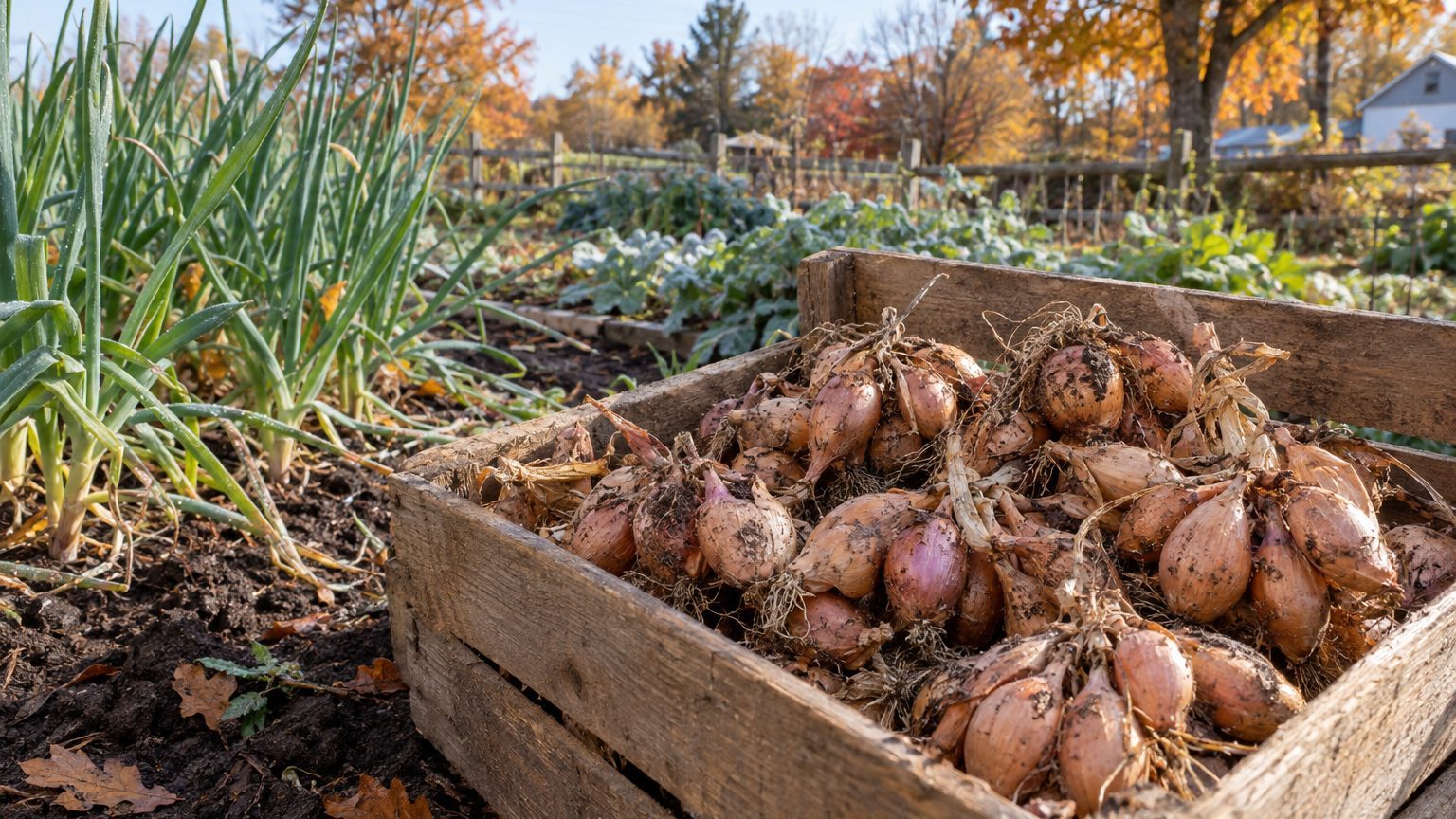

For Massachusetts, the best shallots are multiplier types planted as individual cloves in fall, with spring-planted sets as the backup and seed-grown types a distant third. The state’s winters reward fall planting, and its humid summers punish crowding. This page sorts shallots by type instead of by catalog name, because the verified facts here support a decision about type, not a ranked list of cultivars.
The short answer for Massachusetts
Fall-planted multiplier shallots are the safest bet in Massachusetts. Put cloves in the ground so they root before the soil freezes, mulch them, and let them wake up on their own schedule in spring. If fall slips past you, spring-planted sets are a fair second choice. Shallots grown from seed come last: they spend more of the season as small seedlings, and a Massachusetts spring does not always give them a clean run.
The cold itself is not the obstacle. The mean daily minimum of the coldest month in Boston, the reference station for this page, is 23.1°F. That is the NOAA 1991-2020 normal for the average low, not the record low, and it is the number that decides whether a bulb survives winter at all. A shallot sitting under a few inches of mulch handles it. Shallots are among the hardier alliums, so winter survival in the reference city is a low bar.
| Type | When it goes in | Fit for Massachusetts | Main risk |
|---|---|---|---|
| Multiplier shallots, fall-planted cloves | Fall, before the ground freezes | Best first choice | Frost heaving if planted late or left unmulched |
| Multiplier shallots, spring-planted sets | Spring, once soil is workable | Good backup | Smaller bulbs if spring turns wet and slow |
| Seed-grown shallots | Started early, transplanted in spring | Workable, but a distant third | Little margin if seedlings fall behind |
Why the frost dates favor fall planting
NOAA’s 1991-2020 normals for Boston’s Logan station put the last spring frost at April 1 to April 8 and the first fall frost at November 3 to November 14. Both ranges are probability bands: they mark where the chance of a 32°F freeze sits between 30 and 70 percent. They are the fuzzy middle of a window, not dates after which frost stops. A freeze in the second week of April would not be a freak event.
Logan is a waterfront urban station and the mildest spot in the state. Inland suburbs and the Berkshires frost noticeably earlier in fall and later in spring, so treat these dates as the most generous version of the calendar. A clove planted in fall is already rooted when the soil thaws, which means it can start growing the moment conditions allow. For the planting window itself, see When to Plant Shallots in Massachusetts.
What will not work here
Start with the calendar. At Logan, the stretch between the last spring frost and the first fall frost runs a bit over seven months, and that is the best case in the state. Shallots are not frost-limited at the front end the way tomatoes are, but they do not wait for you either. Bulbs begin to mature as days lengthen and summer warms, whatever size the plant has reached by then. A seed-grown shallot started late, or a set pushed in during late May after a soggy April, has far less time to size up than a clove that has been rooted since the previous autumn.
Crowding fails in a humid state. Massachusetts summers are damp enough that leaves stay wet for long stretches, and tightly spaced shallots hold that moisture against each other. Fungal leaf diseases, downy mildew and botrytis among them, move through a crowded bed faster than through a spaced one. Give each clove room and keep weeds down so air can move through the rows. A bed that looks sparse in October is usually the right density by June.
Calendar habits that backfire
Watering on a fixed weekly schedule is another mistake, and it is borrowed from drier states. In a humid climate, a rain-fed bed often needs no help for weeks, and wet soil around nearly mature bulbs invites rot. Water when the soil is dry a couple of inches down, and back off as the tops start to yellow and fall over.
Timing errors cut both ways in fall. Plant too early and the cloves send up green growth that winter may burn back. Plant too late, with the first fall frost as early as November 3 even at the mild Logan station, and roots may not anchor before the ground starts freezing and thawing. With a coldest-month average low of 23.1°F in Boston, the soil spends a good part of winter near the freezing line, and repeated freeze-thaw cycles can push shallow bulbs up toward the surface. Mulch is the cheap fix.
The last failure is applying the Logan dates inland. Someone in the Berkshires who plants on April 1 because a coastal station says so is working from the wrong data. One gap deserves stating plainly: this page does not have trial results for named shallot cultivars in Massachusetts, so it will not rank cultivars it cannot back up.
What changes across Massachusetts
Massachusetts is not one garden. The USDA Plant Hardiness Zone Map (2023 edition, built on 1991-2020 normals) places the state in zones 5a through 7b. That is six half-zone steps, and each step is 5°F in the average annual extreme minimum temperature, the single variable the map uses. So there is no single answer for the state, only a spread, and the coldest and warmest corners differ by about 30 degrees in their typical coldest night.
Boston is the reference city used here, and its numbers sit toward the milder side of the state. The warm end of the range sits along the coast. The cold end sits in the hills and the western part of the state, where the Berkshires live. This page does not have a verified minimum-temperature figure for those places, and it will not borrow one from a neighboring state.
What a northern or high-elevation gardener should shift
The direction of the adjustment matters more than the exact number. In colder or higher spots, plant cloves earlier in fall so roots establish before hard freezes arrive, and mulch more thickly. Expect spring growth to start later, and do not judge the bed by what a coastal garden is doing in the same week. In milder coastal spots, the risk flips toward planting too early, so a later fall date keeps the green growth in check.
Nobody should guess their own zone from the state range. The USDA map is searchable by ZIP code, and it takes under a minute to look up. Once you have it, return to the broader guide, Growing Shallots in Massachusetts, and compare your zone with the Boston reference city before choosing a planting date.
Where to check this for your own county
This page is the state-level answer. A county recommendation beats it, every time. The people who write county recommendations have seen what survived in local soil, local frost pockets and local disease pressure, and a statewide page built on one reference station cannot match that.
The place to go is UMass Extension, the land-grant extension service for Massachusetts. Look for two things there. First, a local planting calendar for shallots, or for garlic and onions if shallots are not listed on their own, since the timing logic is close. Second, any record of varieties trialled in your county, ideally with notes on storage and disease. Both are more useful than anything a statewide summary can offer.
How to read what you find
Check that the calendar matches the crop. Extension services often publish one calendar per species, not one per state, so a lawn or vegetable calendar tells you nothing about shallots. This page does not cite a UMass shallot calendar, and the verified facts here do not include one, so confirm directly that one exists.
If your county office lists trial results, favor entries that report on fall-planted multipliers, since that is the type this page leans toward. If nothing is published for your county, call or email the local extension office and ask what growers nearby plant and when. A short answer from someone who has watched local beds for years is worth more than a long page like this one.
Checking this against your own garden
Your own observations outrank every date on this page. A backyard on a south-facing slope and one in a shaded hollow a mile away can sit weeks apart in spring, and no state table captures that. Three things are worth watching, and none needs equipment.
- Soil warmth by feel. In spring, push a hand into the bed. If the soil is still cold enough to ache after a minute and clings in a wet clump, it is not ready for sets. Soil that crumbles and feels merely cool is. A bed that warms early is a sheltered, sunny microclimate; one that stays cold is shaded or low and holding water.
- The first green shoots. For fall-planted cloves, note the day the first green tips break the surface, and for seed-grown shallots, the day the first true leaves appear beyond the seed leaf. Write it down. Next year, that date tells you how your garden runs compared with a coastal or inland neighbor.
- When the tops yellow and flop. In summer, the leaves start to fall over as bulbs mature. Early yellowing in one corner and late in another shows where drainage or sun differs, and it tells you where to plant first or space out more.
Keep a few dated notes over a couple of seasons and your garden will give you a calendar that is more precise than any page covering a whole state.
Common questions
Are shallots hardy enough for a Massachusetts winter?
In the Boston reference city, where the coldest month’s mean daily minimum is 23.1°F, yes, with mulch over fall-planted cloves. The Berkshires and other colder areas run lower, and this page does not have a verified figure for them, so mulch more heavily and check with your county extension office.
Should I plant shallots in fall or spring?
Fall is the first choice for multiplier cloves because they root before winter and start early in spring. Spring-planted sets work if you miss the fall window. The details are in the planting calendar for Massachusetts shallots.
Do I need a specific variety name to succeed?
Type matters more than name here. Choose multipliers for fall planting, and ask the seller whether the stock suits northern fall planting. This page has no verified Massachusetts cultivar trial data, so it does not name a winner.
Can I use the Boston frost dates for my own yard?
Only as a loose guide. Logan sits on the waterfront and is the mildest spot in the state, so inland suburbs and the Berkshires frost earlier in fall and later in spring. Shift your own dates toward the colder side the farther you are from the coast.