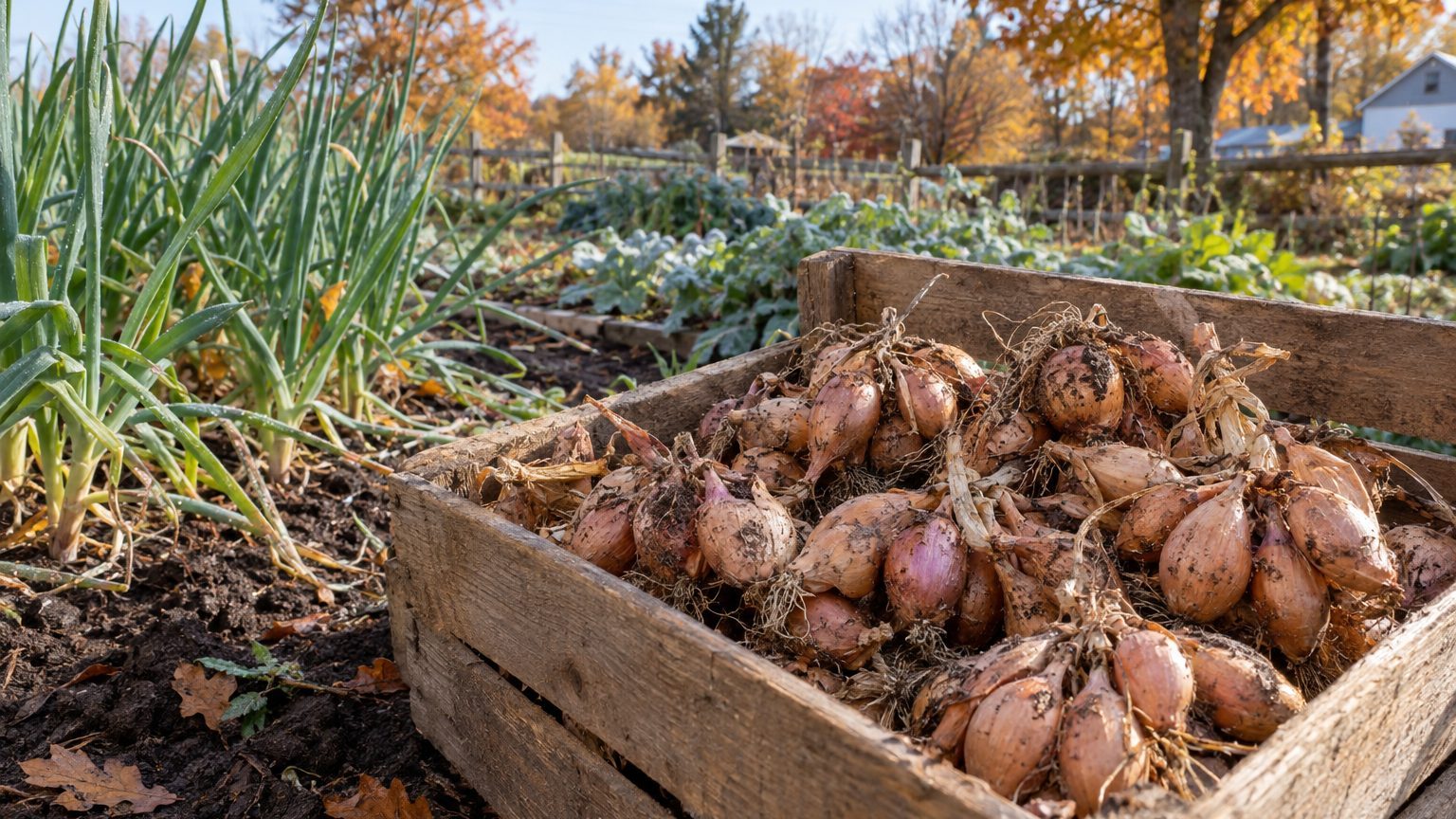

In North Carolina, the best shallots are multiplier types planted as sets in fall, the small bulbs you divide and tuck in before winter for a late spring harvest. Seed-grown shallots are a workable second choice if you start them early. The state’s calendar explains why: shallots here have to finish bulbing before the summer heat and humidity arrive, and fall planting gives them the head start.
The short answer for North Carolina
Choose multiplier-type shallots, planted as sets in fall, and treat seed-grown types as the backup you start early indoors. Spring-planted sets can work, but only if they go in as soon as the soil can be worked.
The numbers behind that call come from NOAA’s 1991-2020 U.S. Climate Normals for Charlotte, a Piedmont station. The last spring frost falls between March 23 and April 5. The first fall frost falls between October 30 and November 8. Both ranges are probabilities of a 32°F freeze, specifically the band where the chance of that freeze sits between 30 and 70 percent. They are not guarantees. A freeze after April 5 is still possible, and one before October 30 is too.
Winter cold is not the limiting factor at that station. The mean daily minimum of the coldest month is 31.8°F, so nights hover around freezing rather than plunging far below it. Shallots are hardy bulbs, and a fall-planted set has the whole mild winter to root before spring growth takes off. The squeeze comes at the other end, when late spring warms into summer and the plant has to size up its bulb before heat takes over.
Which type fits which situation
| Type | When it goes in | Fit for North Carolina |
|---|---|---|
| Multiplier sets (divisions of a mother bulb) | Fall, ahead of the first-frost window | Best match. Roots in cool weather, matures before peak summer |
| Multiplier sets, spring-planted | As soon as soil is workable after the last-frost window | Acceptable. Smaller bulbs if planting slips late |
| Seed-grown shallots | Started indoors in winter, transplanted in early spring | Second choice. Needs timing discipline and more tending |
Variety names change from seller to seller, so shop by type first. French Red and Dutch Yellow are commonly sold as multiplier types, and Conservor and Ambition as seed-grown ones. This page has no North Carolina trial results for any of them, so treat the names as examples of the categories rather than as tested recommendations. Full details on planting and care are in Growing Shallots in North Carolina, and the dates for each region are in When to Plant Shallots in North Carolina.
What will not work here
Slow, long-season shallots fail first. A seed-grown variety that wants a long run of cool growing weather before bulbing is a poor bet in a state where the spring window closes by April 5 at the reference station and warmth builds fast afterward. Bulbing in the onion family is triggered by lengthening days, not by how big the plant has gotten. A shallot started late, with only a few small leaves, still bulbs on schedule and produces a small bulb.
Late planting and sluggish starts
Spring-planted sets that go in during May run into the same wall. They have a few weeks of decent growth before heat arrives, and the harvest shrinks accordingly. Fall planting sidesteps this because the roots are already established when spring warms up. The opposite mistake exists, though. Sets planted in early September, while the ground is still summer-warm, tend to push heavy leafy growth long before the first fall frost window of October 30 to November 8. Planting closer to that window than to Labor Day keeps the tops modest.
Transplants started indoors too late have the same problem from the other direction. Seedlings that reach the garden in mid-April, well after the frost window, are chasing a deadline they will not meet.
Humid summers and tight rows
North Carolina’s humidity makes close spacing risky. Shallot clusters packed shoulder to shoulder hold moisture in the base of the plants, and a wet June is when neck rot and fungal problems take hold. Give each set about 6 inches in the row, and avoid the trap of cramming extra into a small bed because the bulbs look small at planting time. They multiply, and a divided clump needs the room.
Watering habits matter just as much. A weekly soaking schedule, which makes sense in a dry-summer state, works against you where the Piedmont’s red clay already holds water and thunderstorms arrive without warning. Check the soil with a finger before watering anything. Coastal plain sand drains fast and may need more attention, but the mistake in most of the state is too much water near harvest, not too little.
Curing is where humidity bites last. Harvested shallots dried in a damp shed or left in the bed through a rainy spell can rot in storage. Pull them when the tops fall over and dry them where air moves freely.
What changes across North Carolina
There is no single answer for the whole state. The USDA Plant Hardiness Zone Map (2023, built on 1991-2020 normals) places North Carolina in zones 5b to 8b. That system rests on one variable, the average annual extreme minimum temperature, and the span from 5b to 8b is a gap of roughly 30°F in the coldest night of a typical year. Few states stretch that far from top to bottom.
The frost dates above come from Charlotte, so they describe the Piedmont. The Blue Ridge mountains to the west run several weeks later in spring, and the coastal plain runs earlier. Treat the Charlotte dates as a midpoint and shift from there.
For a reader in the mountains or at altitude, the shift has a clear logic. Plant fall sets earlier so roots establish before the ground chills, mulch them, and expect spring growth and harvest to arrive later than the Piedmont schedule. Spring planting there waits for a later thaw. For a reader on the coast, spring comes sooner and so does the heat, which compresses the harvest. Fall-planted multiplier types matter even more in that setting because they leave less to chance.
Which end of the 5b-8b range you fall in is a question for the USDA map, not for this page. Look up your location on the map directly rather than guessing from a neighboring town, since elevation can change the answer within a few miles.
Where to check this for your own county
The best local source is North Carolina State Extension, the land-grant university’s extension service, which runs an office in every county. Two things are worth looking for there. The first is a local planting calendar for vegetables or alliums, which will put real dates on the fall and spring windows for your area. The second is any variety trial in your county or a neighboring one, since a variety that thrived in a test plot near you is better evidence than any list of names.
If the website does not surface what you need, call or visit the county center. Extension agents and Master Gardener volunteers field questions about onions and garlic regularly, and they know which soils in the county stay soggy in June.
A county recommendation beats a state one, and this page is the state one. It rests on the Charlotte climate normals and a USDA hardiness range, which together describe the broad shape of the season but cannot see your elevation, your soil, or your slope. It does not have county-level shallot trial data, and it does not claim to.
One caution on sources. Extension lawn and turf calendars are published per grass species, and shallot guidance is its own category. If a search leads you to a maintenance calendar for turf, it will not help with bulbs.
Checking this against your own garden
Your own observation outranks every date on this page. Three signs are worth watching, and none needs equipment.
- Soil warmth by feel. In fall, press the back of your hand into bare soil a few inches down. If it still feels warm like a sunlit porch, wait on the sets. If it feels cool and damp, the timing is right. A bed that cools sooner than your neighbor’s tells you it is higher or shadier.
- Green shoots on fall-planted sets. If tips show above ground in midwinter, your spot is milder than the regional average. If nothing appears until well into spring, your microclimate runs cold, and next year’s planting can go in a little earlier.
- Tops falling over in late spring. When the green leaves bend and yellow, the bulbs are finishing. Note the date you see it. That date, repeated across years, becomes your own harvest calendar, and it tells you whether heat arrives early where you garden.
Write all three down once a year, even in a few lines on a calendar. After two or three seasons, those notes are a more accurate guide to your yard than a Charlotte frost table.
Common questions
Can I plant shallots in spring in North Carolina?
Yes, but the window is short. Get sets in soon after the soil can be worked, and expect a smaller bulb than fall planting delivers. At the Charlotte reference station the 30-70 percent band for the last 32°F freeze runs March 23 to April 5.
Should I grow shallots from seed or from sets?
Sets are the easier path here. Seed-grown shallots need winter indoor starting and careful transplant timing, and a late start costs bulb size. They are worth trying if you want to experiment, but sets are the safer first season.
Is the best variety the same in Asheville and Wilmington?
The type is the same, fall-planted multipliers, but the schedule is not. The mountains run several weeks later in spring and the coastal plain earlier, so the timing shifts even when the variety does not.
Will shallots survive winter in the mountains?
Shallots are generally cold-hardy bulbs, and mulch helps. The hardiness range for the state runs from 5b to 8b, though, and this page does not have a verified minimum-temperature tolerance for specific varieties. Check with your county extension office, which can tell you what has overwintered in your area.