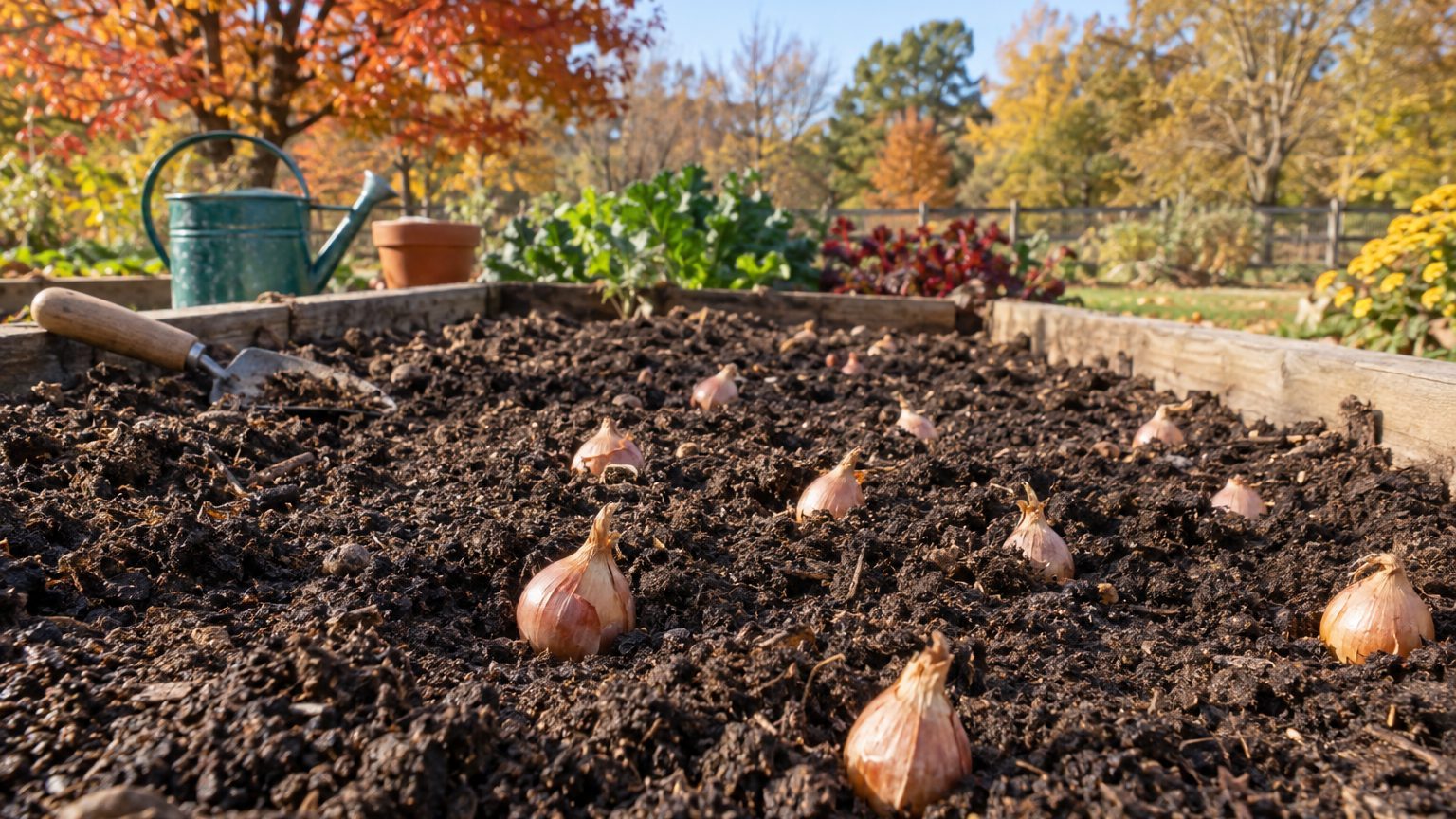

Shallots in North Carolina go in during two windows: fall, in the weeks leading up to the first frost, and late winter into early spring, by the time the last frost comes around. The frost band for the Charlotte reference station runs March 23 to April 5 in spring and October 30 to November 8 in fall. Mountains run later in spring, and the coast runs earlier.
The short answer for North Carolina
Those frost dates are probabilities, not promises. They come from NOAA’s 1991-2020 U.S. Climate Normals for Charlotte and mark the band where the odds of a 32°F freeze sit between 30 and 70 percent. March 23 is the early edge of that band in spring and April 5 the late edge. In fall, October 30 and November 8 bracket the same odds on the way in. Any given year can land outside them, and a late freeze in mid-April is not a freak event.
For fall planting, work backward from the October 30 to November 8 band. Shallots need time to root before the ground cools, but not so much warm weather that they push a lot of top growth ahead of winter. For spring planting, the band of March 23 to April 5 is the finish line, not the starting gun. Get sets in the ground by then, not after. Shallots shrug off light frost, so there is no reason to wait for the last freeze to pass.
Winter helps. At the Charlotte station, the mean daily minimum of the coldest month is 31.8°F. That is a hair under freezing, which means the soil in the Piedmont is rarely locked solid for long. A fall-planted shallot sits through that without drama, and a spring planter can often work the ground weeks before northern gardeners can.
One honest limit: this page does not have a tested, extension-published shallot planting date for North Carolina, so it gives you the frost window and the logic rather than a single calendar day. For the full growing picture, see Growing Shallots in North Carolina. If you are still choosing what to plant, The Best Shallots to Grow in North Carolina covers that side.
The window is wide because shallots are forgiving, and the real constraint comes at the other end of the season: bulbs want to finish sizing up before summer settles in.
What will not work here
Copying a northern calendar is the first thing that fails. Advice written for cold states says to plant “as soon as the ground can be worked,” which implies a long wait for thaw. With a coldest-month minimum of 31.8°F, a Piedmont gardener has no such wait. Following the northern script and holding off until late April means the bulbs start late and run into heat before they have finished bulking.
Planting too early in fall is the opposite mistake. The first fall frost band does not arrive until October 30 to November 8, so October soil can still feel summery. Sets planted into warm, wet ground tend to sprout leaf growth that has no business being there in November, and they sit exposed to rot. Waiting until the weather turns reliably cool is not procrastination here. It is the plan.
Then there is moisture. North Carolina is a humid state, and a humid climate punishes tight spacing. Shallots clustered shoulder to shoulder hold damp air around the bulbs and foliage, which invites fungal trouble as the season warms. Heavy clay, common across much of the Piedmont, makes this worse because it drains slowly after a long rain. A flat bed of clay that stays soggy through a wet winter will rot sets that a raised, loose bed would have carried through fine.
Mulch can backfire for the same reason. A thick blanket of wet leaves or straw over fall-planted shallots helps in a dry cold snap, but in a wet winter it keeps the soil surface saturated. Use a thin layer, and pull it back from the shoots as spring warms.
Finally, the late-spring squeeze. A planting that goes in around the April 5 end of the frost band has far less cool weather left before summer than one set out in March or the previous fall. Shallots planted that late often yield smaller bulbs. They are not a failure, but they are not what a fall planting would have given you.
None of this means the crop is hard. It means the margin for error runs on the warm side, so the penalty for lateness is bigger than the penalty for a cold snap.
What changes across North Carolina
North Carolina is not one garden. On the USDA Plant Hardiness Zone Map (2023 edition, built on 1991-2020 normals), the state spans zones 5b to 8b. That is a wide spread, and there is no single answer to “when do I plant.” The USDA system rests on one variable, the average annual extreme minimum temperature, so it tells you about winter cold, not about frost timing or summer heat.
The frost dates above belong to Charlotte, which sits in the Piedmont. Treat them as a reference point and shift from there:
| Region | Relative to the Charlotte frost band | What to shift |
|---|---|---|
| Piedmont (reference: Charlotte) | March 23 to April 5 last frost; October 30 to November 8 first frost | Use the dates as given |
| Blue Ridge and mountains | Spring runs several weeks later | Push spring planting later; fall planting earlier, as frost arrives sooner |
| Coastal plain | Spring frost comes earlier | Spring planting can start sooner; fall planting can run later |
A reader in the mountains faces a double squeeze. Spring comes later, so the growing season for a spring planting is shorter, and winters bite harder at the cold end of the 5b to 8b range. Fall planting there is a bet on roots establishing before the ground freezes. A mulch layer over fall-planted rows is worth more at altitude than on the coast. A reader on the coastal plain has the opposite problem. Warm soil lingers, so fall planting should wait until the weather has really cooled, and spring bulbs run out of cool days sooner.
Elevation matters even within a county. A valley floor and a ridge a few miles away can differ by weeks. To find where you fall on the zone range, check the USDA Plant Hardiness Zone Map and enter your ZIP code. Do not guess from a neighbor’s garden or from a nursery tag.
Where to check this for your own county
The state-level answer on this page is a starting frame. A county recommendation beats a state one every time, and this page is the state one. For the local version, go to North Carolina State Extension, the land-grant university’s network, which has an office serving every county.
Once you are there, look for two things. First, the local planting calendar for your county, or the vegetable planting guide that lists onions and related crops by region. Shallots are in the onion family, so an onion or allium entry is a fair proxy if shallots are not listed by name. Second, any variety trial results from your county or a neighboring one. Trial data tells you which types sized up, which bolted, and which rotted in local conditions, which is more useful than a catalog description.
A phone call or visit to the county extension office is also worth the effort. Agents field questions about local soil and weather all year and know which spring was unusually wet or which fall stayed warm into December. They can also point you to a soil test, which settles whether your clay needs amending before you plant anything.
One caution from the research behind this page: the extension calendars on file for this territory are lawn guides from a neighboring state’s university, not shallot or vegetable calendars, so they are no help here. That is another reason to go to the North Carolina source directly rather than borrow a calendar from somewhere nearby. A neighboring state’s dates can be off by a few weeks, which is enough to matter for a crop that is sensitive to timing at both ends.
Checking this against your own garden
Your own observations outrank every date on this page. Three are easy to make without any equipment.
Soil warmth by feel. Push your hand a few inches into a bed in the morning. If the soil feels cool and slightly damp rather than warm and dry, it is cool enough for fall planting. If it still feels like summer, wait. A bed that warms early in spring, usually one facing south or sheltered by a wall, will be ready sooner than a shaded corner. That difference is your microclimate.
The first flush of male flowers. Watch for the first catkins dangling from hazel or alder, or the first yellow pine pollen coating the car. Those male flowers open when the season has turned. If they appear early on your street, your spring is running ahead of the frost-band average, and sets can go in sooner. If they come late, shift your planting later by the same margin.
The first true leaves. Once shallots are planted, green shoots tell you how the bed is behaving. Shoots showing in fall mean the soil stayed warm enough to push growth, a sign to plant later next year or add mulch. Shoots that do not appear until well into spring suggest a cold, slow site, and next time you may want to plant earlier.
Write down what you see, with dates, in a notebook or on a calendar. After two seasons, you will have a planting calendar that fits your yard better than any state table could.
Common questions
Can I plant shallots in fall in North Carolina?
Yes. Aim for the weeks leading up to the October 30 to November 8 frost band at the Charlotte reference station, adjusting for your region. Mountain gardeners should plant earlier, and coastal gardeners can plant later.
Is March too late to plant shallots?
Not in the Piedmont, where the last-frost band runs March 23 to April 5. Planting before or within that band is reasonable. Later spring plantings still produce, but with less cool weather to bulk up.
Will a late frost kill shallot shoots?
Light frost generally does not. Shallots are cool-season plants and tolerate it well. A hard freeze after a mild spell can burn the leaf tips, but the bulb underground usually recovers.
Do these dates apply in the mountains?
Not directly. The dates are for Charlotte, in the Piedmont. The Blue Ridge runs several weeks later in spring, so shift spring planting later and check your county extension office for the local window.