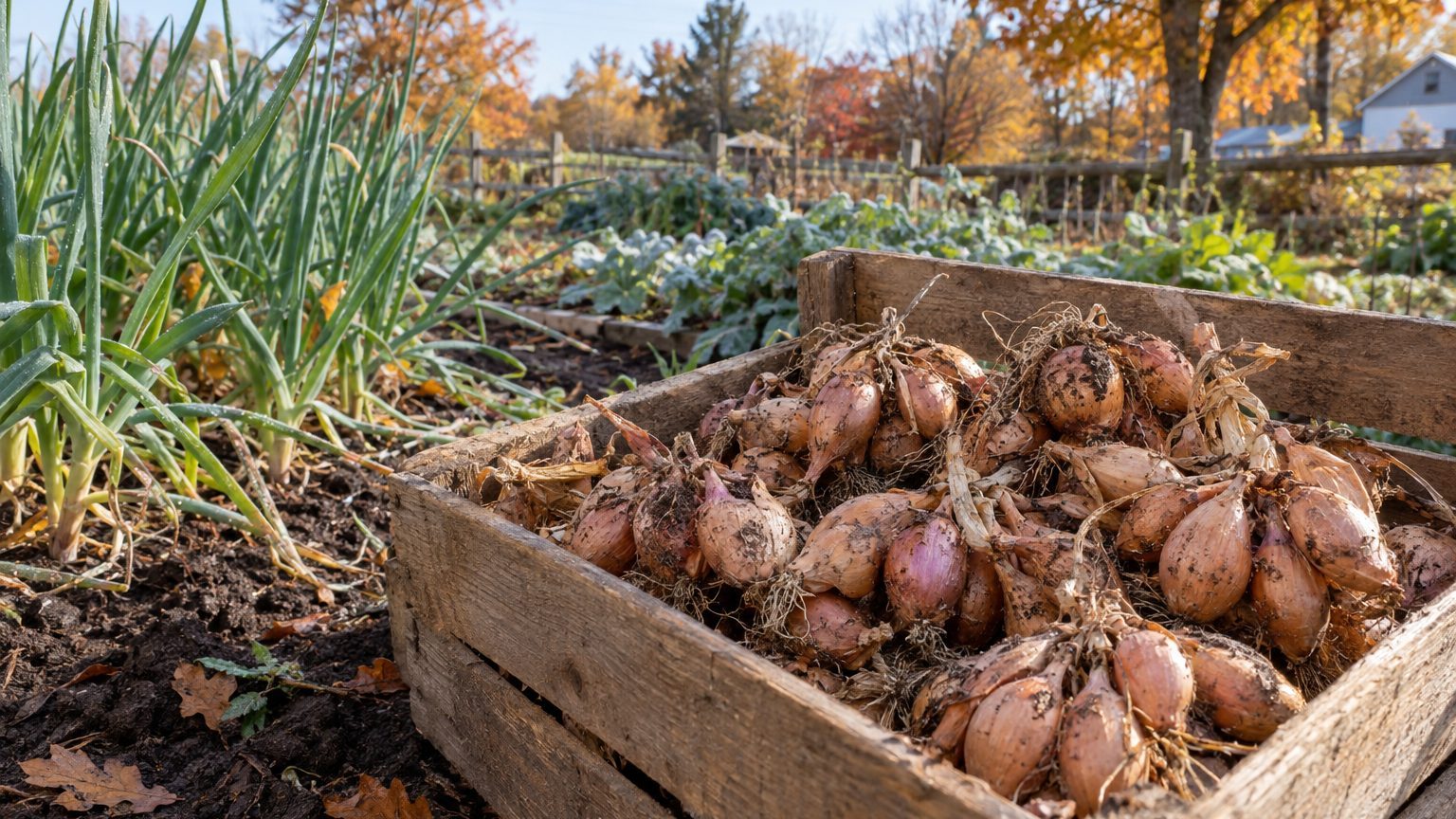

Choose a hardy multiplier shallot grown from bulbs, and plant it in fall if you can. That is the safest bet in Nova Scotia. The cool, short, damp season sorts shallots by how fast they mature and how they handle winter wet, so type matters more than any variety name on a seed rack.
The short answer for Nova Scotia
Go with multiplier shallots from bulbs, where one planted bulb splits into a small cluster, and plant them in fall so they root before the ground freezes. Spring-planted bulbs are the fallback. Seed-grown shallots are an optional extra for gardeners willing to start them indoors well ahead of the last frost. That is the decision by type, and it comes from the length and temperament of the season here.
Environment and Climate Change Canada’s 1981-2010 normals for Halifax Stanfield put the average last spring frost on May 7 and the average first fall frost on October 18. Counting between them gives about 164 days. Both dates are means, and a mean is a midpoint. Frost has roughly even odds of arriving before or after each date, so neither one is a safe date. In one year out of two the last spring frost falls later than May 7.
Winter matters just as much for a bulb that spends it in the ground. The mean daily minimum of the coldest month at the Halifax reference station is -10.4 °C (13.3 °F). That is an average night, not a record low, so colder nights will come. Whether a fall-planted shallot gets through them depends less on the number than on snow cover, mulch and drainage.
Why type beats variety name
A catalog variety can change from one year to the next. The planting method decides how a shallot fits your calendar.
| Type | When it goes in | Fit for Nova Scotia |
|---|---|---|
| Bulbs, fall-planted | Fall, to root before the ground freezes | Best default. Gets a head start on the short season. |
| Bulbs, spring-planted | As soon as the soil can be worked | Reliable fallback if fall planting slips. |
| Seed-grown | Sown indoors, transplanted out | Workable, but it depends on an early indoor start. |
Timing details, including how to read the frost dates as a window, are on the page about when to plant shallots in Nova Scotia. For the full growing picture, start with growing shallots in Nova Scotia.
What will not work here
The slowest shallots lose in a short season. About 164 days sit between the mean frost dates, but the days that count are the ones after the soil warms, and spring here is slow to deliver them. A type that needs a long, hot run to size up, or one sown straight into cold spring ground, will finish small or not at all.
Late starts and the weather
A late spring planting is the quiet failure. Shallots need time to bulb and then to cure, and a bed started in late May or June pushes both stages into the damp end of summer. Curing wants dry air. A coast known for fog and humid stretches is a poor place to hang bulbs that were planted late and harvested late. This page does not carry rainfall or summer heat figures, so it will not put a number on that risk, but the pattern is a familiar one for maritime gardens.
Tight spacing is the next mistake. Dense rows hold moisture around the leaf bases, and in a humid summer that invites fungal trouble. Wider spacing than a dry-climate guide suggests costs you a few plants per bed and buys airflow. Mulch that stays wet against the bulbs works against you for the same reason.
Borrowed dates and unprotected winters
Treating May 7 as the day it is safe to plant out tender seedlings will cost you plants in about half of all years. Shallots themselves shrug off light frost, but seed-grown transplants raised indoors are still soft, and companions like beans are not hardy at all.
Fall planting without cover is another way to lose a crop. A mean coldest-month night of -10.4 °C is survivable for a mulched bulb. An unmulched one can heave out of the soil during freeze-thaw swings, which are common in maritime winters.
Finally, do not import US advice unchanged. American planting dates on this site use 1991-2020 normals, while the Canadian frost dates here use 1981-2010. And a Canadian hardiness zone does not convert to a USDA zone, because the two systems measure different things.
What changes across Nova Scotia
The Canadian hardiness zone for the Halifax reference city is 6b, according to Natural Resources Canada’s 1991-2020 normals. That is the Canadian system, built on seven climate variables, not a USDA zone, and it describes one city. The page does not have a zone figure for every district, so it cannot give you a provincial spread. What it can say is that there is no single answer for Nova Scotia, and the same caution applies to the frost dates: they come from the Halifax Stanfield station, and northern and upland districts run weeks behind it.
If you garden inland, at elevation, or well away from the Halifax coast, shift three things. Plant fall bulbs a little earlier, because the ground freezes sooner and roots need time to anchor. Mulch more heavily. And lean toward bulbs over seed-grown shallots, since a later spring leaves less room for a transplant to catch up.
A gardener on a milder, sheltered patch can stretch in the other direction, planting a bit later in fall and treating the spring-planted fallback more casually. Neither shift is a rule, just a direction.
Nobody on this page can tell you which zone your own yard falls in. The Plant Hardiness Zone by Municipality map from Natural Resources Canada lets you look up your municipality directly. Check it before you lean on any date here, and note that its 1991-2020 period differs from the 1981-2010 frost dates above.
Where to check this for your own county
Start with the Nova Scotia Department of Agriculture, the provincial body closest to what US gardeners call an extension service. Look for two things: a local planting calendar for your part of the province, and any shallot varieties that have been trialled near you, not just somewhere else in Nova Scotia. If the department does not publish shallot-specific material, ask whether it covers garlic or other overwintered alliums, since the fall-planting logic is the same.
A county recommendation beats a state or provincial one, and this page is the province-wide version. Nova Scotia’s counties differ enough in coastal influence, elevation and soil that a trial in one valley can mislead a gardener on a hillside an hour away. Treat everything here as a starting frame, and let local trial results override it where they exist.
When you check, write down the frost dates a local source gives, the period they cover, and the station they come from. Dates drawn from different decades or different stations are not directly comparable, and that single habit will save you from most mismatches.
Checking this against your own garden
Your own observations outrank every date on this page. Three are worth watching, and none needs equipment.
- Soil warmth by feel. In spring, grab a handful from planting depth. If it crumbles and does not clump or feel icy, it is workable. The week you first get that result, compared with other years, shows how early your bed warms.
- The first green shoots on fall-planted shallots. Note the date they push through. A bed that greens up early is sheltered or well drained, and a late one is cold or soggy, which tells you whether to plant earlier next fall.
- The first frost on your own lawn or tender plants in autumn. Compare it with the October 18 mean. If it lands weeks early, you are in one of the upland or inland pockets, and you should plant bulbs sooner.
Keep a short notebook with those three dates for a couple of seasons. After two years it will be a better guide for your yard than any table, including the ones above.
Common questions
Can I grow shallots from seed in Nova Scotia?
Yes, but start them indoors well before the last frost, which averages May 7 at Halifax Stanfield. Bulbs are less demanding in a season this short.
Will shallots survive a Nova Scotia winter?
Mulched, well-drained, fall-planted bulbs generally have a fair chance. The mean coldest-month night at the Halifax reference station is -10.4 °C, but colder nights happen, and heaving from freeze-thaw swings is the real risk.
Is Halifax’s zone 6b the same as USDA zone 6b?
No. It is Canadian hardiness zone 6b from Natural Resources Canada, built on seven climate variables. The two systems do not convert.
Does May 7 mean it is safe to plant?
No. It is the mean last spring frost, so in one year out of two the last frost falls later. Hardy shallots tolerate it, but tender seedlings do not.