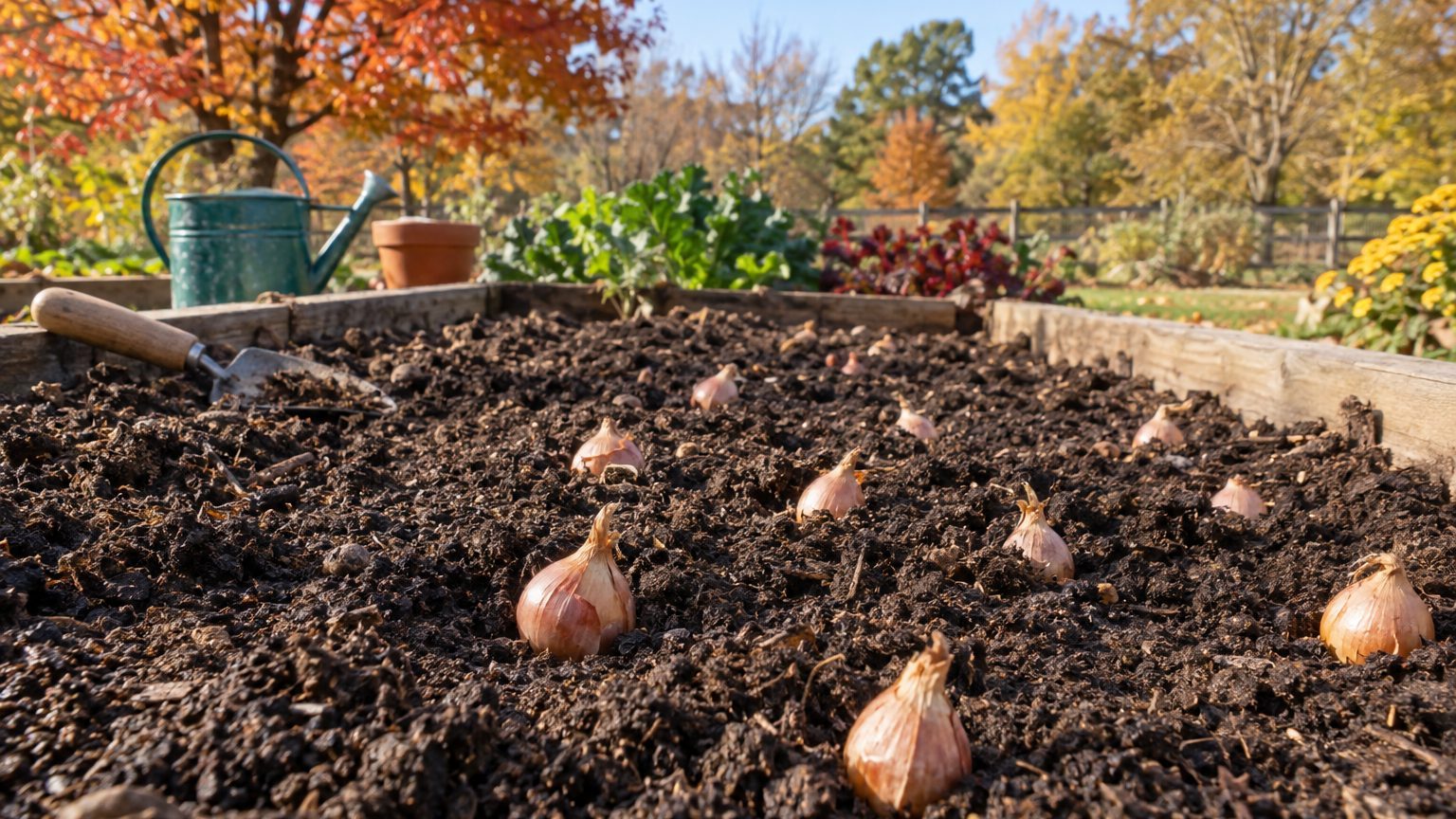

Fall is the better planting season for shallots in Nova Scotia, with spring as the fallback. Bulbs set in the ground before freeze-up root early and are ready to grow the moment the soil thaws. Spring-planted bulbs get a shorter run. Neither window has a safe date, though, and the reason lies in how frost dates are calculated.
The short answer for Nova Scotia
Two dates anchor the calendar. Environment and Climate Change Canada’s Canadian Climate Normals for the Halifax Stanfield International Airport station put the last spring frost on average on May 7 and the first fall frost on average on October 18. Both are mean dates, not probability bands and not safe dates. A mean is a midpoint: in one year out of two, the last spring frost lands after May 7. The October 18 figure works the same way, with the first fall frost arriving later than that date in half of all years and earlier in the other half.
Count the days between the two and you get roughly 164, a frost-free stretch that suits shallots well. The crop shrugs off light frost at both ends, so it does not need the full span. What matters more is where you place the planting inside it.
| Window | Anchor | How to read it |
|---|---|---|
| Fall planting | The weeks around the October 18 mean first frost, before the ground freezes | Roots form before winter, shoots appear early in spring. The date is a marker, not a deadline. |
| Spring planting | As soon as the soil can be worked, often before May 7 | May 7 is the middle of the last-frost window, so waiting for it wastes the cool weeks bulbs like. |
Winter sets the other limit. The mean daily minimum of the coldest month at Halifax is -10.4 °C (13.3 °F), taken from the 1981-2010 normals. That is an average of nightly lows, not a record low, so individual nights run colder. A fall-planted shallot gets through that with a layer of mulch over the bed. A bare one in an exposed spot has a harder time.
These figures come from one airport station. The page does not have frost dates for any other Nova Scotia location, and it will not borrow them from a neighboring province or state. Treat May 7 and October 18 as the Halifax answer and shift from there (more on that below). For the full picture on the crop itself, start with Growing Shallots in Nova Scotia.
What will not work here
Waiting for May 7 is the classic mistake. People treat the average last frost as the all-clear, then plant a week or two after it. Shallots do not need that caution. Bulbs planted late in spring are pushed into long summer days before their roots and leaves have grown enough, and they finish small. A frost after May 7 is a coin flip in any given year, and shallots tolerate light frost anyway.
Planting too late in fall fails just as reliably, in the opposite direction. The October 18 mean says nothing about when your soil actually freezes, and a bulb set in cold ground has no time to root. It then sits loose near the surface, ready to be pushed up by the first freeze-thaw cycles. Coastal winters tend to swing back and forth across freezing, and that is exactly the pattern that heaves shallow bulbs out of bare soil. Planting at the proper depth and mulching afterward is the standard defense.
Then there is the winter minimum. A mean coldest-month low of -10.4 °C is not extreme by Canadian standards (for a comparison with the United States, that is 13.3 °F). But an average hides the cold snaps. A bed with no snow cover and no mulch can lose bulbs on a night colder than the mean, and a Nova Scotia winter does not always supply snow when you need it.
Close spacing is the quieter failure. This page carries no rainfall or humidity figures for the province, so it will not quote any. Still, gardeners near the Atlantic coast know the pattern of fog, damp air and slow-drying foliage, and shallots packed tightly in such conditions invite fungal trouble. Give each bulb room, choose a bed that drains, and do not crowd a clump of shallots just to fit more into a raised bed.
Slow varieties are the last trap. A shallot that needs a long, warm run to size up and then dry down for storage will struggle in a spring planting that starts late, because it leaves too little time for curing in the dry weather of late summer. Pick quicker, reliable types for spring sowing and keep the slower ones for fall planting. The variety question has its own page: The Best Shallots to Grow in Nova Scotia.
What changes across Nova Scotia
The hardiness zone for the reference city, Halifax, is 6b in the Canadian system, from Natural Resources Canada’s Plant Hardiness Site using 1991-2020 normals. It is not a USDA zone and does not convert to one. The Canadian system is built on seven climate variables, while the USDA system uses one, and Natural Resources Canada itself says there is no simple conversion between them. It gives an example: Canadian zone 4a overlaps nine different USDA zones, from 3a to 7a. So never read “6b” here as a number you can compare with a US zone.
It is also the zone of one city, not of the province. This page does not have the spread of zones across Nova Scotia, so there is no single answer to give. What can be said is that a province is not one climate, and that northern and upland districts run weeks behind the Halifax Stanfield figures. The coast, the interior and the highlands do not warm up on the same day or freeze on the same night.
If you garden in the north or at altitude, shift the whole calendar in the direction the weather is already pushing you. Plant fall shallots earlier than the October 18 marker suggests, so roots get established before the ground locks up. Expect spring planting to start later than the Halifax pattern, and expect the soil to take longer to dry out. Mulch more heavily over winter. In a cold pocket, a bed on a slope with good air drainage does more for you than any date on this page.
One more caution about the numbers. The frost dates and the coldest-month figure come from the 1981-2010 normals, while the hardiness zone uses 1991-2020. The two periods do not match, so do not stack them together as if they described the same decades. For your own zone, do not rely on a neighbor’s guess or a plant tag. Look it up on the Canada’s Plant Hardiness Site map, which lets you search by location.
Where to check this for your own county
In Canada, the provincial agriculture department does the job that a state extension service does in the United States. For Nova Scotia, that is Nova Scotia Department of Agriculture. Start there when you want something more local than a Halifax weather station.
Look for two things. First, a planting calendar that fits your area, ideally one that names shallots or the onion family and gives dates for your part of the province instead of the whole. Second, any list of varieties that have been trialled near you. A variety that thrived in a research plot under your local conditions is worth more than one that simply sounds good in a catalog. Not every page on a government site covers shallots specifically, so check onions and garlic too, since their calendars are close cousins.
A county recommendation beats a state one, and a provincial one is no different. This page is the provincial one, built on a single reference station and one hardiness zone. It gives you a starting window and a list of what fails. It cannot tell you whether your ground thaws two weeks after Halifax’s or whether your hillside gets the frost that skips the valley. Use it as a frame, then let the local source adjust it.
Checking this against your own garden
Your own observation outranks every date above. Three things are worth watching, and none needs an instrument.
- Soil warmth by feel. In spring, dig a handful from the bed and squeeze it. If it crumbles instead of clumping into a cold, sticky ball, the soil is workable. Compare beds: the one that crumbles first is your warmest, best-drained spot.
- The first green shoots. Note the day green tips of fall-planted shallots break through the mulch. Over a few years, that date shows how quickly your garden wakes up compared with the Halifax pattern.
- Your own first frost. Write down the day frost blackens tender plants in fall. Set it beside October 18. If yours comes much earlier, you have a cold pocket or a high spot, and your fall planting should move up.
One season is a coin flip, just as the mean dates are. Two or three seasons of notes start to show a pattern that no map can give you.
Common questions
Can I plant shallots in spring in Nova Scotia?
Yes. Plant as soon as the soil can be worked, which is often before the May 7 average last spring frost at Halifax. Spring planting works, though fall planting usually gives larger bulbs.
Is May 7 a safe date to plant?
No. It is the mean last spring frost from the 1981-2010 normals for the Halifax Stanfield station, so in one year out of two the last frost falls later. Shallots tolerate light frost, so you rarely need to wait for it.
How cold do Nova Scotia winters get for fall-planted shallots?
The mean daily minimum of the coldest month at Halifax is -10.4 °C (13.3 °F). That is an average, not a record low, so protect fall plantings with mulch.
Is zone 6b a USDA zone?
No. It is a Canadian hardiness zone for the Halifax reference city, built on seven climate variables, and it does not convert to a USDA zone. Check the Natural Resources Canada map for your own location.