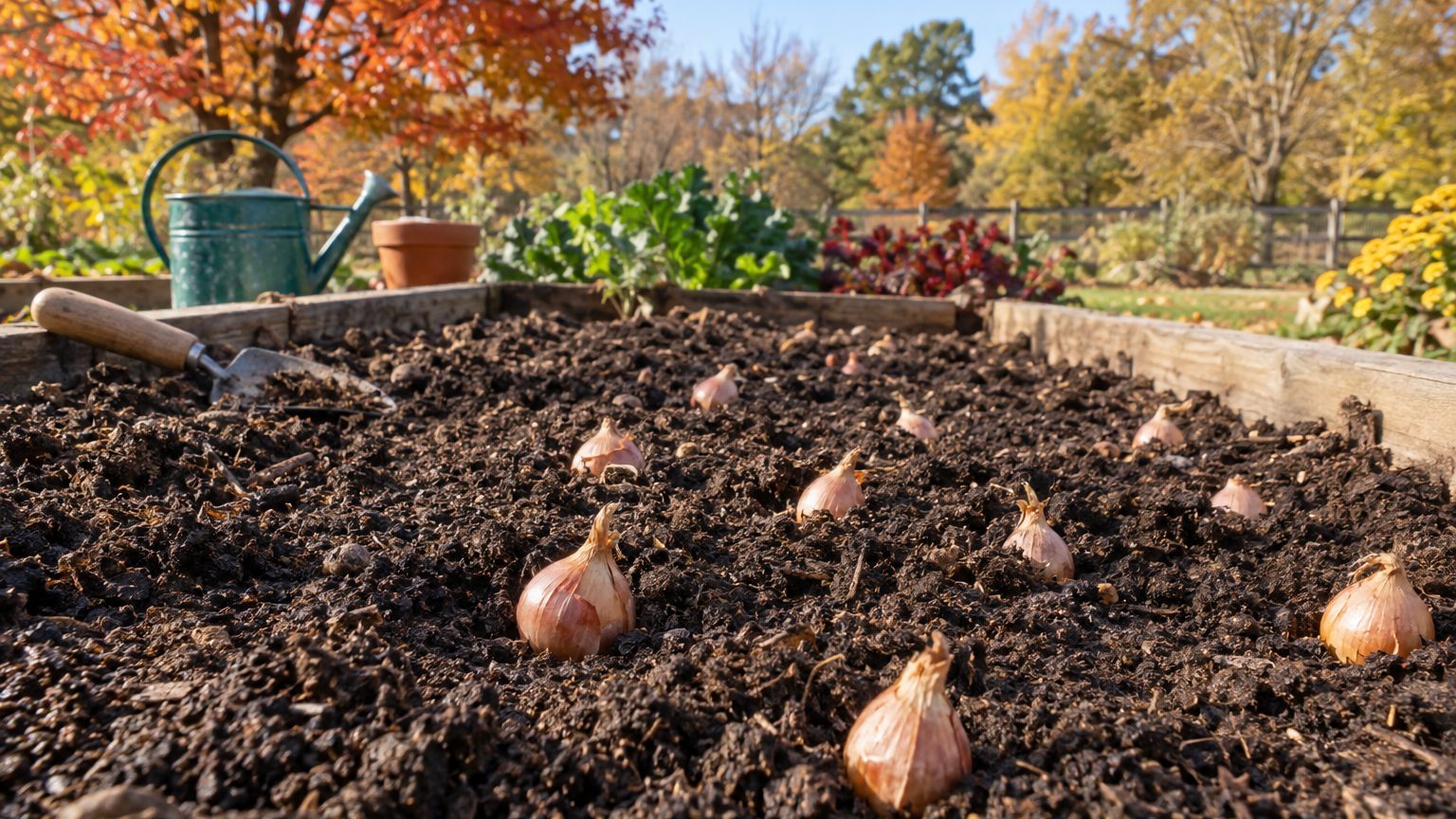

Shallots go into Saskatchewan ground in one of two windows: early spring, as soon as the soil can be worked, or fall, after the first frosts and before the ground locks up. Spring is the safer default on the prairies. The frost dates below come from a single weather station, and they are midpoints, not guarantees. For the full growing picture, start with Growing Shallots in Saskatchewan.
The short answer for Saskatchewan
The Saskatoon SRC station, using Environment and Climate Change Canada’s 1981-2010 normals, puts the last spring frost on average at May 18 and the first fall frost on average at September 18. Those two dates bracket the season. They are also a probability of frost, not a promise of warmth. May 18 is the mean date of the last spring frost, so in one year out of two a frost falls later than that. September 18 works the same way in autumn: in one year out of two, frost arrives after it.
Count the days and you get 123 between the two mean dates. That is the stretch a spring-planted shallot has to work with, and a bulb that goes in late in May spends much of it just getting established. Treat each date as the middle of a window, never as a safe date to circle on the calendar.
Spring planting
Sets can go in as soon as the ground thaws and crumbles rather than clumping, which in many years falls before May 18. Shallots are among the hardier vegetables once their roots take hold, so a spring frost after planting is not the threat it is to tomatoes or squash. Waiting for a frost-free date wastes the cool weeks that shallots actually like.
Fall planting
The fall option sits after the September 18 mean frost date and before freeze-up. The aim is roots without much top growth. The cost is winter. The mean daily minimum of the coldest month at Saskatoon is -20.7 °C (-5.3 °F), and that is the figure that decides whether a buried bulb survives. This page has no snow-cover figure, which matters a great deal for fall plantings, so a fall crop is a bet that mulch and snow will do the insulating.
| Window | Anchor in the facts | What it is betting on |
|---|---|---|
| Spring | Soil workable, around the mean last frost of May 18 | Enough days left before the mean first frost of September 18 |
| Fall | After the mean first frost of September 18, before the ground freezes | Surviving a coldest-month mean minimum of -20.7 °C (-5.3 °F) |
What will not work here
Slow varieties are the first casualty. A season of 123 days between mean frost dates leaves little room for a shallot that wants a long runway, and a late-maturing type planted in late May can still be sizing up when autumn frost arrives. Matching the type to the season is the whole game, and The Best Shallots to Grow in Saskatchewan sorts that out by maturity.
Starting from seed outdoors fails for the same reason. Shallots grown from seed need an early start under lights indoors to finish at all, and sowing straight into prairie soil in May burns most of the season before a bulb exists. Sets are the practical route on a short calendar.
Planting in July does not work either. Bulbs set that late have only weeks before the mean first frost on September 18, and half of all years bring frost after that date, which is not the same as a long season. You get small bulbs and green tops with nothing stored.
Fall planting too early is a quieter failure. Plant in the first days of September, ahead of the mean first frost, and warm soil pushes green growth that a -20.7 °C winter minimum will flatten. Bare, windswept ground makes it worse. The coldest-month figure is a mean of daily lows, so individual nights run colder, and a bed without mulch or reliable snow takes the full hit. Prairie wind strips snow off exposed rows faster than it strips it from a sheltered yard.
Calendars from elsewhere fail for a plainer reason. A date borrowed from a US state or another province rests on different normals, and Canadian figures here cover 1981-2010 while US figures on this site cover 1991-2020. Even the zone numbers do not travel: Canadian and USDA systems are built differently, so a “3” on one is not a “3” on the other.
Finally, cold, waterlogged soil in the spring melt rots sets before they root. Wait until the bed drains.
What changes across Saskatchewan
The page has one zone on file: 3a in the Canadian system for the Saskatoon reference city, from Natural Resources Canada’s 1991-2020 normals. That is the zone of one city, not of the province, and the province has no single answer. Natural Resources Canada says plainly that the two systems have no simple conversion; its Canadian system uses seven climate variables, and Canadian zone 4a alone overlaps nine USDA zones, from 3a to 7a. Never read this 3a as a USDA zone.
The frost dates carry the same warning. They are from one station, and northern or upland districts run weeks behind it. A gardener well north of Saskatoon should expect a later May start and an earlier September ending, which squeezes the season from both ends. The practical shift is toward spring planting, earlier-maturing types, and, for anyone considering fall planting, a heavier mulch plan, since a colder winter is likely. Southern districts may have more room, but this page does not have their dates, so it will not guess.
Do not take the zone from this page or from a neighbor’s guess. Find your own municipality on the Natural Resources Canada plant hardiness map and read the zone it gives you, noting that it will be in the Canadian system. Then compare that zone with 3a: if yours sits colder, shift later in spring and lean harder on mulch in fall.
Where to check this for your own county
A county recommendation beats a state one, and this page is the state one. It rests on a single weather station and a province-wide climate, so it can tell you the shape of the season but not whether your own valley, hilltop or shelterbelt behaves the same way.
The place to go next is Saskatchewan Agriculture, the provincial agriculture pages for farmers and growers. Saskatchewan works through rural municipalities and regions rather than counties, so look for whatever is organized for your own district. What you want from it is specific: a local planting calendar with dates for your area, and a list of the varieties trialled near you, ideally with notes on how they handled the local winter.
This page does not have a Saskatchewan shallot calendar published by a provincial source, and it will not borrow one from another jurisdiction. Where a local source gives a different date from the ones here, believe the local source.
Checking this against your own garden
Your own observations outrank every date above. Three are worth watching, and none needs equipment beyond your hands and eyes.
- Soil warmth by feel. Dig a handful from planting depth. If it crumbles, drains and no longer feels icy, the bed is ready. A bed that stays cold and sticky while others have dried out tells you it is low, shaded, or slow to drain.
- The first catkins. Watch willows and aspen for male catkins opening. Compare your own trees with a friend’s across town: a few days’ gap tells you whether your yard runs early or late.
- The first true leaves. When green shoots appear from your sets, note the date. Year to year, that date is your own garden’s calendar, and it shows whether a south wall or a sheltered corner really buys you time.
Write all three dates down for a couple of seasons. They will tell you more about your microclimate than any station 100 miles away.
Common questions
Is May 18 a safe planting date?
No. It is the average last spring frost at the Saskatoon SRC station, so in one year out of two a frost lands later. Shallot sets tolerate that better than most crops, which is why spring planting can begin before the date.
Should I plant shallots in spring or fall?
Spring is the safer choice. Fall planting works only if the bulbs get established after the September 18 mean frost date and the bed is mulched against a coldest-month mean minimum of -20.7 °C (-5.3 °F).
Does Canadian zone 3a mean the same as USDA zone 3a?
No. The Canadian system uses seven climate variables and the USDA system one, and Natural Resources Canada says there are no simple conversions. The 3a here is the Canadian zone of the Saskatoon reference city only.
What if I garden in the north of the province?
Expect a later spring and an earlier fall than the dates here, since northern and upland districts run weeks behind Saskatoon. This page has no frost dates for those districts, so check the Saskatchewan Agriculture pages and the Natural Resources Canada map for your own area.