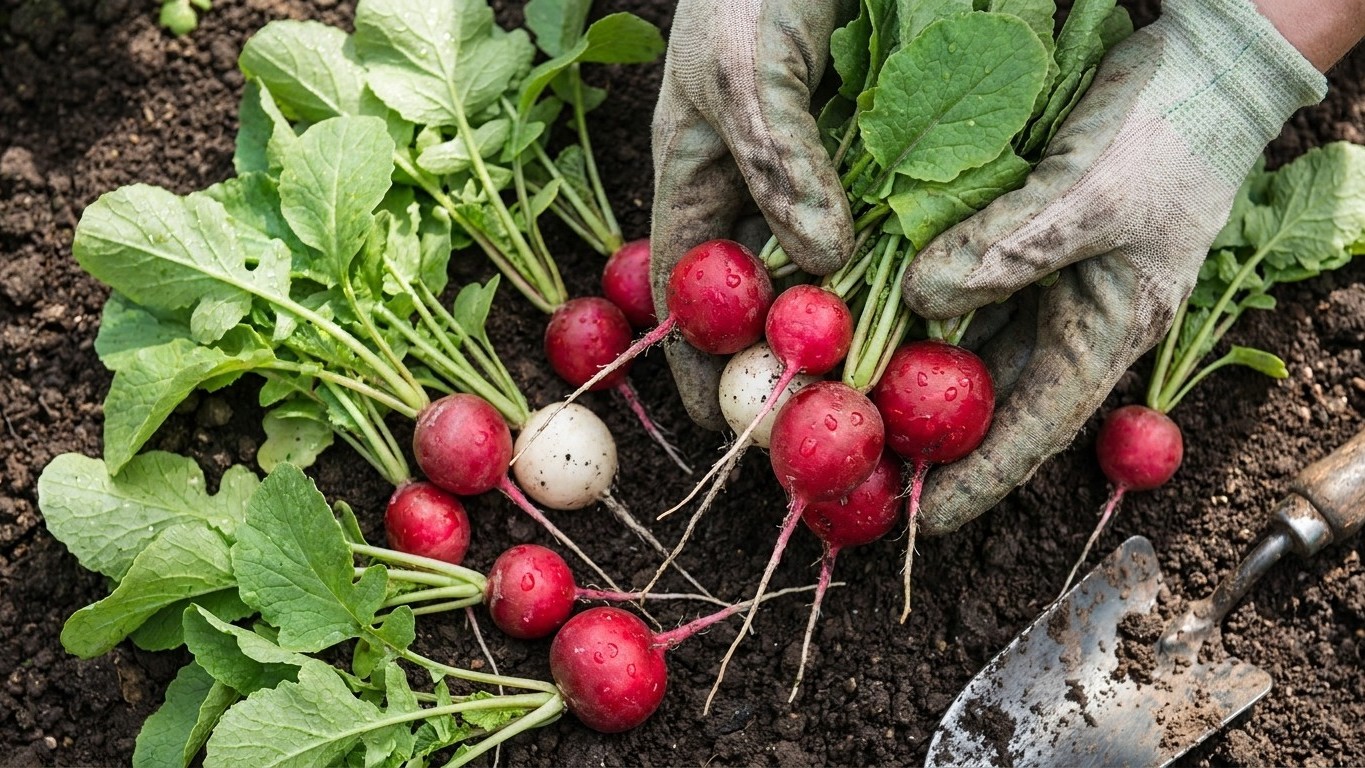

According to almanac tradition, radishes belong to the root group, and root crops go in during the third quarter of the Moon, from full moon to last quarter. Add the sign rule, and the Traditional Days for 2026 are:
- October 26-27 (Moon in Taurus)
- October 30-31 (Moon in Cancer)
The 2027 windows are in the table further down. None of this is proven, and the calendar of your state comes first.
What the tradition says about planting radishes

The almanac rule is built on the Moon’s phase cycle, which lasts 29.53 days from one new moon to the next. Gardeners who plant by the Moon cut that cycle into four quarters and give each quarter a job. Radishes land in the third one. Under this convention they share a group with potatoes, carrots, garlic, onions and beets: root crops, bulbs and perennials. The third quarter is the stretch from full moon to last quarter, which makes it part of the waning moon. If that phase is new to you, the page on planting in a waning moon covers it in more detail.
| Quarter | Phase span | Crop type, according to the almanac rule |
|---|---|---|
| First | New moon to first quarter | Leafy crops that bear above ground (lettuce, spinach, cabbage, broccoli, celery) |
| Second | First quarter to full moon | Above-ground crops with seed inside the fruit (tomatoes, peppers, beans, squash, corn) |
| Third (radishes) | Full moon to last quarter | Root crops, bulbs, perennials (potatoes, carrots, garlic, onions, beets) |
A fourth quarter, from last quarter to new moon, is set aside in this tradition for rest: weeding, pruning, turning the soil and composting. No planting is assigned to it.
Many almanacs add a second filter, the Moon’s sign. This convention labels Cancer, Scorpio and Pisces fruitful. It labels Taurus, Libra and Capricorn semi-fruitful. Aries, Gemini, Leo, Virgo, Sagittarius and Aquarius are labeled barren, although sources differ on Virgo, Sagittarius and Aquarius. The traditional days for radishes on this page are the ones where the third quarter overlaps a fruitful or semi-fruitful sign.
A separate school, the biodynamic calendar associated with Maria Thun, sorts days differently. It calls Taurus, Virgo and Capricorn root days, and it does not use the quarter rule in the same way. Treat it as another system, not a correction.
Now the part the almanacs skip. No effect of the Moon’s phase or sign on radishes has been established. The Moon’s tidal pull at the Earth’s surface is about 1.1 millionths of a meter per second squared, roughly one ten-millionth of gravity at its strongest. That is far too small to move anything as small as a seed or a root. What follows is a record of a custom, and it makes no promise about results.
Traditional radishes planting days, 2026 and 2027
This table lists every month from October 2026 to December 2027 for which traditional days apply to radishes. Each run combines the third-quarter rule with a fruitful or semi-fruitful sign. The Moon sign is shown in parentheses, and the label comes from the convention described above.
| Month | Traditional days | Moon sign (convention label) |
|---|---|---|
| October 2026 | October 26-27 October 30-31 |
Taurus (semi-fruitful) Cancer (fruitful) |
| March 2027 | March 22-26 March 29 |
Libra/Scorpio (semi-fruitful/fruitful) Capricorn (semi-fruitful) |
| April 2027 | April 21-22 April 25-27 |
Scorpio (fruitful) Capricorn (semi-fruitful) |
| May 2027 | May 23-24 | Capricorn (semi-fruitful) |
| September 2027 | September 19-20 | Taurus (semi-fruitful) |
| October 2027 | October 16-17 October 20-22 |
Taurus (semi-fruitful) Cancer (fruitful) |
The months shown are those when gardeners in much of the country plant radishes. Your state may start earlier or later, so only the rows that fall inside your state’s own window count. A row outside it is not a planting day for you, whatever the Moon is doing.
How to read the edges of a run
Days in the table are read at noon Eastern time, and the Moon changes sign during the day. So the first and last day of any run are soft edges. A day listed as Taurus may spend its morning in the sign before and its evening in the sign after. If you follow the custom closely, the middle days of a run are the ones that sit most firmly inside the window.
Runs are short because two cycles of different length have to line up. The Moon needs 29.53 days to go through its phases and 27.32 days to complete one orbit against the stars, which is the span in which it passes through all twelve signs. The quarter and the sign drift against each other, so the overlap comes back only in pieces, once or twice a month at most. That is also why a month such as May 2027 shows only one run.
For a full month-by-month view of the phases around the nearest window, see the October 2026 moon calendar.
Check your state first: when to plant radishes where you live
The order of decisions matters more than any single date in the table. Start with your state’s planting calendar for radishes. That tells you which weeks are open for sowing where you garden. Only then, if you want to follow the Moon, look at the traditional days that fall inside those weeks.
The Moon never overrides the calendar of the place. Frost dates and soil temperature decide whether a crop can go in the ground. The Moon, if you follow it, only chooses among days that are already open. A traditional day that falls outside your state’s window is just a date on a page.
Dates, soil temperatures and frost risk are owned by the planting pages, not this one. The guide on when to plant radishes where you live covers the crop itself, and the state guides let you find your own state’s calendar. Use those to mark your window, then bring that window back here and see which rows of the table overlap with it.
Overlap can turn out thin. A state with a short window may have only one traditional run inside it, or none. That is a normal outcome of combining two calendars, and nothing says you must plant on a traditional day. The broader planting by the moon pages explain how the same quarter rule applies to other crops, if you want to plan a whole garden around it.
A fair way to try it
If you are curious whether the custom does anything on your own plot, the only honest test is a side-by-side comparison. A short routine keeps it fair:
- Pick a week that sits inside your state’s planting window for radishes and contains a traditional day from the table.
- Split the planting in two. Sow half the row on the traditional day and half on an ordinary day inside the same week. Use the same seed packet, the same bed and the same depth.
- Label both halves with the sowing date and the reason for it. A stake with the date and the word “Moon” or “ordinary” is enough.
- Keep notes on when seedlings emerge and when you harvest each half, and what the roots look like. Write it down rather than trusting memory.
One season will not settle anything. Weather, watering and small differences in the soil can swamp whatever the Moon might add, and a single comparison can easily point either way by chance. Several seasons of notes would tell you more, though even then a home garden is a small sample. What this method gives you is an answer about your own plot, which is the only answer a home gardener can really check. Whatever you find, the result belongs to that bed and that year.
Questions about planting radishes by the moon
Does the tradition say to plant radishes in a waxing or a waning moon?
The almanac rule puts radishes in the third quarter, from full moon to last quarter. That is a waning moon. The waxing half, from new moon to full moon, is given to leafy crops in the first quarter and to above-ground crops that bear seed inside the fruit in the second. Radishes sit with the root crops, so the tradition points to the waning side.
What if a traditional day falls on a frost?
The tradition has no rule that overrides your state’s calendar, and this page does not either. If a traditional day falls outside your state’s planting window, the almanac custom offers no reason to plant on it. Check the state guides for your window, and choose another traditional day inside it, or an ordinary day if none is left.
Do I need to follow the Moon sign as well?
Not under every version of the custom. Some almanacs use only the quarter rule, and others add the sign. The days in this page’s table use both, so each listed run is in the third quarter and under a sign this convention labels fruitful or semi-fruitful. If you prefer the quarter rule alone, you have more days to choose from. The biodynamic approach is a different system again, with root days in Taurus, Virgo and Capricorn. Whichever you pick, it stays a custom and not a proven method.